By BK, Athletic Hitting Development
Complete Hitters Are Built… It’s Earned!
Every hitter slumps.
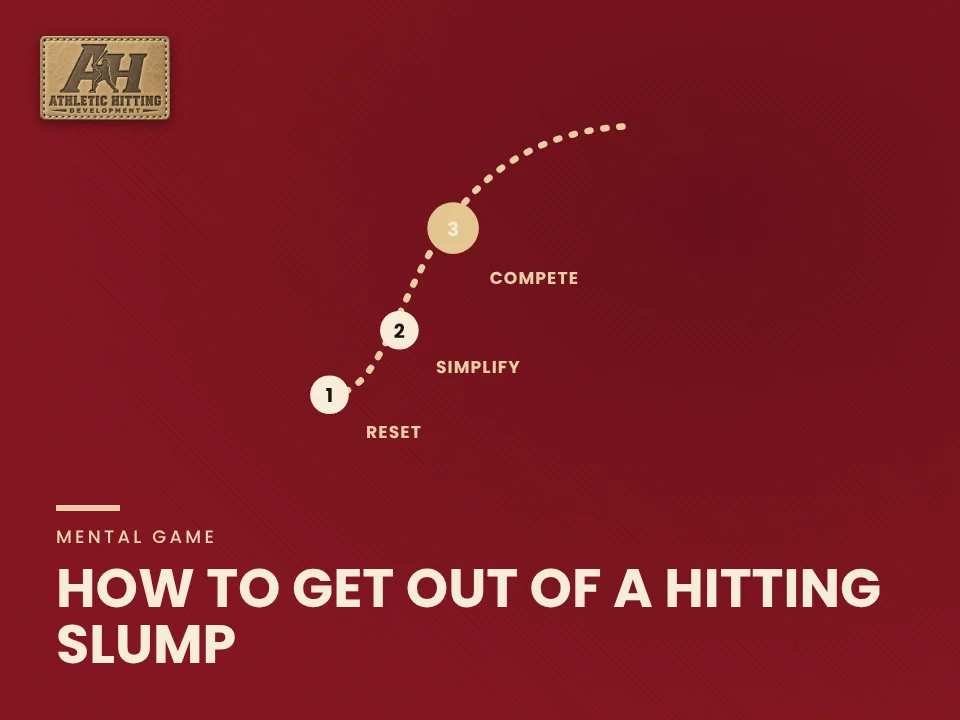
Get out of a hitting slump by reviewing at-bats honestly instead of judging only results, then running a 24-hour reset: one physical priority, one Hitting Processor priority and one next-at-bat intention. Don’t rebuild your swing — make practice look like the problem and return to one simple approach.
Train it: Mental Approach Masterclass →The problem is not the slump. The problem is what happens next.
Some players panic, change five things, take 400 angry swings, and become worse. Others are told to “just relax,” as if a vague sentence fixes timing, posture, decision-making, or confidence.
It does not.
Getting out of a hitting slump starts with a better question:
What is actually happening?
Are you getting good pitches and missing them? Chasing? Late on the heater? Out front on off-speed? Losing your athletic position? Or hitting balls hard right at people?
Results matter. They just do not tell the whole story by themselves.
1. First: Stop turning every bad at-bat into a new swing
A 0-for-3 can happen with three good swings. A 2-for-3 can happen with three poor decisions.
Do not let one box score rewrite your entire identity as a hitter.
Instead, review the at-bats honestly:
- What pitches did I swing at?
- Was I early, on time, or late?
- Did I stay athletic through contact?
- Did I have a plan before the pitcher released the ball?
- Did I compete after the first bad pitch or bad at-bat?
That is feedback. Panic is not.
2. The 24-hour reset
After a tough game, give yourself a short window to be disappointed. You care. That is fine.
Then reset.
Within 24 hours, do three things:
- Name one physical priority. Maybe your posture rose early. Maybe the barrel dumped. Maybe your stride got out of control. Choose one.
- Name one processor priority. Maybe you were late recognizing spin. Maybe you chased outside your zone. Choose one.
- Name one next-at-bat intention. “See the ball early.” “Be ready for my heater.” “Stay through the middle.” Keep it simple.
That is a plan. It gives the hitter something real to do instead of something vague to feel.
THE 24-HOUR RESET
ONE FIX.NOT FIVE.
- One physical priority
- One processor priority
- One next-at-bat plan
A SLUMP IS INFORMATION.
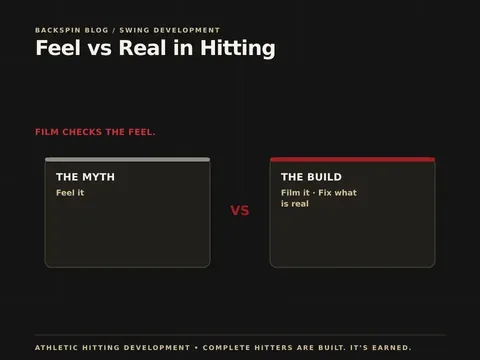
3. Do not confuse feel with real
Slumps create bad stories.
“I am under everything.”
“My hands are too slow.”
“I have to swing harder.”
Maybe. But maybe you are actually late. Maybe your body is losing balance. Maybe you are missing your pitch selection. Maybe you are pressing and your timing is collapsing.
This is why video matters. One side-view clip and one front-view clip can show whether the issue is what you think it is.
Read Feel vs. Real in Hitting before making a huge change based on one feeling.
4. Make practice look more like the problem
If you are struggling with off-speed, do not only take perfect front toss.
If you are late on velocity, do not only train slow flips.
If you are chasing, do not turn every practice pitch into a swing.
Build practice around the challenge:
- Mix speeds.
- Call out pitch type or color early.
- Take rounds where the goal is “yes/no” decision-making.
- Use a smaller target zone and let the heater travel into it.
- End with game-count rounds: 0–0, 1–1, 2–2.
The hitter has to train the processor as much as the body. See it → recognize it → time it → decide → attack it.
5. Return to your best simple approach
The slump is not the time for 12 thoughts.
Most hitters need one clean approach they trust:
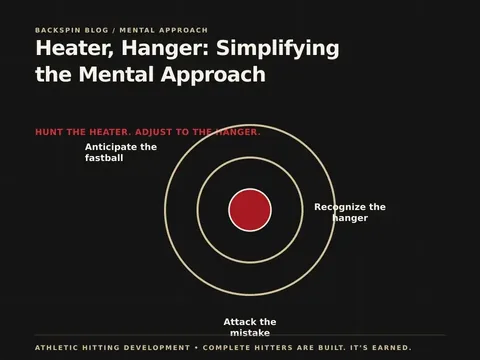
Heater, hanger.
Be ready to attack the fastball in your destroy zone. Adjust when the off-speed pitch hangs. Make a clear decision. Compete.
That does not mean guessing. It means entering the box prepared instead of hoping you recognize everything at the last second.
The Heater, Hanger approach is powerful because it is simple enough to use when the game gets fast.
6. Confidence is earned, not performed
Confidence is not standing in the mirror and saying you are great while avoiding the work.
Real confidence is earned when you:
- Review the truth without beating yourself up.
- Train one important thing with intention.
- Show up again after a bad result.
- Trust your preparation in the next box.
Your best stretches will not last forever. Neither will your worst stretches.
The game gives you another chance. The question is whether you are ready for it.
7. If you need a clean start
Do not try to fix all of hitting during a slump.
Find the first priority. Train it. Compete with it. Let the rest of your game breathe.
If you do not know the first priority, use SwingChecker™ to identify the pattern and build a smarter plan.
A slump is not a verdict. It is information. Use it.
Parent of a hitter in a slump? Read When Your Hitter Is in a Slump: A Parent’s Guide for what to say on the car ride home.
Complete Hitters Are Built… It’s Earned!

THELESSON.
- Review the truth.
- Practice the problem.
- Heater, hanger.
- Show up again.
Complete Hitters Are Built…Earned.
Quick answers
How do you get out of a hitting slump?
Review at-bats honestly instead of judging only results, then use a 24-hour reset: name one physical priority, one Hitting Processor priority and one next-at-bat intention. Make practice look like the problem and return to one simple approach.
Should I change my swing in a slump?
Usually not all at once. A slump of hard-hit outs means the swing is working. Use side and front video to check whether the issue is really mechanical before making a change.
How long do hitting slumps last?
It varies, but hitters who reset quickly, simplify their approach and judge the process rather than the box score usually shorten them.
What should a parent say to a hitter in a slump?
Keep it simple: ask what they worked on, not how many hits they got. Avoid swing tips on the car ride home, and remind them that good at-bats count even when the box score doesn’t show it.
This article is part of the AHD guide The Mental Game of Hitting. Start there for the full picture and every related article.