By Athletic Hitting Development
Complete Hitters Are Built… It’s Earned!
Three games, one hit. Your hitter is pressing, changing their stance every at-bat and staring at the ground walking back to the dugout. You want to help, and everything you say seems to land wrong.
Help your hitter judge the at-bat, not the box score: grade the decision, the timing and the commitment, and teach a 10-second reset. Keep the car ride about them, ask one question and listen.
Train it: Mental Approach Masterclass →Here’s the hard truth about hitting: even great hitters fail most of the time. A slump isn’t a sign that something is broken. How a hitter responds to one is a skill, and it can be trained.
Good decision. On time. Committed.
1. If you judge by hits, you’re judging luck
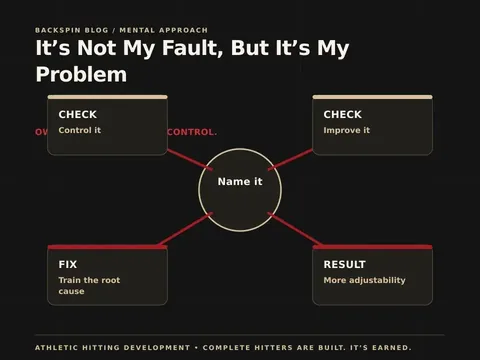
A bloop single can come from a bad decision. A line drive caught by the shortstop can be a perfect at-bat. The hitter controls the decision, the timing, the commitment and the intent. The defense and luck control the rest.
Hitters who grade themselves by hits ride an emotional roller coaster that has nothing to do with how well they’re hitting. When a slump is mostly line-drive outs, the worst thing a hitter can do is change everything.
The lineout was a good at-bat. Teach your hitter to see that, and slumps get shorter.
2. The 10-question at-bat audit
After the next game, when emotions have cooled, have your hitter rate each statement from 1 to 5 about that game. Honestly. No discussion until they finish.
- I had a plan before every at-bat.
- I knew the pitch I was hunting.
- I swung with full commitment.
- I didn’t change my plan after one bad swing.
- My body stayed calm with runners on.
- I didn’t think about the score or who was watching.
- I reset within one pitch after a bad call.
- A bad at-bat didn’t follow me to the field.
- I knew the count and situation every pitch.
- I was locked in on this pitch, not the last one.
| Area | Questions | Score |
|---|---|---|
| Plan | 1–2 | __ / 10 |
| Commitment | 3–4 | __ / 10 |
| Emotion | 5–6 | __ / 10 |
| Reset | 7–8 | __ / 10 |
| Focus | 9–10 | __ / 10 |
The lowest pair is the priority. “Be confident” isn’t a plan. Knowing that the reset is what breaks first gives your hitter something specific to work on.
FOR PARENTS
JUDGE THEAT-BAT.
- Decision
- Timing
- Commitment
- Reset
HITS ARE PARTLY LUCK.
3. The 10-second reset
One bad at-bat turns into a bad game when there’s no reset. Teach this one: after a bad pitch or a bad call, step out, take one long exhale, name one thing to keep and one thing to fix, then say the plan for the next pitch. Practice it in batting practice after every miss so it’s automatic by game day.
Cue: “Flush it. Next pitch.”
4. The car ride
The car ride home is where a lot of slumps get longer. Your hitter already knows they went 0-for-3. Keep the ride about them, not the at-bats. If they want to talk, ask one question and listen: “What was your plan that at-bat?”
5. What to say — and what not to
| Try this | Instead of this |
|---|---|
| “That lineout was a great at-bat.” | “Tough luck, you’ll get one next time.” |
| “What pitch were you hunting?” | “Why did you swing at that?” |
| “Did you reset after strike two?” | “You have to be more confident.” |
| “I love watching you compete.” | “You need to start hitting or you’ll lose your spot.” |
For more on keeping practice and feedback from turning into arguments, see How Parents Can Help a Hitter Get Better Without Guessing.
Are you the hitter? Read How to Get Out of a Hitting Slump for the 24-hour reset you can use yourself.
6. When it’s more than a slump
If your hitter dreads going to the field, has stopped enjoying the game or the stress is showing up away from baseball and softball, that’s bigger than a hitting slump. Talk with them, and don’t hesitate to involve a counselor or another trusted adult.
7. Go deeper: the Mental Training Program
Sixty lessons that build the mental game as a system: a plan for every at-bat, a pre-pitch routine, a reset script, pressure work, slump thinking vs. adjustment thinking and a personal game-day card.
The first three lessons are free. Start with Lesson 1: The At-Bat Audit — it takes about ten minutes and gives you a score to retest against.
See the full Mental Training Program →

THELESSON.
- Celebrate good at-bats.
- Teach the 10-second reset.
- Keep the car ride about them.
- Ask one question. Listen.
Complete Hitters Are Built…Earned.
Quick answers
How do I help my kid get out of a hitting slump?
Help them judge the at-bat, not the result. Grade the decision, the timing and the commitment, give them a simple reset routine for after bad pitches, and keep the car ride about them rather than the box score.
What should I say to my child after a bad game?
Less is more. Tell them you love watching them compete. If they want to talk, ask one question, such as what their plan was that at-bat, and listen instead of coaching.
Can the mental game be trained?
Yes. Having a plan, committing to a swing, controlling emotions, resetting after mistakes and focusing on the next pitch are all trainable skills with specific routines and practice.
Should my hitter change their swing during a slump?
Usually not right away. If the slump is mostly hard-hit outs, the swing is working. Check the decisions and the approach first, and make swing changes in practice, not in the middle of a game.
Should I talk about the game on the car ride home?
Keep the ride about your hitter, not the at-bats. If they want to talk, ask one question, like “What was your plan that at-bat?”, and listen instead of coaching.
From the 2015 archive: 4 Rules for Being a Good Sports Parent.
This article is part of the AHD guide The Mental Game of Hitting. Start there for the full picture and every related article.