By BK, Athletic Hitting Development
Complete Hitters Are Built… It’s Earned!
Key takeaways
- A review of 12 studies across sports found occlusion training had a large effect on anticipation.
- The gains transferred equally to video tests and on-field tests.
- Stop pitcher video at or just after release and have the hitter call pitch type and location.
- It’s a review across sports, not baseball-only. Applying it to hitters is coaching judgment.
The hitter who reads the pitch first gets the most time to hit it.
Stop pitcher video at or just after release and have the hitter call pitch type and location, then check the answer and keep score. This occlusion work forces him to read early cues like arm slot, hand and release, and the earlier he reads it, the more time he has to hit it.
Train it: Hitting Processor Masterclass →You can train that read in 5 minutes with a pause button.
1. What the research found
A 2024 review in Sports Medicine pulled together 12 intervention studies, 25 effect sizes in all, on something called temporal occlusion training. The idea is simple. You show an athlete video of an opponent, cut the clip off early, and make the athlete predict what happens next.
The result: a large overall training effect on anticipation. And the gains showed up equally on video tests and on-field tests. That second part matters. It means the skill didn’t stay stuck on the screen.
Be clear about what this is. It’s a review across sports, including cricket and baseball-type tasks. It is not a baseball-only or softball-only study. Applying it to hitters is my coaching judgment, and I think it’s a good one, because hitting a pitched ball is an anticipation skill if there ever was one.
2. Why earlier reads win
A hitter doesn’t have time to watch the whole pitch and then react. The swing has to start before the ball gets there. So the hitter who picks up information sooner gets more time to decide.
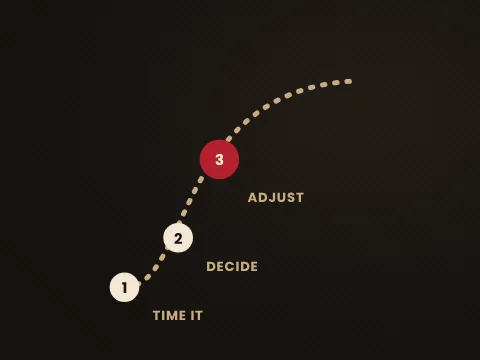
That’s the Hitting Processor: See It → Recognize It → Time It → Decide → Attack It. Occlusion training goes right at the first two steps. When the clip stops at release, the hitter has to see and recognize off what the pitcher gave away early: arm slot, hand, release, the first few feet of flight.
If you can’t call it at release, you’re guessing at the plate.
Early reads also protect the swing. A hitter who recognizes the pitch late tends to panic, lose the athletic position and dump the barrel. A hitter who reads it early can stay on his heater plan and adjust to the hanger without falling apart. See the Heater/Hanger approach.
STOP THE CLIP. MAKE THE CALL.
READ ITEARLY.
- Clip stops at or just after release.
- Call pitch type.
- Call location.
- Check it. Keep score.
THE EARLIER YOU READ IT, THE MORE TIME YOU HAVE.
3. The 5-minute at-home version
You don’t need a lab. You need a phone or laptop, some pitcher video and a pause button.
- Find the clips.Use video of pitchers from the hitter’s view or close to it. Your own team’s bullpen filmed from behind the plate is perfect.
- Stop at release.A partner pauses the clip at the moment of release or just after. The hitter can’t see the rest.
- Call two things.Pitch type (heater or off-speed) and location (up, down, in, away, or strike/ball).
- Check the answer.Play the rest of the clip. Right or wrong, out loud.
- Keep score.20 clips, about 5 minutes. Write down how many were right. Next week, beat it.
Do it standing in a stance, bat in hand, athletic. When scores climb, stop the clip a little earlier. Make it harder as he gets better.
4. Common mistakes
- Letting the clip run too long. If the hitter sees the ball halfway home, it’s not occlusion training. Stop it at or just after release.
- Not checking answers. Without feedback, it’s just watching video. Feel isn’t always real. The score tells the truth.
- Doing it once. This is a Daily Processor tool. Five minutes most training days beats an hour once a month.
- Stopping at the screen. Take it to live work next: hitter calls the pitch out loud from the box on a machine or live arm, then decides take or attack.
5. For parents and coaches
Parents: this is the easiest processor work you’ll ever run. Five minutes at the kitchen table, a scorecard on the fridge. You don’t need to know mechanics to pause a video.
Coaches: film your own pitchers in a bullpen, then build a clip set. Run it as a station at practice or a team competition at a rainout. The best part is it works for your whole roster at once.
Where MAA fits. Reading the pitch earlier buys time for the body. An early read lets a hitter get to launch above the ball with his bat lag intact, his Mechanically Advantaged Angles (MAA), instead of lunging or dumping the barrel to catch up.
Quick answers
What is occlusion training in hitting?
Showing the hitter pitcher video that stops early, at or just after release, and having him call pitch type and location. It forces him to use early cues.
Does occlusion training work for baseball and softball?
A 2024 review across sports found a large effect on anticipation that transferred to on-field tests. It wasn’t baseball-specific, so using it for hitters is a reasonable coaching call, not a proven baseball result.
How long should a hitter do occlusion drills?
About 5 minutes, 20 clips, most training days. Keep score and stop the clip earlier as he improves.
Can I do pitch recognition training at home?
Yes. All you need is pitcher video, a partner to pause it and a scorecard. Do it standing in an athletic stance with a bat.
What should a hitter look for to read a pitch early?
The early cues the pitcher gives away: arm slot, hand, release and the first few feet of flight. If you can’t call it at release, you’re guessing at the plate.
Research: Müller S et al., “Accelerating Visual Anticipation in Sport Through Temporal Occlusion Training: A Meta-Analysis,” Sports Medicine (2024). This meta-analysis covered 12 studies across several sports, including cricket and baseball-type tasks, not hitting alone, and is summarized here from the abstract.
Don’t collect drills. Build a complete hitter.
Complete Hitters Are Built… It’s Earned!
This article is part of the AHD guide Pitch Recognition & Timing. Start there for the full picture and every related article.