By BK, Athletic Hitting Development
Complete Hitters Aren’t Born. They’re Built… and Earned.
Key takeaways
- A study of 23 professional hitters hid the ball partway through its flight to see what broke down.
- Barrel adjustment to location fell off sharply. Decisions slipped a little. Timing didn’t change at all.
- That points to an order: timing gets set first, then the decision, then the late barrel adjustment.
- Train in that order, with mixed-pitch practice so all three get reps.
Your brain doesn’t hit all at once. It hits in order.
A study of 23 pro hitters points to an order: timing gets set first, the swing decision comes next and the barrel adjustment comes last. Train in that order, with timing rounds, then decision rounds, then adjust rounds, then a full random mix, because late timing can’t be fixed late.
Train it: Hitting Processor Masterclass →Timing first. Decision next. Barrel adjustment last. Here’s the study that shows it.
1. What the study found
Saijo and colleagues put 23 professional Japanese hitters in a virtual reality batting setup. On some pitches, they made the ball disappear midway through its flight. Then they measured what happened to the swing.
Three things, three different results:
- Barrel adjustment to location fell off sharply when the ball vanished.
- Swing decisions declined slightly.
- Timing wasn’t affected at all.
The researchers read that as a sequence. The brain sets timing first, decides next and fine-tunes the bat path late. Take away the back half of the flight and the late job suffers most. The early job is already done.
2. The order your brain hits in
Think about what that means for a hitter.
In coaching terms, timing gets locked in early, off the pitcher and the first part of the ball’s flight. If a hitter isn’t on time by then, no late adjustment saves him.
The decision comes next. Swing or take. Mostly made before the ball gets deep, which is why hiding the back half only hurt it a little.
The barrel adjustment comes last. Up, down, in, out. That’s the job that needs the most late information about where the ball is going.
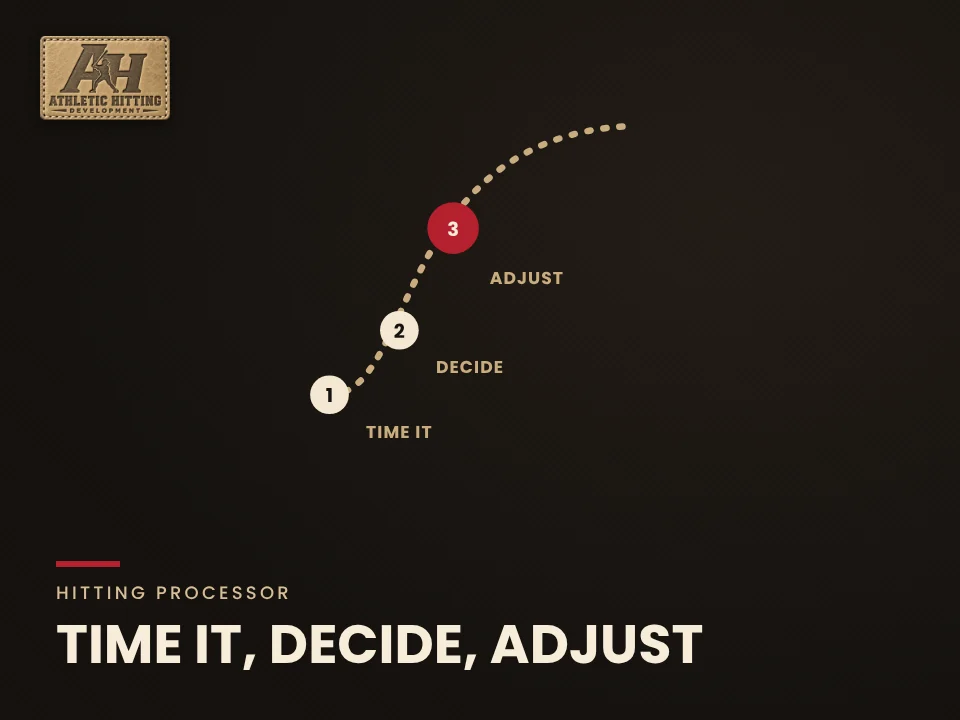
Get on time early. Decide in the middle. Adjust the barrel late.
ONE. TWO. THREE.
TIME IT.DECIDE.
- Timing is set first.
- The decision comes next.
- The barrel adjusts last.
- Train them in that order.
LATE TIMING CAN’T BE FIXED LATE.
3. Where it fits in the Hitting Processor
Our Hitting Processor runs See It → Recognize It → Time It → Decide → Attack It. This study lines up with the back half of it: Time It, then Decide, then the fine-tuning inside Attack It.
It also explains why the Heater/Hanger approach works. Be ready for the heater means your timing is set for the fastest pitch you’ll see. Adjust to the hanger is the late part: the decision and the barrel adjustment when the pitch is slower or breaking. Read more in our Heater/Hanger guide.
And it ties to launch timing. A hitter who gets to a good launch position on time, with the barrel above the ball and bat lag, has room left to decide and adjust. A hitter who’s late to launch is rushing all three. We cover it in launch position timing.
4. A practice plan in the right order
- Timing roundsFastballs only, one speed. The hitter starts his load off the pitcher, not the ball. Goal: on time, every rep.
- Decision roundsSame speed, mixed locations. Swing at strikes, take balls. Score every decision.
- Adjust roundsMix in a slower pitch. Ready for the heater, adjust to the hanger. Score barrel contact, not results.
- Full mixRandom speeds and locations. All three jobs at once, like a game.
- Diagnose the missLate on everything? That’s timing, so go back to step 1. Chasing? Step 2. On time and swinging at strikes but missing the barrel? Step 3.
Don’t skip ahead. Barrel adjustments mean nothing if the timing isn’t there first.
5. For coaches and parents
These were professional hitters in a VR lab. So I’m not telling you the study proves the same order in a 14-year-old. But as coaching judgment, it’s a clean way to sort a struggling hitter. When I see a young hitter miss, I ask: was he late, did he pick a bad pitch, or did he just miss the barrel? Each answer has a different fix.
Coaches: in team training, stop running only straight batting practice. Mixed-pitch rounds train all three steps. Parents: if your kid is late, more swings at the same speed won’t fix his barrel. Fix his start first.
Where MAA fits. Timing is what makes the angles usable. A late hitter can’t reach launch above the ball with bat lag and an athletic front side; he’s rushing to catch up. Get on time early, and his Mechanically Advantaged Angles (MAA) are there when he decides.
Quick answers
What does a hitter’s brain do first: timing or decision?
In a study of 23 pro hitters, hiding the ball late didn’t affect timing, barely affected decisions and sharply hurt barrel adjustment. That suggests timing is set first, then the decision, then the late barrel adjustment.
Why does my hitter swing late even when he sees the ball well?
Timing gets set early, off the pitcher and the first part of the ball’s flight. If the start is late, no late adjustment can fix it. Work on when the load and launch start.
How should I structure hitting practice?
Timing rounds first, then decision rounds, then adjustment rounds with mixed pitches, then a full random mix.
Does this apply to youth hitters?
The study used pro hitters, so it isn’t proof for kids. As coaching judgment, sorting a miss into timing, decision or barrel adjustment helps hitters at any age.
How do I figure out why my hitter keeps missing?
Sort the miss. Late on everything? That’s timing. Chasing? That’s the decision. On time and swinging at strikes but missing the barrel? That’s the late barrel adjustment. Each answer has a different fix, so start with timing.
Research: Saijo et al., “The temporal structure of multiple visuomotor processes in baseball batting: insights from a virtual reality system,” Frontiers in Psychology (2025). This study tested 23 professional hitters in virtual reality and is summarized here from the published abstract; it suggests an order rather than proving it, and it didn’t test youth hitters or practice plans.
Don’t collect drills. Build a complete hitter.
Complete Hitters Aren’t Born. They’re Built… and Earned.
This article is part of the AHD guide Pitch Recognition & Timing. Start there for the full picture and every related article.