By BK, Athletic Hitting Development
Complete Hitters Are Built… It’s Earned!
Key takeaways
- In 14 college hitters, scores on a ball/strike calling task tracked real on-base percentage (r=0.57) and walk rate (r=0.82).
- Pitch selection and a quick-thinking skill each mattered on their own. Good decisions aren’t just good eyes.
- Swing decisions are a skill. If it’s a skill, you can train it, and you can score it.
- Try the 20-pitch decision test: call 20 pitches without swinging, then take 20 swings.
Your hitter doesn’t have a swing problem. He has a decision problem.
Swing decisions are a skill you can train and score, separate from the swing itself. In a study of college hitters, better ball/strike calls tracked higher on-base percentage and walk rate, so score decisions in practice, not just hard contact.
Train it: Hitting Processor Masterclass →And decisions can be trained. Here’s what the research says.
1. What the study found
Morishita and colleagues tested 14 first-division college players, average age about 20. Hitters called balls and strikes on pitches in virtual reality. Then the researchers lined those scores up against real game stats.
The hitters who called balls and strikes better had better on-base percentage (r=0.57) and much better walk rates (r=0.82). That walk-rate link is a strong one.
They also gave hitters a spatial reaction-time test, a quick-thinking task. Faster reactions went with better strike recognition (r=-0.67). And here’s the key: pitch selection and that quick-thinking skill each predicted performance on their own.
In plain English: knowing a ball from a strike is its own skill, separate from the swing. And it shows up in the box score.
2. Decide is a step, not a mood
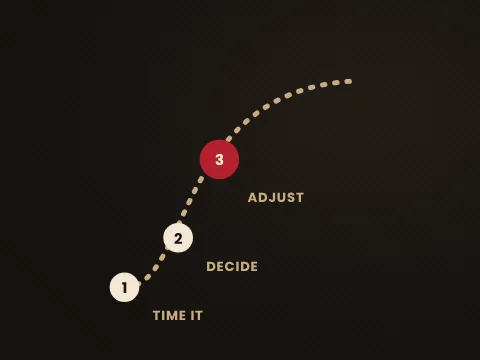
The Hitting Processor runs in five steps: See It → Recognize It → Time It → Decide → Attack It. Most hitters train the last one and hope the others take care of themselves.
Decide is where at-bats are won or lost. Chase a slider in the dirt and the best swing in the world doesn’t matter. Take a strike down the middle and you just gave one away.
A great swing at a bad pitch is still a bad at-bat.
Most hitters train one or two pillars. AHD trains all four. The Hitting Processor is a pillar, not an afterthought.
BALL OR STRIKE?
DECIDEBETTER.
- Call 20 pitches. No swings.
- Then take 20 swings.
- Score every decision.
- Track it week to week.
IF YOU CAN SCORE IT, YOU CAN TRAIN IT.
3. The 20-pitch decision test
You don’t need a VR headset. You need a machine or a live arm and somebody honest calling the zone.
- Call 20The hitter gets in his stance and tracks 20 pitches without swinging. He calls each one out loud, “ball” or “strike,” before it hits the mitt.
- Score the callsOne point per correct call. Write it down. Out of 20.
- Swing 20Now 20 more pitches, same mix. He swings at strikes and takes balls.
- Score the decisionsOne point for every swing at a strike and every take on a ball. Swinging at a ball or taking a strike scores zero.
- CompareIf his calling score is good and his swing score drops, the problem isn’t his eyes. It’s committing too early or too eager.
Run it once a week. The number tells the truth, and that’s Feel vs Real. A hitter who “feels” disciplined but chases five out of 20 isn’t.
4. Score decisions, not just hits
If the only stat you track in practice is hard contact, you’re training hitters to swing at everything. Change the scoreboard:
- Good take on a ball. A point.
- Swing at a strike in his damage zone. A point, hit or miss.
- Chase. Lose a point.
- Taking a cookie. Lose a point.
Then layer in the Heater/Hanger approach. Hunt your pitch, be ready for the heater and adjust to the hanger. Decisions get easier when the hitter knows what he’s looking for.
5. For coaches and parents
This study used 14 college hitters, so it doesn’t prove a 13-year-old’s ball/strike score will predict his OBP. But in my experience, younger hitters improve their decisions fast once somebody starts keeping score.
Coaches: put the 20-pitch test in your team training. Five minutes a hitter. Post the scores. At our camps & clinics, decision reps are built into every round.
Parents: on the drive home, don’t ask “Did you get a hit?” Ask “Did you swing at strikes?” If your kid chases, read why your kid swings at bad pitches.
Where MAA fits. Good decisions let good mechanics play. A hitter can own great Mechanically Advantaged Angles (MAA) and still make outs swinging at pitches he can’t barrel. Decide well, and the angles he’s built get to do damage.
Quick answers
Can pitch recognition be trained?
Swing decisions behave like a skill. In one study of college hitters, ball/strike calling scores tracked on-base percentage and walk rate, and AHD trains and scores those decisions in practice.
What is the 20-pitch decision test?
The hitter calls 20 pitches ball or strike without swinging, then takes 20 swings, scoring a point for every swing at a strike and every take on a ball.
Does plate discipline really affect on-base percentage?
In 14 college hitters, better ball/strike calls went with higher OBP (r=0.57) and a much higher walk rate (r=0.82).
How do I score swing decisions in practice?
Give a point for a good take on a ball and for swinging at a strike, and subtract a point for chases and taken cookies. Track it every week.
Why does my kid swing at bad pitches?
Often it’s a decision problem, not a swing problem. If practice only rewards hard contact, you train hitters to swing at everything. Score good takes and swings at strikes, subtract for chases, and give him a simple heater/hanger plan.
Research: Morishita et al., “Pitch Selection Ability and Spatial Executive Function Independently Predict Baseball Batting Performance,” Sports (Basel) (2025). This was a small study of 14 male college players, summarized here from the published abstract; correlations show a link, not proof that training decisions raises OBP.
Don’t collect drills. Build a complete hitter.
Complete Hitters Are Built… It’s Earned!
This article is part of the AHD guide Pitch Recognition & Timing. Start there for the full picture and every related article.