By Athletic Hitting Development
Complete Hitters Are Built… It’s Earned!
You watch your hitter roll over to short three times, and the advice starts flying: keep your head down, stay back, swing level, don’t drop your back shoulder. By the fourth tip, the swing is worse.
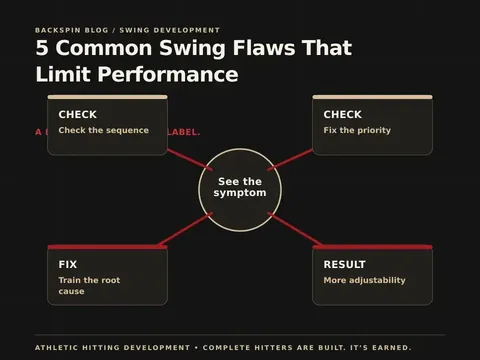
Film 5 swings from the side and 5 from the front, then grade five checkpoints: athletic setup, controlled forward move, launch, barrel direction and balanced finish. Fix the earliest breakdown first with one cue, because an early drift or cast often causes the problems you see later.
Train it: Swing Structure & Mechanics Masterclass →🛠️ Not sure where to start? Run the free SwingChecker™. It finds your hitter’s #1 priority in a few minutes.
That isn’t because you’re a bad helper. It’s because most of those tips are aimed at the result, not the cause. The ground ball to short is where the problem shows up. The problem usually started earlier in the swing.
Don’t fix what you see. Fix what breaks first.
1. Why tips stop working
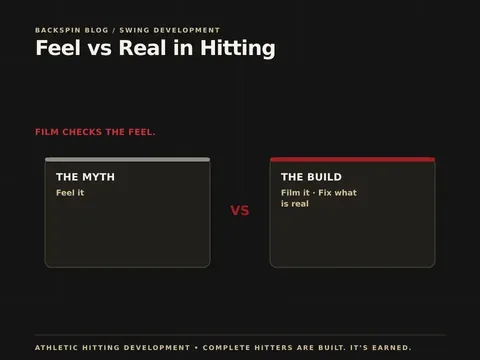
Two things happen when a hitter gets too many cues. First, they can only hold one thought at game speed, so the rest is noise. Second, what a hitter feels and what they do are often far apart. A hitter told to “stay back” can feel back while drifting forward. A hitter told to “swing down” can feel level while chopping.
That gap is called feel vs. real, and it’s why video beats advice. Your phone sees what your hitter can’t feel.
2. The 5 checkpoints
A sound swing doesn’t have to look like anyone else’s. Stances are different, hand positions are different, styles are different. What has to hold is the structure underneath. These five checkpoints cover it:
- Athletic setup. Feet a little wider than the shoulders, knees soft, weight on the balls of the feet, hands relaxed. Ready to move, not stuck in a pose.
- Controlled forward move. The hitter strides toward the pitcher without the head and body sliding out over the front foot (drifting).
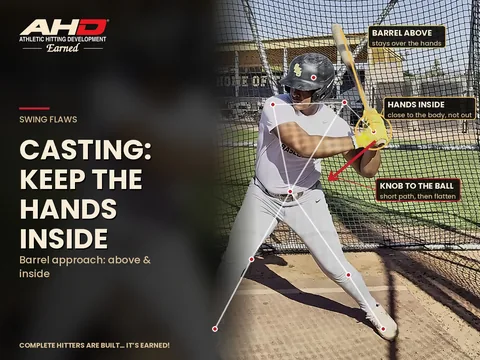
- Launch. At foot strike, the hands are back and ready, not already pushing the barrel out toward the ball (casting).
- Barrel direction at contact. The barrel works through the ball toward the middle of the field instead of pulling off around it.
- Balanced finish. The hitter can hold the finish for a three-count without stepping or tipping.
FIVE CHECKPOINTS
FIX THEFIRST BREAK.
- Athletic setup
- Controlled forward move
- Launch
- Barrel direction
FILM IT. DON’T GUESS.
3. The 10-minute video test
This is the same test that opens the AHD Swing Structure course.
The 5-swing video test
Set up: Prop your phone on a fence or tripod. Film 5 game-speed swings from the side, then 5 from the front, off a tee or front toss.
Grade: Watch at ¼ speed. For each swing, mark each checkpoint pass or fail.
Score: 1 point per checkpoint passed, out of 25. Circle the checkpoint that failed most often.
| Checkpoint | Swings passed (out of 5) |
|---|---|
| Athletic setup | __ / 5 |
| Controlled forward move | __ / 5 |
| Launch (no cast) | __ / 5 |
| Barrel direction | __ / 5 |
| Balanced finish | __ / 5 |
| Total | __ / 25 |
4. Fix the earliest breakdown first
If two checkpoints fail, fix the one that happens first in the swing. A hitter who drifts forward will often cast and pull off too, because once the body slides, the hands have to rescue the swing. Fix the drift and the later problems often clean up on their own.
The earliest breakdown wins. Fix that one, re-film, then decide what’s next.
5. Match the drill to the checkpoint
- Setup or finish → freeze-finish swings. Hold every finish for a three-count. Cue: “Start athletic. Stay athletic. Finish athletic.”
- Forward move (drift) → wall-back stride drill. Cue: “Stride, don’t slide.”
- Launch or casting → fence drill. Cue: “Knob to the ball.”
- Barrel direction (pulling off) → opposite-field tee. Cue: “Show the pitcher your back pocket.”
Three sets of eight, slow first and then full speed. Then re-film five swings from the same angles and re-grade only the checkpoint you circled. A gain of two or more is a real change.
6. What to say at practice
Pick one cue and use the same words every time. Then stop talking and let the reps do the work. After the session, show the before-and-after video side by side. Seeing the change does more for a young hitter’s confidence than any speech.
If your hitter rolls over a lot, our rolling-over self-check walks through the same idea for that one problem.
7. Go deeper: the Swing Mechanics Program
Sixty lessons that take the swing apart in the right order: setup and posture, load and stride, launch, contact, extension and finish, then adjusting to every location — with an assessment every ten lessons so you can see the swing change on video.
The first three lessons are free. Start with Lesson 1: The 5-Swing Video Test — it takes about ten minutes and gives you a score to retest against.
See the full Swing Mechanics Program →

THELESSON.
- One cue at a time.
- Trust the video.
- Earliest breakdown first.
- Re-film and compare.
Complete Hitters Are Built…Earned.
Quick answers
How do I know what is wrong with my kid’s swing?
Film 5 swings from the side and 5 from the front, watch at quarter speed and grade five checkpoints: athletic setup, a controlled forward move, launch, barrel direction and a balanced finish. The checkpoint that fails most often, and earliest in the swing, is the priority.
Should I give my hitter a lot of tips?
No. Use one cue at a time with the same words every time. Hitters can only hold one thought at game speed, and too many tips usually make the swing worse.
What is the most common youth swing problem?
It varies by hitter, which is why testing matters. Drifting forward, casting the hands and pulling off the ball are all common. Fix the one that happens earliest in the swing first, because it often causes the others.
How long does it take to fix a swing problem?
Many hitters show a visible change on video in a single focused session. Making it hold up at full speed and against live pitching takes weeks of short, regular reps on the same checkpoint.
What drill fixes casting in a youth swing?
The fence drill, with the cue “Knob to the ball.” Do three sets of eight, slow first and then full speed, then re-film and re-grade the launch checkpoint.
From the 2015 archive: The Hitter’s Base: How Wide Should Your Feet Be?.
This article is part of the AHD guide Baseball Swing Mechanics. Start there for the full picture and every related article.