Rolling over is a result
Early rollover can come from timing, posture, bat path, approach or the hitter running out of space. Treating it as one universal hand problem oversimplifies the swing.
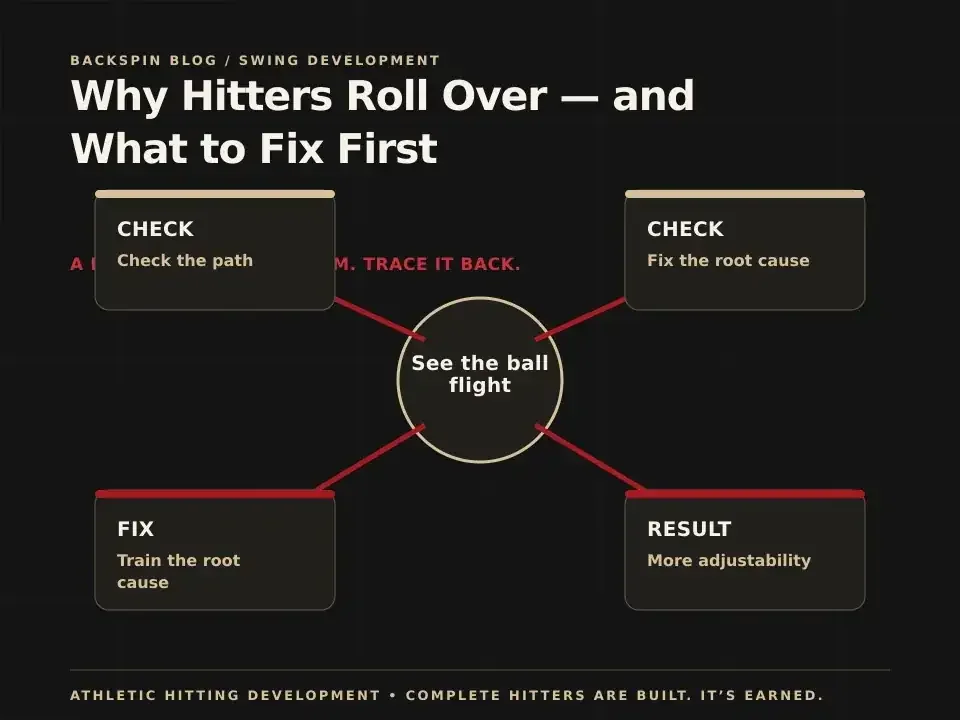
Hitters roll over because something earlier in the swing breaks down: timing, posture, bat path, approach or running out of room to the ball. Find where the breakdown starts on video, then train that cause — usually with opposite-field work — instead of telling the hitter to fix his hands.
Train it: Swing Structure & Mechanics Masterclass →Check where the breakdown begins
Look at the hitter before contact. Did the stride direction change posture? Did the barrel dump? Did the hands cast? Was the pitch simply too far away or too early?
CHECK WHERE THE BREAKDOWN BEGINS
ROLLOVER ISA RESULT.
- Stride changed the posture.
- Barrel dumped.
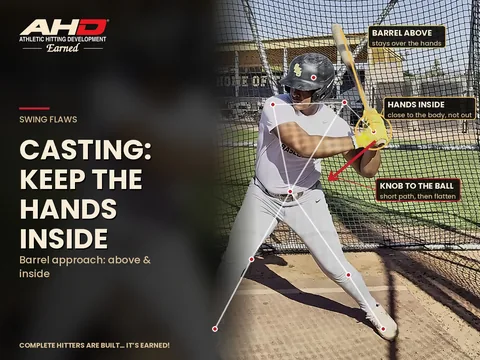
- Hands cast.
- Pitch was too far away.
IT IS NOT ONE UNIVERSAL HAND PROBLEM.
Contact direction matters
Different pitch locations require different contact points. Trying to force the same contact position on every pitch can create rollover on pitches that require more depth or extension.
The 60-second self-check
Film five swings from the side and five from the front. Watch them at ¼ speed and check in this order. The earliest breakdown wins — fix that one first, because it causes the problems that show up later.
| What you see | Likely cause | Start with |
|---|---|---|
| Late on good fastballs, swing feels hurried | Late or rushed load | Rhythm tee drill — early, slow and on time |
| Out front, off balance, weak pulled balls | Drifting over the front foot | Wall-back stride drill — stride, don’t slide |
| Rollover grounders, pulling off the outside pitch | Front side opens early | Opposite-field tee — show the pitcher your back pocket |
| Jammed, weak contact on inside pitches | Casting the hands | Fence drill — knob to the ball |
| Weak rollover grounders to the pull side | Rolling the top hand over early | Top-hand short swings — palm up, palm down |
| Rolling over on pitches off the plate | Swinging at the wrong pitch | Call-it drill — yes or no before you swing |
Right-handed youth hitters who roll over to shortstop all day are a classic case — here’s why the best youth players play shortstop.
One drill to start: the opposite-field tee
For the most common pattern — rollover grounders and pulling off the outside pitch — start here:
- Set the tee on the outside corner, at the contact point for that pitch.
- Every ball must go middle to opposite field, on a line.
- Three rounds of eight. Count the balls that go hard, middle-oppo.
- Cue: “Show the pitcher your back pocket.”
If the ball still rolls over, don’t add more reps. Go back up the self-check — timing or the stride is usually the earlier link.
Your 7-day rollover plan
| Day | The work |
|---|---|
| 1 | Film side and front. Run the self-check. Pick one cause. |
| 2 | Learn the move slowly: your drill from the table, dry swings then tee, 3×8. |
| 3 | Your drill 3×8, then the opposite-field tee 3×8. Score middle-oppo line drives. |
| 4 | Rest or mobility. Watch your video once with your cue in mind. |
| 5 | Front toss on the outer half. Only one thought: your cue. |
| 6 | Mixed locations, front toss or live. Call “yes” or “no” before every swing. |
| 7 | Re-film both angles. Compare to Day 1. Re-run SwingChecker™. |
Want the plan built around your hitter instead of the most common pattern? SwingChecker™ ranks the likely root causes in about 3 minutes and gives you a 7-day plan of your own. Keep reading: Casting · Stride direction · Bat path · Going oppo
Train the root cause
Once the likely cause is identified, choose the cue or drill that addresses that cause. Do not collect rollover drills without knowing what the hitter needs.

THELESSON.
- Rollover is a result.
- Look before contact.
- Match contact to location.
- Find the root cause.
- Then pick the drill.
Complete Hitters Are Built…Earned.
Quick answers
How long does it take to stop rolling over?
Train one root cause at a time. Most hitters can see a difference on video within a week of focused work on the right cause, then it has to hold up against live and mixed pitches before it counts.
What causes rolling over in baseball?
Rolling over is a result, not the problem itself. It can come from timing, posture, bat path, approach or the hitter running out of space. Treating it as one universal hand problem oversimplifies the swing. Look for where the breakdown starts before you try to fix it.
How do I find out why my hitter rolls over?
Look at the hitter before contact. Did the stride direction change posture? Did the barrel dump? Did the hands cast? Was the pitch simply too far away or too early? The answer to those questions tells you what to train, instead of guessing.
What is the best drill to stop rolling over?
There is no one best drill. Once you identify the likely cause, choose the cue or drill that addresses that cause. Do not collect rollover drills without knowing what the hitter needs. Also remember different pitch locations need different contact points, so forcing one contact spot on every pitch can create rollover.
Why does my kid keep hitting weak ground balls to the pull side?
That pattern is usually rolling over, often from being early or from the barrel getting around the ball too soon. Check timing first, then posture and bat path, and use opposite-field tee and front-toss work to retrain the direction.
From the 2015 archive: Extension and Wrist Release in the Swing.
No subscription. No login. Keep learning, then take one priority into training.