By Athletic Hitting Development
Complete Hitters Are Built… Not Given. Earned!
In 2025, Jacob Wilson did something no A’s shortstop had done since Campy Campaneris in 1974: he started the All-Star Game. He did it as a rookie, voted in by the fans, with a swing that almost never misses.
Jacob Wilson’s lesson for hitters: build a swing that stays inside the ball and on plane early, so contact becomes repeatable. Copy the idea, not the stance, then get stronger and compete in every count.
Train it: Swing Structure & Mechanics Masterclass →In an era of big swings and big strikeout totals, Wilson is a throwback. He puts the ball in play, uses the whole field, and treats a strikeout like a personal insult.
“I just take strikeouts so personally.” — Jacob Wilson
JACOB WILSON • 2025 ROOKIE
IT RARELYMISSES.
- .311 batting average.
- 8.5% whiff rate early in 2025.
- 33 straight PAs without a K.
A THROWBACK IN A BIG-SWING ERA.
1. Built in the backyard
Wilson’s swing didn’t show up by accident. His dad, Jack Wilson, played 12 years in the big leagues as a shortstop and built a practice field in the family’s backyard. Jacob trained with a custom wood bat with a barrel about an inch across and hit tennis balls fired in at 85 mph from 45 feet.
Think about that. A tiny barrel and a fast, small ball punish every swing that isn’t on time and on plane. Miss by a little and you miss completely. Do that for years and the regular bat starts to feel like a paddle.
His dad also borrowed from three great hitters when he shaped the swing: Miguel Cabrera’s tall stance and leg sink, Mike Trout’s quick hand load and Albert Pujols’ flat bat path. The goal wasn’t to copy any one of them. It was to build a swing that stays in the hitting zone and works to all fields.
“He always hated strikeouts when he was playing and that just adapted to me.” — Jacob Wilson, on his dad
2. The numbers behind the contact
- College: at Grand Canyon University he struck out 7 times in 275 plate appearances as a sophomore, then 5 times in 217 at-bats as a junior.
- Draft: the A’s took him 6th overall in 2023.
- Rookie year: he opened 2025 with 33 straight plate appearances without a strikeout and hit .311 with 13 home runs and 63 RBIs.
- Getting stronger: after an offseason of strength work his hard-hit rate early in 2025 jumped from 19.0% to 28.3%. “I’m feeling a lot stronger,” he said.
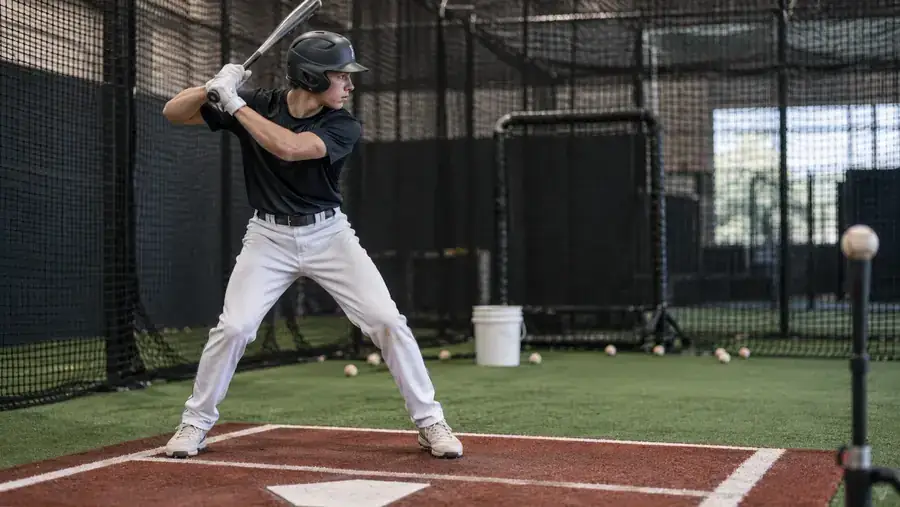
BUILT IN THE BACKYARD
TINYBARREL.
- An inch-wide wood bat.
- Tennis balls at 85 mph.
- From 45 feet.
MISS BY A LITTLE AND YOU KNOW IT.
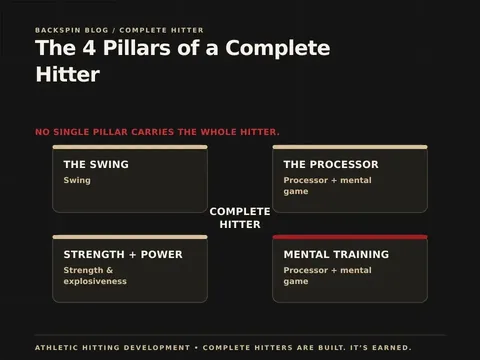
3. The four pillars inside the swing
1. The swing: stay inside the ball
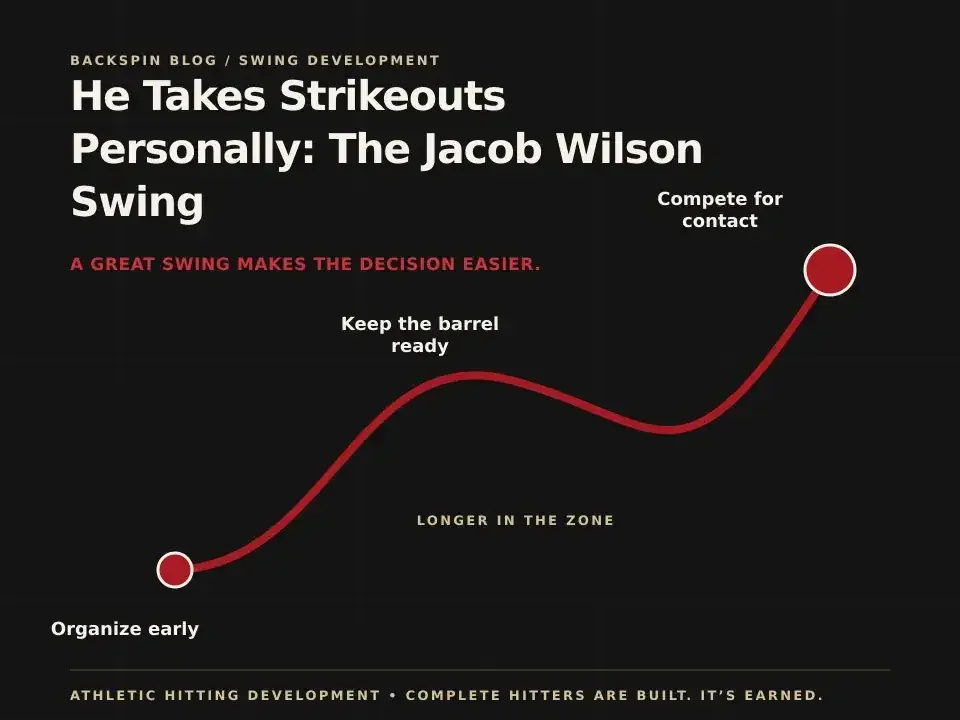
Wilson starts wide open and closes as his legs move, and he keeps the knob of the bat pointed at the ball longer than most hitters. That was his dad’s rule: stay inside the baseball. A flat path that gets on plane early gives him a long runway to make contact.
Coaching translation: Don’t copy the stance. Copy the idea. Keep the hands inside, get the barrel on the plane of the pitch early, and let the ball travel. That is what makes contact repeatable, in baseball and fastpitch softball.
2. Athletic development: contact needs strength behind it
Wilson’s contact skill was already elite in college. What changed in the big leagues was what happened after contact. He got stronger, and the ball started coming off the bat harder.
Coaching translation: Contact gets you on base. Strength decides whether that contact is a routine grounder or a line drive in the gap. Train both.
3. The hitting processor: know what you’re doing and why
Wilson is aggressive. He said he will swing at a pitch “maybe a couple inches off and take a base hit to right.” For him that works, because he can put almost anything in play. It also means he walks very little. That trade-off is his, and he earned it with years of bat-to-ball reps.
Coaching translation: Young hitters should learn the strike zone first and earn the right to expand it later. See It → Recognize It → Time It → Decide → Attack It. Know your pitch, then decide.
4. Mental approach: hate the strikeout, not yourself
Taking strikeouts personally is a competitive edge when it turns into a fight with two strikes: shorten up, protect the plate, put it in play. It becomes a problem when a strikeout turns into three more bad at-bats.
Coaching translation: Compete like Wilson with two strikes, then reset. One at-bat never gets to decide the next one.
4. Try this at home
- Small-barrel rounds: hit off a tee or soft toss with a skinny training bat or a broomstick and small balls, like tennis balls or wiffle golf balls. Miss-hits show up right away.
- Knob-to-ball dry swings: 10 slow swings where the knob leads toward the ball and the barrel stays behind the hands until the last moment.
- Opposite-field rounds: 10 swings trying to hit every ball through the middle or the other way. It teaches you to let the ball travel.
- Two-strike battle: start every round at 0–2. Your only job is to put the ball in play hard. Keep score: ball in play wins.

DON'T COPY THE STANCE. COPY THE IDEA.
STAY INSIDETHE BALL.
- Knob points at the ball longer.
- Get on plane early.
- Long runway to contact.
KEEP THE HANDS INSIDE.
5. Build the complete hitter
Jacob Wilson isn’t great because he found a weird stance that works. He is great because he spent years building a swing that stays in the zone, got stronger when the game demanded it, and competes in every count.
Don’t collect drills. Build a complete hitter.
Start with SwingChecker™ to find your first swing priority. Then see how the AHD Complete Hitter Masterclass trains all four pillars together, or contact Coach about online remote baseball and softball training built for your hitter.
Source note: Wilson’s All-Star start and swing were featured by the San Francisco Chronicle. His backyard training, college strikeout totals and the “take strikeouts so personally” quote come from ABC30 Fresno. Early-2025 contact and hard-hit numbers and the quotes about his dad and getting stronger come from MLB.com. Season totals and draft details: Baseball-Reference. This article is AHD’s coaching interpretation.

THELESSON.
- Small-barrel rounds.
- Knob-to-ball dry swings.
- Opposite-field rounds.
- Get stronger.
- Compete in every count.
Complete Hitters Are Built…Earned.
Quick answers
How did Jacob Wilson train his swing as a kid?
His dad, Jack Wilson, built a practice field in the backyard. Jacob trained with a custom wood bat with a barrel about an inch across and hit tennis balls fired at 85 mph from 45 feet. A tiny barrel and a fast, small ball punish every swing that is not on time and on plane.
What does stay inside the ball mean in hitting?
It means keeping the hands inside and the knob pointed at the ball longer, so the barrel gets on the plane of the pitch early. Wilson does this, and it gives him a long runway to make contact. Do not copy his stance. Copy the idea and let the ball travel.
What drills help a hitter make more contact?
Try small-barrel rounds with a skinny bat or broomstick and small balls. Do knob-to-ball dry swings where the barrel stays behind the hands. Hit opposite-field rounds to let the ball travel. Then play a two-strike battle starting at 0-2, where a ball in play wins.
Does training with a small barrel bat help contact?
A tiny barrel and a small, fast ball punish every swing that isn’t on time and on plane, so miss-hits show up right away. Try small-barrel rounds with a skinny training bat or broomstick and tennis balls or wiffle golf balls.
This article is part of the AHD guide Baseball Swing Mechanics. Start there for the full picture and every related article.