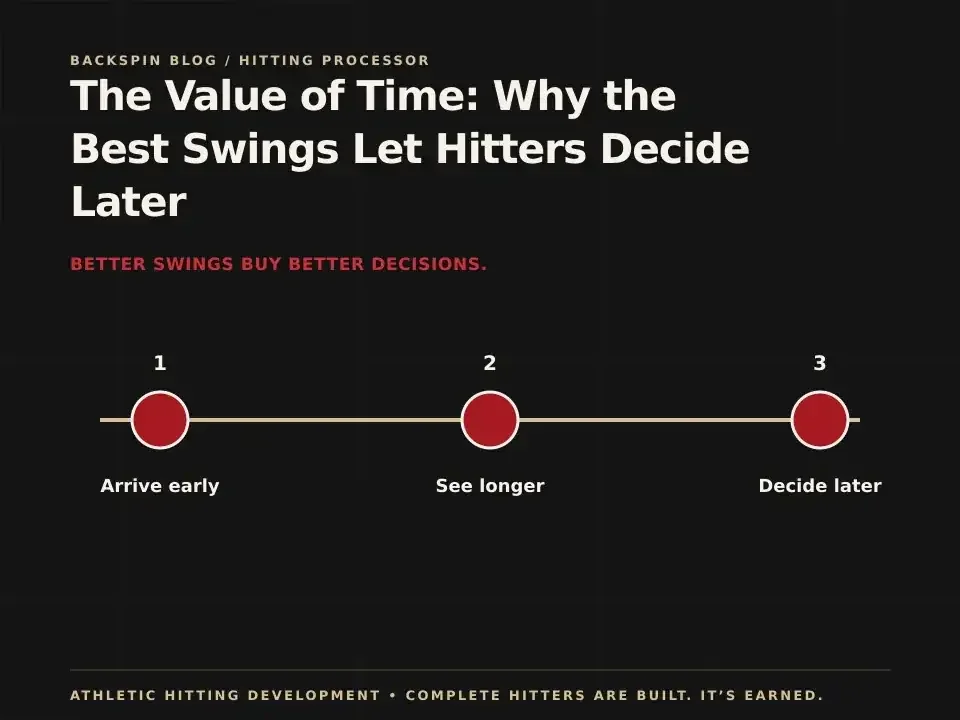
You cannot make the pitch travel slower. You can build a hitter who needs less time to execute.
Baseball gives every hitter the same basic problem. The pitcher releases the ball and the clock starts. The hitter has to see it, recognize what it is, track where it is going, get the body organized, time the pitch, decide whether to swing and—if the answer is yes—deliver the barrel accurately enough to do damage.
You can’t make the pitch travel slower, but an efficient, adjustable swing needs less time, so the hitter can gather more information before committing. Jacob Wilson’s compact move shows how that keeps options alive longer.
Train it: Hitting Processor Masterclass →All of it happens incredibly fast.
At Athletic Hitting Development, we do not look at swing efficiency as a beauty contest. We look at what that efficiency gives the athlete. One of the biggest benefits is usable decision time.
Jacob Wilson gives us a real-world example
Athletics shortstop Jacob Wilson is interesting to us because his game highlights something that often gets lost when people talk about bat speed and swing mechanics. His compact, adjustable move can allow him to stay available longer before the final commitment has to happen.
The pitch does not slow down for him. The advantage is that the swing can require less unnecessary time and movement. That can leave more of the pitch flight available for information.
The swing should help the brain—not rush it.
This is the Hitting Processor
At AHD, the order matters:
Time It comes before Decide. The hitter is not standing still until the brain produces a yes-or-no answer. The body and brain are working together as the pitch travels. The hitter gathers, moves, tracks, recognizes, times and gradually eliminates choices.
A swing that forces an early commitment steals information from the hitter. An efficient, adjustable movement pattern can preserve options longer.

THE ORDER MATTERS
TIME ITFIRST.
- Time it comes before decide.
- Body and brain work together.
- Keep options alive longer.
THE SWING SHOULD HELP THE BRAIN.
Earlier commitment means less information
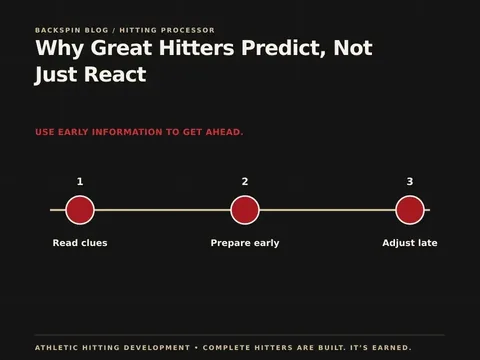
If the swing takes longer to organize and deliver, the hitter often has to begin the final commitment earlier in the pitch flight. Earlier commitment can mean less information about speed, spin, location and trajectory.
That is why we do not treat “quick” or “short” as cosmetic descriptions. The important question is functional:
How much time does this hitter's movement require before he can no longer adjust?
At high levels of baseball and softball, fractions of a second matter. A movement pattern that keeps the athlete athletic and adjustable longer can increase the hitter's ability to solve what the pitcher actually throws instead of what the hitter hoped was coming.
The largest margin for error
This connects directly to one of the central goals of Athletic Hitting Development: build the largest margin for error for solid contact while generating maximum force and an effective bat-to-ball angle.
Those pieces have to live together. We do not want a hitter who simply slaps the baseball around. We do not want a hitter chasing exit velocity with no adjustability. And we do not want a visually perfect swing that only works against one pitch in one spot.
We want room—room to recognize, room to adjust, room to be a little early, room to be a little late, room for the pitch to move and room for the hitter to compete.
THE LARGEST MARGIN FOR ERROR
BUILDROOM.
- Room to recognize.
- Room to adjust.
- Room to be a little early.
- Room to be a little late.
ROOM FOR THE HITTER TO COMPETE.
Why opposite-field ability matters
Wilson's ability to use the opposite field is another useful teaching point. At AHD, opposite-field ability is not about teaching a hitter to become passive or to push the ball the other way. It is evidence that the hitter can control the barrel across more than one contact point.
A complete hitter should be able to pull the right pitch, drive the middle of the field, stay through a pitch away and survive when timing is not perfect. When only one contact point works, the hitter's margin for error becomes very small.
All-fields ability gives the hitter more solutions.
Short does not mean weak
This is where language can hurt young hitters. “Be short” can turn into hand manipulation, fear of swinging hard or a defensive move to the ball.
That is not what we mean.
At AHD, the target is efficient movement + violent intent + adjustability. The body still has to produce force. The sequence still matters. The barrel still needs room to accelerate. The hitter still needs intent.
The goal is not to remove athleticism. The goal is to remove unnecessary movement that steals time without adding useful force, direction or adjustability.
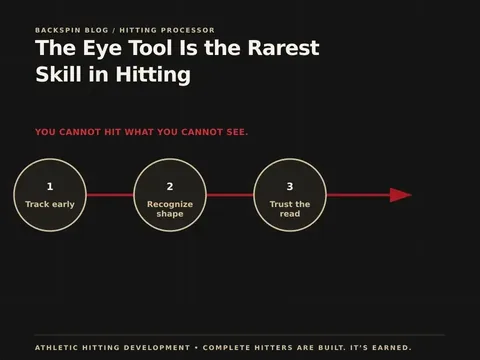
The eye tool and the swing cannot be separated
A hitter can see spin well and still be late if the body needs too much time to execute. A hitter can own an efficient swing and still struggle if pitch information arrives too late or is processed poorly.
That is why we teach the swing and the processor as connected systems.
- The eyes gather information.
- The brain recognizes and processes it.
- The body prepares and times the pitch.
- The hitter keeps choices alive as long as possible.
- Then the athlete commits and attacks.
Do not coach away the hitter's superpower
Every hitter does not need to look the same. When an athlete owns an unusual strength—elite barrel accuracy, bat speed, pitch recognition, power, opposite-field control or adjustability—the first coaching question should be:
What makes this athlete special, and how do we protect it while improving everything around it?
Coaches do not get bonus points for changing hitters. The goal is improvement. Sometimes that requires a mechanical change. Sometimes it requires more strength. Sometimes it is the processor. Sometimes it is approach. And sometimes the smartest coaching decision is to protect what already works.
Four questions for developing hitters
Can you stay athletic and adjustable long enough to react to what the pitch actually does?
Can you pull the right pitch, drive the middle and handle the ball away without manufacturing a different swing?
Extra movement only helps if it creates useful force, direction, timing or adjustability.
The best solution is the one that lets your individual athleticism work against the widest range of game pitches.

THELESSON.
- Keep options alive.
- Control more contact points.
- Create time, don't steal it.
- Find your margin for error.
- Protect the superpower.
Complete Hitters Are Built…Earned.
Time is a hitting tool
You cannot create more milliseconds between release and home plate. But you can waste fewer of them.
You can see the baseball better. Recognize it earlier. Organize the body more efficiently. Maintain athletic position longer. Build an adjustable barrel path. Understand your own movement well enough to know what is changing.
The best hitters are not simply making decisions faster. They are building a system that lets them gather as much useful information as possible before the decision has to become final.
That is the value of time.
COMPLETE HITTERS ARE BUILT… NOT GIVEN. EARNED!
The Backspin Blog is free instruction.
Keep learning without buying anything. AHD's Backspin Blog is part of the education: hitting development, swing, processor, approach and coaching articles you can use right now.
READ THE BACKSPIN BLOG →Quick answers
Does a short swing mean a weak swing?
No. The target is efficient movement plus violent intent plus adjustability. The goal is to remove unnecessary movement that steals time without adding useful force, not to remove athleticism.
No subscription. No login. Keep learning, then take one priority into training.