By BK, Athletic Hitting Development
Complete Hitters Are Built… It’s Earned!
Key takeaways
- Kiké Hernández’s career postseason OPS is about .825. In the regular season it’s about .708.
- His swing doesn’t change in October. His mental approach does.
- The mental approach is the pillar most hitters never train, and it’s the one that shows up in big moments.
- Pressure can be practiced. A big-moment plan, a reset routine and a trained swing let the mind compete.
- Your hitter’s October is any big game: a tournament, a playoff at-bat, a showcase.
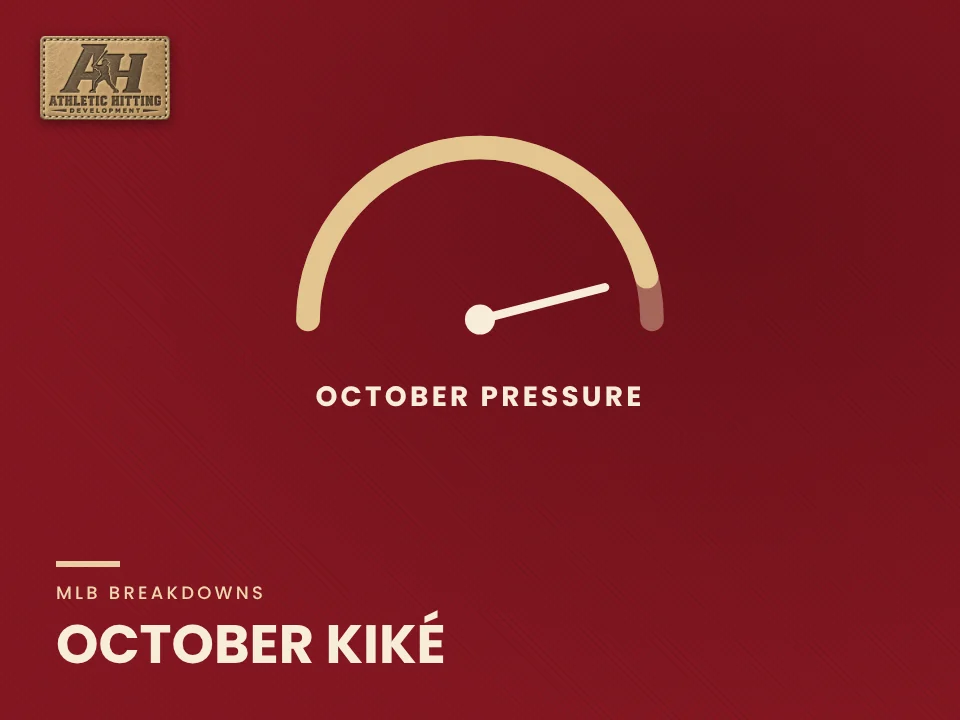
Some hitters shrink when the lights get bright. Kiké Hernández gets bigger.
Kiké Hernández’s swing doesn’t change in October; his mental approach does, and his numbers rise when the stakes do. The lesson for hitters: pressure can be practiced with a simple one-pitch, one-zone plan, a reset routine and a swing trained well enough that you don’t have to think about it.
Train it: Mental Approach Masterclass →Every fall it’s the same story. A utility man who hits like an ordinary big leaguer from April to September turns into one of the most dangerous bats in baseball once October starts. Even the people around the Dodgers can’t fully explain it, and Kiké says he can’t either.
I’ve spent 52 years playing, coaching and scouting this game. I don’t think October Kiké is magic. I think he’s a lesson, and it’s one every hitter can learn.
1. The numbers don’t lie
Kiké’s career OPS in the postseason is about .825. In the regular season it’s about .708. He homers in October at roughly twice his regular-season rate, and entering 2026 he had 16 postseason home runs and 42 RBIs in 103 playoff games.
| Career | Regular season | Postseason |
|---|---|---|
| OPS | About .708 | About .825 |
| Home run rate | Baseline | About 2x |
He’s also come through in the biggest spots. In Game 7 of the 2020 NLCS against the Braves, he came off the bench and hit a game-tying home run. In 2025 he played the whole postseason on an elbow so bad he had surgery right after, and he still started every game.
This fall he’s 34, coming off that surgery, and he’s doing it again.
KIKÉ HERNÁNDEZ · CAREER
OCTOBERKIKÉ.
- Regular-season OPS: about .708
- Postseason OPS: about .825
- October HR rate: about 2x
- Same swing. Different mind.
THE LIGHTS GET BRIGHT. HE GETS BIGGER.
2. Why it happens: the mental approach
Kiké’s swing doesn’t change in October. What changes is what’s going on between his ears. That’s the pillar most hitters never train.
At AHD we build complete hitters on 4 pillars: the swing, athletic development, the hitting processor and the mental approach. Most players spend all their time on the first one. Then the big moment comes and the swing they built in the cage never shows up.
Here’s what I see in hitters who rise in big games:
- Pressure feels like fun, not fear. Kiké plays with energy and joy. A loose body moves faster than a tight one.
- The approach gets simpler. Big-game hitters stop thinking about mechanics and narrow down to one pitch, one zone, one job.
- They trust what they’ve built. When the swing and the processor are already trained, the mind is free to compete.
- They want to be up there. Some hitters hope the inning ends before their turn. October hitters want the bat in their hands.
Same swing. Different mind. That’s October.
3. What your hitter can steal from October Kiké
You don’t need a World Series ring to use this. A tournament game, a playoff at-bat or a showcase in front of scouts is your hitter’s October.
- Build one simple big-moment planBefore every at-bat, pick one pitch to hunt and one zone to look in. Nothing else.
- Practice under pressurePut stakes on cage rounds: count games, a score to beat, a teammate watching. Pressure you’ve felt before is pressure you can handle.
- Own a reset routineStep out, breathe, one cue word, step back in. Same routine every at-bat so it shows up when it matters.
- Train the swing so you don’t have to think about itAHD hitters build Mechanically Advantaged Angles (MAA) so the swing holds up on its own when the mind is busy competing.
- Want the momentParents and coaches, celebrate the competitive at-bat, not just the hit. Hitters who aren’t scared of failing are the ones who come through.
YOUR HITTER’S OCTOBER
WANT THEMOMENT.
- One pitch. One zone.
- Practice with stakes.
- Same reset. Every at-bat.
- Trust the swing you built.
PRESSURE YOU’VE FELT IS PRESSURE YOU CAN HANDLE.
Coaches, the same goes for your whole lineup. A dugout that practices pressure doesn’t panic in it. AHD offers team pricing on every course and brings hands-on team hitting camps and clinics to teams and organizations.
4. The bottom line
October Kiké isn’t luck. He’s a hitter whose mind gets quieter when everyone else’s gets louder. That skill can be trained, and the earlier a hitter starts, the more big moments they’ll own.

THELESSON.
- Same swing.
- Different mind.
- Train all 4 pillars.
- Practice the pressure.
- Want the moment.
Complete Hitters Are Built…Earned.
Want to go deeper? Read The #1 Common Trait of Elite Hitters and What October Does to Hitters, or start the free Mental Approach Lesson 1: The At-Bat Audit.
Quick answers
Why does Kiké Hernández hit better in October?
His swing doesn't change. His mental approach does. He treats pressure as fun, simplifies his plan to one pitch and one zone, trusts the work he's already done and wants to be at the plate in the big moment.
How much better is Kiké Hernández in the postseason?
His career postseason OPS is about .825 compared with about .708 in the regular season, and he homers at roughly twice his regular-season rate in October.
Can a hitter learn to hit better under pressure?
Yes. Hitters build it with a simple big-moment plan, practice that carries real stakes, the same reset routine every at-bat, a trained swing they don't have to think about and a mindset that wants the moment.
What can parents do to help a hitter in big games?
Celebrate the competitive at-bat, not just the hit. Keep mechanics for practice, give one simple thought or none in the game, and let your hitter know failing in a big spot is part of getting good in big spots.
Why do some hitters play worse in big games?
Most hitters spend all their time on the swing and never train the mental approach, so the swing they built in the cage doesn’t show up. Big-game hitters simplify to one pitch, one zone, one job, and they want to be up there.
Sources: MLB.com · Baseball-Reference Bullpen · AP · SI
Don’t collect drills. Build a complete hitter.
Complete Hitters Are Built… It’s Earned!
This article is part of the AHD guide The Mental Game of Hitting. Start there for the full picture and every related article.