By BK, Athletic Hitting Development
Complete Hitters Aren’t Born. They’re Built… and Earned.
Key takeaways
- The on-deck circle is where you update the hitting processor information, not just a place to loosen up.
- Watch his release window, his tempo, his heater, his spin and what got the hitter ahead of you.
- Load with his delivery, call heater or spin, then lock a yes pitch before you step in.
- Information first, swings last: about one minute, the same routine every at-bat.
As I tell every hitter, the on-deck circle is where you update the hitting processor information. It’s your last scouting report, your last timing rep and your last decision before the at-bat counts.
Use the on-deck circle to update the Hitting Processor: find the pitcher’s release window, call heater or spin, load with his delivery, then lock a yes pitch for the count. Finish with two fast game-bat swings and one breath. About a minute, the same every at-bat.
Train it: Hitting Processor → Free tool: Pitch Recognition Trainer →Too many hitters treat the on-deck circle like a waiting room. A few swings, a look around, fix the batting gloves. Then they step in and see the pitcher for the first time with a strike already on the board.
The Hitting Processor is one of the 4 Pillars of a Complete Hitter: See It, Recognize It, Time It, Decide, Attack It. All five start before you ever step in the box. For the bat-speed side of the circle, read On-Deck Routine to Keep Bat Speed Up. This post is about the information.
1. What is the on-deck circle really for?
Two jobs: get the body ready and get the brain ready. Most hitters only do the first one.
The on-deck circle is where you update the hitting processor information.
Every pitch you watch from there is a free look. You get his release, his rhythm, his best pitch and what he does when he’s behind, without spending a single strike of your own.
That’s why we train the processor DAILY at AHD. If it’s trained, it shows up on deck. If it isn’t, the hitter is just standing there holding a bat.
2. What should a hitter watch from the on-deck circle?
- His release window. Arm slot, height, how far out front the ball comes out. Find it now so your eyes go straight there in the box.
- His tempo. Quick or slow to the plate? Does he speed up with runners on? That’s your timing.
- His heater. How does it play? Is it beating hitters or getting fouled back?
- His spin. What breaking ball, and when: first pitch, ahead in the count, two strikes?
- What got the hitter ahead of you. If he just finished a hitter with spin, expect to see it again.
- The zone. Is the umpire giving the corner or calling it tight?
ON-DECK SCOUTING
SEE IT.TIME IT.
- Find his release window
- Feel his tempo
- Learn his heater
- Spot his spin and when
- Read the umpire’s zone
FREE LOOKS. NO STRIKES SPENT.
3. The AHD on-deck processor routine (about one minute)
Same routine every at-bat, in practice and in games. Game bat only.
- Eyes on the pitcherSoft focus on his body, then fine focus to the release window as his arm comes through.
- Call the pitchHeater or spin, quietly, before it’s halfway. You’re training Recognize It against a live arm.
- Load with his deliveryGather and load as his hands break, landed and ready at release. Early, slow and on time.
- Two speed swingsA couple of fast, full-intent swings with the game bat. Aggressive and athletic. Ready, not tired.
- Lock the planKnow your yes pitch for the first pitch. Heater ready, adjust to the hanger. One breath.
- Walk up loadedStep in already knowing his release, his rhythm and your plan. It’s a great day to hit!!
Notice the order. Information first, swings last. The swings are there to wake up speed, not to fill time.
4. Vision, brain, swing: how the Hitting Processor works on deck
The eyes feed the brain. The brain drives the swing. That chain runs on every pitch, and the on-deck circle is where you update it before it counts.
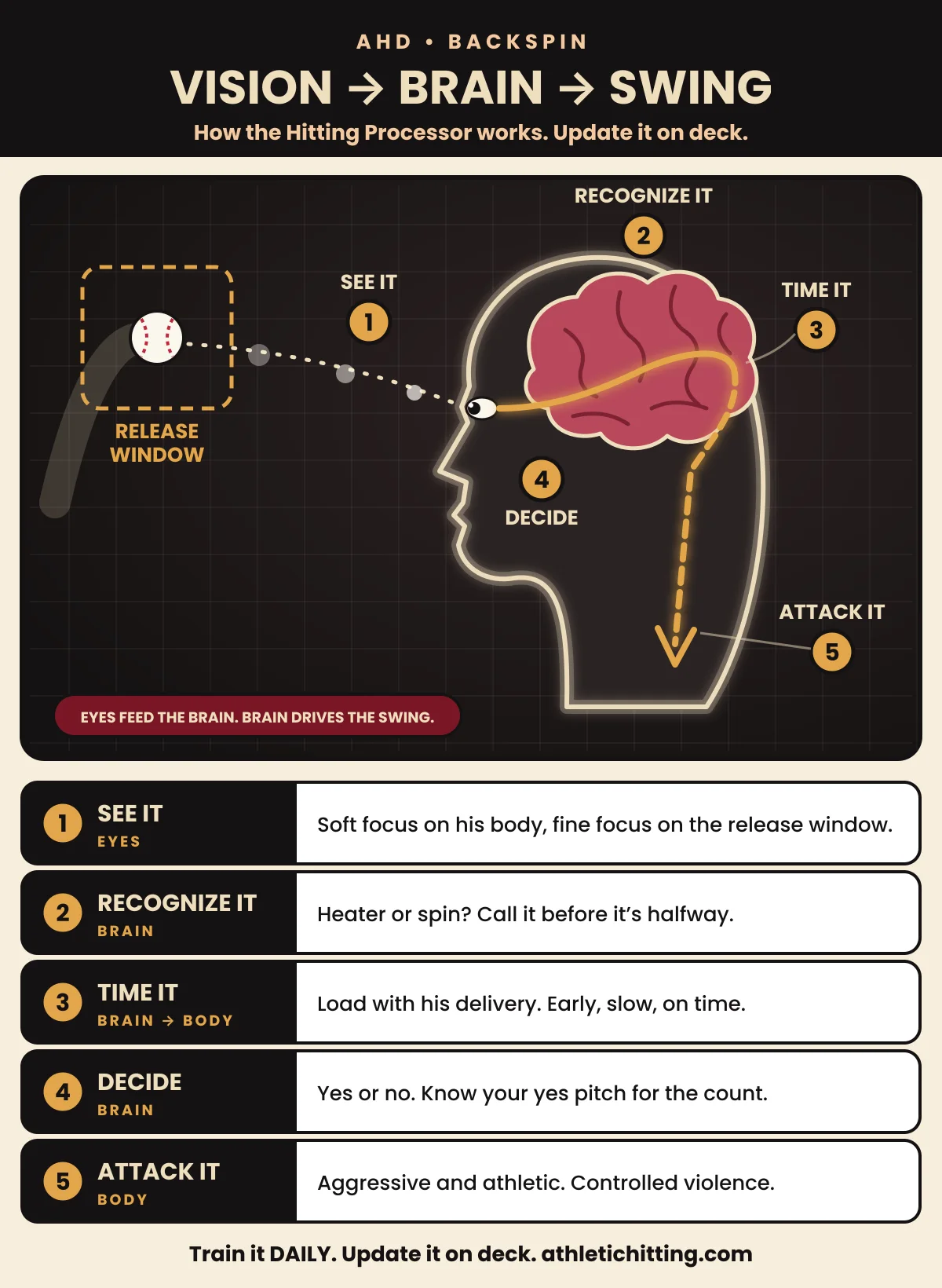
- See It (eyes). Soft focus on his body, then fine focus on the release window.
- Recognize It (brain). Heater or spin, called before the ball is halfway.
- Time It (brain to body). Load with his delivery until the rhythm is his.
- Decide (brain). Yes or no. Know your yes pitch for the count.
- Attack It (body). Aggressive and athletic. Controlled violence.
5. How do you practice an on-deck routine?
If it only happens in games, it won’t happen in games. Build it into practice.
- Live BP. Put the next hitter in an on-deck spot. They call every pitch and time every delivery. Their at-bat starts there.
- Video at home. Pause a pitcher’s delivery on TV or film, load with him, call heater or spin. Five minutes.
- Score it. After each at-bat, three questions: Where was his release? Was I on time? Did I swing at my yes pitch?
- Parents. Skip the swing coaching from the stands. After the game, ask what the pitcher was throwing. If your hitter knows, the processor is working.
The 5-minute daily Hitting Processor plan trains the same skills at home. AHD hitters build Mechanically Advantaged Angles (MAA) so the swing holds up; the on-deck routine makes sure that swing starts on time, at the right pitch.
6. Where should a hitter start?
If your hitter keeps getting surprised by the first pitch, the swing usually isn’t the problem. The information is. Take the free SwingChecker™ to see which pillar is the top priority right now.
Then train the processor on purpose. The Hitting Processor course is 16 lessons, most of them 10–20 minutes, and Lessons 1–3 are free. Gotta swing it to hit it, but you have to see it first.

THELESSON.
- On deck is the processor’s last rep
- Information first, swings last
- Know his release and rhythm
- Walk up with a yes pitch
Complete Hitters Are Built…Earned.
Want to go deeper? Read Build an On-Deck Routine That Keeps the Swing Fast and The 5-Minute Daily Hitting Processor Plan.
Quick answers
What should you do in the on-deck circle?
Watch the pitcher’s release window and tempo, call his pitches heater or spin, load and time his delivery, take two fast swings with your game bat, and lock a plan for the first pitch.
How long should an on-deck routine take?
About a minute. It should fit while the hitter ahead of you is batting and be the same every at-bat.
Should you swing a weighted bat on deck?
The AHD routine uses the game bat. The on-deck circle is for priming speed and timing, not for making the bat feel light.
Does an on-deck routine work in softball?
Yes. Release point, tempo and pitch type matter just as much in fastpitch, and timing the pitcher’s motion on deck is the same job.
Don’t collect drills. Build a complete hitter.
Complete Hitters Aren’t Born. They’re Built… and Earned.