By BK, Athletic Hitting Development
Complete Hitters Are Built… It’s Earned!
Key takeaways
- A good two strike approach in baseball widens the zone a little, shortens the swing a little and looks for the pitcher’s out pitch.
- The swing stays the same. Choking up and a quieter load make it shorter and easier to adjust, not a different swing.
- A foul ball can’t be strike three (unless it’s a foul tip the catcher holds), so fouling off a tough pitch buys another look; a foul bunt with two strikes is a strikeout.
- The two-strike mindset is ‘compete, don’t survive’: a hitter who plays scared with two strikes gets beat by the next pitch.
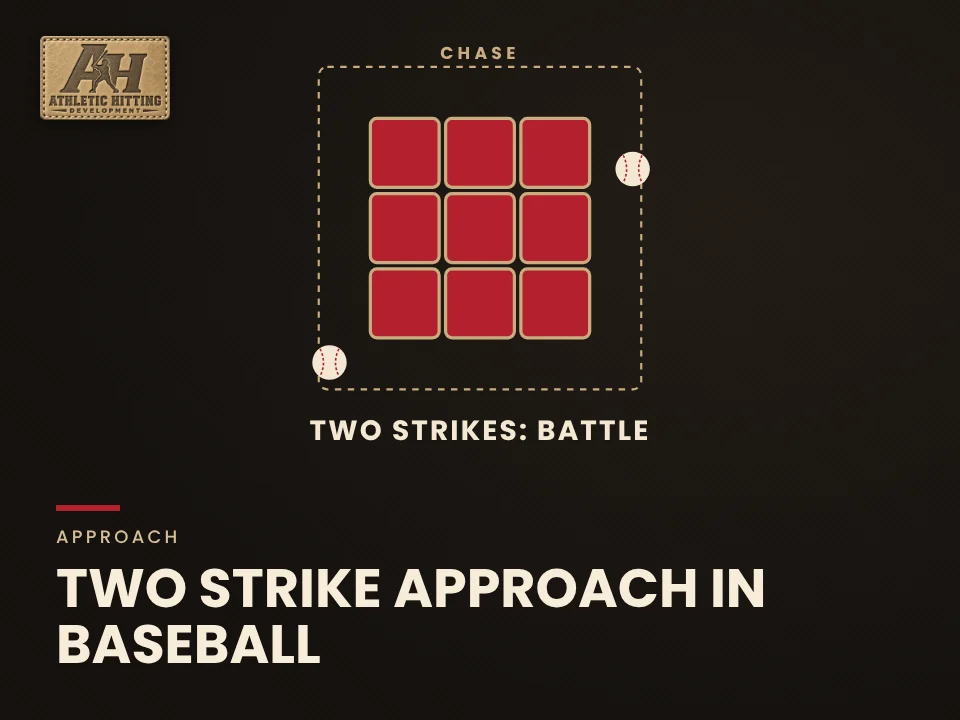
A two strike approach in baseball means the hitter widens his zone a little, shortens his swing a little and looks for the pitcher’s out pitch, so he can put the ball in play hard or foul off the tough one. The swing doesn’t get rebuilt with two strikes. The plan does.
A two strike approach in baseball widens the zone a little, shortens the swing with a choke-up and a quieter load, and looks middle while knowing the pitcher’s out pitch. The goal is to drive a strike, foul off the tough one and take the breaking ball in the dirt.
Train it: Mental Approach →I’ve coached and scouted this game for 52 years. The hitters I’d want up with two strikes aren’t the ones with the prettiest swing. They’re the ones who make the pitcher throw one more pitch, then one more.
Here’s what changes with two strikes, what doesn’t, what the pitcher is likely to throw, and how to train it so it shows up on game day.
1. What is a two strike approach in baseball?
Before two strikes, a hitter can hunt. He’s looking for one pitch in one spot, and he can take everything else. With two strikes, he can’t take a strike anymore. So the job changes from hunting to defending the plate and competing.
That doesn’t mean poking at the ball. The best two-strike hitters still swing to do damage. They just give themselves more margin: a little more plate to cover, a little less movement to manage and a little more time to decide.
Same swing. Different plan.
Kids get this backwards. They either change nothing and strike out on a pitch two inches off the plate, or they change everything and slap weakly at whatever comes. Neither works. The two-strike adjustment is small and specific.
2. How should a hitter adjust with two strikes?
Here’s the sequence I teach. It’s the same order every time, so it becomes automatic when he gets to two strikes.
- Widen the zone a little.Cover about a ball’s width off each edge of the plate, because the umpire’s zone isn’t yours to argue with two strikes.
- Choke up half an inch to an inch.Shorter lever, quicker barrel to the ball and better control; it is optional, but most hitters benefit.
- Quiet the load.A smaller, earlier load, or a shorter stride, gives him more time to see the ball and decide.
- Look middle, adjust out.Set eyes on the middle of the plate and react to pitches in, away and down rather than guessing a corner.
- Think line drive, middle of the field.A center-field approach keeps the barrel in the zone longest, so he can still hit the pitch he’s late or early on.
Notice what’s NOT on the list: a new stance, a new swing path, a ‘protect’ swing that cuts off the finish. If the base swing is sound, the adjustments are small. AHD hitters build Mechanically Advantaged Angles (MAA), and those angles are what let a shorter, quieter swing still produce hard contact.
If he struggles to stay through the middle of the field, that’s a swing issue, not a two-strike issue. Start with How to Hit Line Drives.
TWO STRIKES
SHORTEN UP.STAY DANGEROUS.
- Widen the zone a ball’s width
- Choke up, quiet the load
- Look middle, adjust out
- Line drive, middle of the field
SAME SWING. DIFFERENT PLAN.
3. What pitch will a pitcher throw with two strikes?
Usually his best put-away pitch. Every pitcher has an out pitch, and two strikes is when he reaches for it. Your hitter should know what it is before he steps in.
- The breaking ball in the dirt. A slider or curveball that starts as a strike and ends below the zone. This is the most common two-strike chase.
- The fastball up. Above the hands, where it looks hittable and is nearly impossible to get on top of.
- The changeup down. Same arm speed as the fastball, then it dies under the barrel.
- The fastball on the black. Paint the edge and hope the hitter freezes.
Watch the first two strikes. Watch what this pitcher threw to the hitters before him with two strikes. Ask the on-deck question: what has he used to get guys out today? That’s the pitch to be ready to lay off or fight off.
For the pitches themselves, see How to Hit a Slider and How to Hit a Changeup. For why hitters chase in the first place, read Why Your Kid Swings at Bad Pitches.
4. How do you battle and foul off pitches with two strikes?
Under the rules, a foul ball counts as a strike, but it can’t be the third strike. The one exception is a foul tip that goes sharply to the catcher and is caught; that’s strike three. So a foul ball buys another pitch. And a foul bunt with two strikes is a strikeout, so the bunt is off the table unless the coach calls it.
That rule is why battling matters. Every foul ball is another look at the pitcher, another chance for him to miss, and more pitches on his arm. Long at-bats wear pitchers down.
Fouling off pitches isn’t a trick swing. It’s the same swing that is a little late or a little early on a pitch he couldn’t square. You don’t practice ‘fouling off.’ You practice getting the barrel to tough pitches, and the fouls come with it.
| Two-strike pitch | Goal | What it looks like |
|---|---|---|
| Strike he can drive | Hit it hard | Line drive, middle of the field |
| Tough strike on the edge | Stay alive | Foul it off, get another pitch |
| Ball just off the plate | Defend if close | Foul it off rather than take a coin flip |
| Breaking ball in the dirt | Take it | Spit on it; it’s the pitcher’s best trap |
Battling is a mindset first: compete, don’t survive. A hitter who steps in thinking ‘don’t strike out’ is already playing scared. His body gets tight, his load gets late, and he chases the first pitch that looks close.
The mindset I want: ‘I’m still the most dangerous guy on the field. You have to beat me.’ That’s irrational confidence, and it’s a trait the best hitters share. It pairs with a simple routine: step out, one breath, one thought (‘middle, line drive’), step back in. My breathing routine for hitters works here.
Coaches and parents matter too. If a strikeout on a tough two-strike battle gets the same reaction as a lazy take, he learns that competing doesn’t count. Praise the eight-pitch at-bat, even when it ends in a strikeout.
This is the Mental Approach pillar of a complete hitter, and it’s trainable. Fastpitch families: the same principles show up in our softball two strike approach guide.
5. How do you stay calm with two strikes?
Most two-strike at-bats are lost between pitches, not during the swing. The hitter steps out thinking about the strikeout instead of the next pitch.
Give your hitter a short routine for two strikes:
- Step out and breathe.One slow breath to slow the heart rate down. My breathing routine is in Breathing Routine for Hitters.
- Say the plan in one line.Something like “on time, middle-away, compete.”
- Step in and see the ball.Eyes on the pitcher’s release, nothing else.
This is the Mental Approach pillar. Confidence in a 0-2 count isn’t luck. It’s built in practice, rep after rep.
Parents, one note from the fence: don’t yell “just put it in play” with two strikes. That cue turns an aggressive hitter into a defensive one. Say nothing, or say “compete.” The hitter already knows the count.
6. How do you practice a two strike approach?
Don’t collect drills. Put two strikes into the practice you already do.
- Two-strike rounds in BP. Last round of every session starts at 0-2. Choke up, quiet load, middle of the field. Track balls in play and fouls, not homers.
- Edge front toss. Feed pitches a ball’s width off the plate. He fights them off to the opposite side or pulls the inside one foul.
- Take the trap. Mix in tosses in the dirt; a swing at one ends the round. This trains the take.
- Count games. Live at-bats starting at 1-2. Points for balls in play and for every foul, double for a walk.
Film a few at-bats and check that the swing still looks like his swing, just shorter. Not sure if two-strike approach is his real issue? Run the free SwingChecker; it ranks his top priority across the 4 pillars in about 3 minutes. For the full plan, the Mental Approach course builds the routine, the compete level and the at-bat plan. If you want Coach to review his game at-bats with you, that’s part of our online hitting instruction. And if he’s getting beat by heat with two strikes, start with How to Hit a Fastball.

THELESSON.
- Know his out pitch
- Foul off the tough strike
- Spit on the one in the dirt
- Compete, don’t survive
Complete Hitters Are Built…Earned.
Want to go deeper? Read Swing Decisions Are a Skill and Why Hitters Choke, and 5 Fixes That Work.
Quick answers
Should you choke up with two strikes?
Most hitters benefit from choking up half an inch to an inch with two strikes. It shortens the lever and helps barrel control without changing the swing.
Is a foul ball with two strikes a strikeout?
No. A foul ball can’t be the third strike unless it is a foul tip caught by the catcher. A foul bunt with two strikes is a strikeout.
What should a hitter look for with two strikes?
Look middle of the plate and adjust out to the edges, while knowing the pitcher’s out pitch. Most pitchers go to a breaking ball low, a fastball up or a changeup down.
How do you stop striking out looking with two strikes?
Widen the zone a ball’s width off each edge and be ready to defend anything close. Train it with two-strike rounds and count games in practice so the bigger zone is a habit, not a hope.
Sources: MLB.com Glossary: Strikeout (foul ball and foul tip with two strikes) · CBS Sports: History of the two-strike bunt rule
Don’t collect drills. Build a complete hitter.
Complete Hitters Are Built… It’s Earned!
This article is part of the AHD guide Pitch Recognition & Timing. Start there for the full picture and every related article.