By BK, Athletic Hitting Development
Complete Hitters Aren’t Born. They’re Built… and Earned.
Key takeaways
- The ball doesn’t change shape until the bat compresses it. It doesn’t get smaller. It doesn’t defy gravity.
- A baseball is about 9 to 9¼ inches around. A fastpitch softball is about 12 inches around. Every pitch.
- When the ball looks like the moon or like cut-up aspirin, that’s your perception changing, not the ball.
- The ball doesn’t change and the bat doesn’t change. Get the barrel to the right place at the right time.
The ball doesn’t change shapes until it’s compressed by the bat!
The ball never changes size or shape until the bat compresses it; only your perception changes. So the job stays the same every pitch: get the barrel to the right place at the right time.
Train it: Hitting Processor Masterclass →It doesn’t get smaller. It doesn’t defy gravity. It is the same EXACT shape EVERY time it comes into the hitting zone.
At times it looks small. At times it seems so fast. At times it’s slow. But every dang one of those times, it’s the EXACT same size and shape.
1. The facts don’t change
A baseball is about 9 to 9¼ inches around, a little under 3 inches across. A fastpitch softball is about 12 inches around. Those numbers are the same on the first pitch of the season and the last pitch of the state championship. The same against the kid throwing 50 and the kid throwing 90.
The only time the ball changes shape is the instant the bat squashes it at contact. Before that, it’s the same ball. And your bat is the same bat. Same length, same weight, same barrel.
Same ball. Same bat. Every pitch.
FACT, NOT FEEL
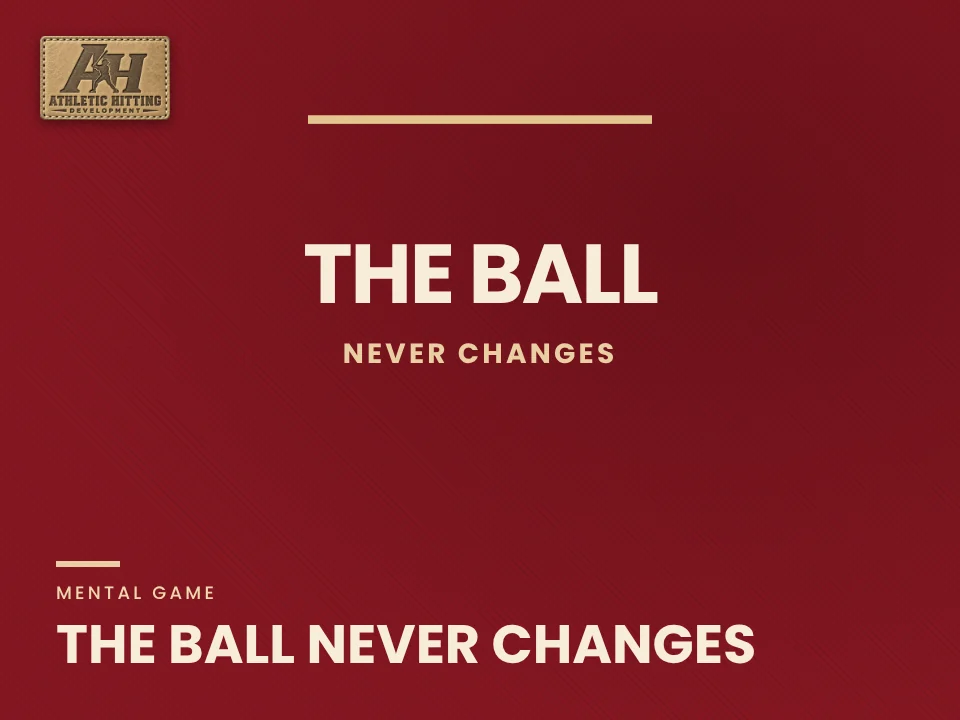
THE BALLNEVER CHANGES.
- It doesn’t get smaller.
- It doesn’t rise.
- Same size and shape, every pitch.
- Only the bat changes it, at contact.
MOON OR ASPIRIN, IT’S THE SAME BALL.
2. Moon or aspirin: why the ball looks different
There are many reasons the optical illusion of tracking a baseball or softball can vary from looking like the moon to looking like cut-up aspirin. Here are the big ones.
- Confidence and readiness. Researchers asked 47 softball players to pick the size of the ball from a set of circles right after their games. The players who hit well picked bigger circles. Only the ones hitting .500 or better picked the biggest one. The ball didn’t grow. Their perception did.
- Timing. When you’re on time, you see the ball longer and it feels slow. When you’re late, you rush, your head moves and the same pitch feels like a rocket.
- Tension and pressure. A tight body and a racing mind narrow what you see. That’s why a big moment can make the ball look tiny.
- Background and light. A white ball against a busy outfield, a bad backdrop or shadows is harder to pick up than a ball against a clean batter’s eye.
- Your eyes and your plan. Late in the pitch, the ball moves faster than the eyes can track smoothly. The brain fills in the rest from what it expects. A hitter with a clear plan expects the right pitch. A hitter guessing gets fooled.
None of those change the ball. Every one of them changes the hitter.
3. The fastball that “rises”
Hitters swear the high heater jumped. It didn’t. A fastball with a lot of backspin drops less than your brain expects, so it looks like it rises. It is still falling the whole way to the plate. The same thing works in reverse on a sinker or splitter that drops more than you expect.
The ball obeys gravity every single time. It’s our expectations that get fooled. That’s why pitch recognition and a plan matter so much. It’s also why we train the hitter’s brain, not just the swing.
4. So what’s the job?
If we go by fact here, the ball doesn’t change and the bat doesn’t change. So we just have to get the barrel to the right place at the right time, and nothing else matters.
Right place. Right time. That’s the whole job.
That’s what AHD trains across all 4 pillars. A swing built on Mechanically Advantaged Angles (MAA) gives the barrel a short, direct route. The Hitting Processor gets you on time and ready for the right pitch. Strength and explosiveness let you get there fast. And the mental approach keeps your perception from lying to you when it counts.
- Remind yourself of the factsSame ball, same bat. Say it in the on-deck circle when the pitcher looks nasty.
- Start on timeGet your trigger and gather going early. On-time hitters see a slower ball.
- Keep the plan simpleOne pitch, one zone. Expect the right thing and the ball looks bigger.
- Breathe the tension outOne slow exhale before you step in. A loose body sees more.

THELESSON.
- Same ball.
- Same bat.
- Right place.
- Right time.
- Nothing else matters.
Complete Hitters Are Built…Earned.
Want to go deeper? Read The Hitter’s Brain and The #1 Common Trait of Elite Hitters.
Quick answers
Does a baseball or softball change size during a pitch?
No. A baseball is about 9 to 9¼ inches around and a fastpitch softball is about 12 inches around, every pitch. The ball only changes shape for an instant when the bat compresses it at contact.
Can a fastball really rise?
No. A fastball with a lot of backspin drops less than the hitter expects, so it looks like it rises. It is still falling the whole way to the plate.
Why does the ball look bigger when I’m hitting well?
Researchers asked softball players to pick the ball’s size from a set of circles after games. Players who hit well picked bigger circles. Confidence, readiness and timing change how the ball looks, not how big it is.
What should a hitter focus on if the ball looks small?
The facts. The ball and the bat are the same every time, so the job is the same: get the barrel to the right place at the right time. Simplify the plan, start on time and trust your routine.
Why does the ball look so fast when I’m struggling?
When you’re late, you rush, your head moves and the same pitch feels like a rocket. Tension and a racing mind narrow what you see. Start on time, keep the plan simple and breathe the tension out before you step in.
Sources: Witt & Proffitt, Psychological Science (2005), via Live Science · Tufts Journal on the rising-fastball illusion
Don’t collect drills. Build a complete hitter.
Complete Hitters Aren’t Born. They’re Built… and Earned.
This article is part of the AHD guide Pitch Recognition & Timing. Start there for the full picture and every related article.