
By BK, Athletic Hitting Development
Complete Hitters Aren’t Born. They’re Built… and Earned.
Key takeaways
- Before the pitch, use a soft focus on the pitcher’s body. Don’t stare a hole in anything yet.
- As the arm comes up, shift to a hard focus on the release window, the small area where the ball comes out of the hand.
- Pick the ball up out of the hand, read it early, and keep the head quiet so the picture stays steady.
- Seeing is a skill. It gets better when you train it DAILY, not just on game day.
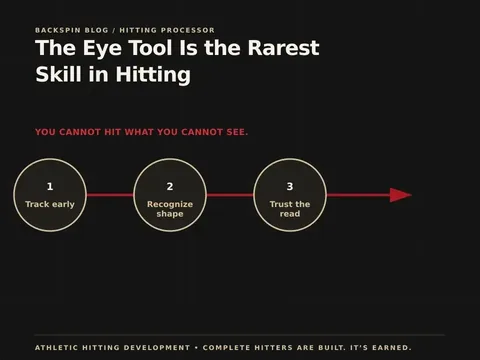
Look at the pitcher’s release window, the small spot where the ball comes out of the hand. Start with a soft focus on the pitcher’s body, shift to a hard focus on that window as the arm comes up, then pick the ball up early and track it with a quiet head.
Look at the pitcher's release window, the spot where the ball comes out of the hand. Use a soft focus on the pitcher's body first, shift to a hard focus on that window as the arm comes up, then pick the ball up early and track it with a quiet head.
Train it: Hitting Processor → Free tool: Pitch Recognition Trainer →Parents ask me this all the time: “Coach, my kid keeps swinging at junk. What is he supposed to be looking at?” Great question. Most hitters were told “watch the ball” and nothing else. That’s like telling a driver “watch the road.” True, but it doesn’t teach anything.
Where your eyes go, and WHEN they go there, is the first job of the Hitting Processor: see it, time it, decide, attack it. If the eyes are late, everything after them is late too.
1. Where should a hitter look before the pitch?
Before the pitcher starts, don’t lock onto anything. Use a soft focus: look at the pitcher’s whole body, relaxed, like you’re looking at a picture instead of a single dot. Staring hard too early wears the eyes out and makes hitters tense.
A lot of hitters like to rest their eyes on the pitcher’s cap or chest while he gets his sign. That’s fine. The point is calm eyes, calm body, ready to go.
Soft focus first. Hard focus when it counts.
2. What is the release window, and why does it matter?
Every pitcher lets the ball go from about the same spot, pitch after pitch. That spot is his release window. For a righty throwing over the top it’s up and to his arm side, a little above his head. For a sidearm guy it’s lower and wider. In fastpitch, it comes out low near the hip.
As the pitcher’s arm comes up, shift your eyes from soft focus to a hard focus on that window. Now you’re waiting where the ball will appear, instead of chasing it after it’s already on the way. That’s how good hitters pick the ball up EARLY.
WHERE THE EYES GO
SOFT, THENHARD.
- Soft focus on the pitcher’s body
- Hard focus on the release window
- Pick it up out of the hand
- Quiet head, read the spin
SEE IT EARLY. DECIDE EARLY.
Watch the first few warm-up pitches from the on-deck circle and find the window. Every pitcher is a little different, so do this every game.
3. How do you track the ball once it leaves the hand?
Once the ball is out, your eyes go with it. The early part of the flight is where you get the most information: speed, spin and location. That’s where a hitter decides heater or hanger, strike or ball, swing or take.
- Read it early. The decision is made out front, not when the ball is on top of you.
- Keep the head quiet. A head that jumps makes the picture jump. Let the body turn underneath a still head.
- Both eyes on the pitcher. Set up so your head is turned enough that both eyes see the pitcher clearly.
- See spin, not just a white ball. The spin tells you what’s coming before the break shows up.
In my experience coaching hitters, the ones who say “I never saw it” usually lost it EARLY, not late. They picked it up late, rushed, and the head flew. Fix the start and the rest gets easier.
4. What are the most common eye mistakes hitters make?
| Mistake | What it looks like | The fix |
|---|---|---|
| Hard focus too early | Tense, staring, eyes tired by the pitch | Soft focus on the body until the arm comes up |
| Looking at the glove side | Picks the ball up late, always rushed | Find the release window in warm-ups |
| Head moving with the stride | The ball seems to jump or disappear | Quiet head, let the body work underneath it |
| Watching the ball, not reading it | Chases spin, freezes on strikes | Read spin and location early, decide out front |
| Only training eyes at games | Great in BP, lost against live arms | A few minutes of eye work every day |
5. How do you train a hitter’s eyes at home?
Seeing is a SKILL. You can train it like a swing. A few minutes a day beats an hour once a week.
- Find the windowOn every video or live pitcher you watch, call out where the ball comes out of the hand before it does.
- Soft to hardHave a partner start a throwing motion. Stay soft on the body, go hard on the window as the arm comes up.
- Call it earlyOn front toss or live arms, call “yes” or “no” out loud before the ball is halfway. Strike or ball, heater or hanger.
- Read the spinMark balls with a stripe or colored dots and name the spin or color as early as you can.
- Do it dailyFive to ten minutes on non-game days. The free Pitch Recognition Trainer is a great place to start.
If you want more on this, read The Eye Tool: the rarest skill in hitting and how Saguaro hitters see spin every day. Softball players, train the eyes without swinging is built for you.

THELESSON.
- Find the window every game
- Call it early, out loud
- Read spin, not a white ball
- Train the eyes DAILY
Complete Hitters Are Built…Earned.
6. Where do the eyes fit in building a complete hitter?
The eyes feed the Hitting Processor, one of the 4 Pillars of a Complete Hitter along with the Swing, Strength & Explosiveness, and the Mental Approach. A beautiful swing with Mechanically Advantaged Angles (MAA) still needs good information to work with. Bad information in, bad swing decisions out.
Not sure which pillar is holding your hitter back? Run the free SwingChecker™; it takes about 3 minutes and ranks the top priority. If it’s the eyes and decisions, the Hitting Processor course trains them every day, 10–20 minutes at a time, with Lessons 1–3 free.
Don’t collect drills. Build a complete hitter. See it early, decide early, then be aggressive and athletic. It’s a great day to hit!!
Want to go deeper? Read The Eye Tool Is the Rarest Skill in Hitting and They Didn’t Have a True Ace. They Just Smashed..
Quick answers
Should you watch the ball hit the bat?
Try to keep the head quiet and the eyes on the contact area, but the real work happens earlier. Picking the ball up out of the hand and reading it early matters far more than seeing the exact moment of contact.
Where should my eyes be in my batting stance?
Turn your head so both eyes see the pitcher clearly, keep it level, and start with a soft focus on the pitcher’s body. Shift to a hard focus on the release window as the arm comes up.
What is soft focus and hard focus in hitting?
Soft focus is a relaxed look at the whole pitcher before he delivers. Hard focus is a narrow, sharp look at the release window as the ball is about to come out of the hand. Going soft to hard keeps the eyes fresh and ready.
Why does my child say they can't see the ball?
Often they are picking the ball up late, moving their head, or staring too hard too early. Teach the release window and a quiet head first. If the problem continues, have their vision checked by an eye doctor.
Don’t collect drills. Build a complete hitter.
Complete Hitters Aren’t Born. They’re Built… and Earned.