By BK, Athletic Hitting Development
Complete Hitters Are Built… It’s Earned!
Key takeaways
- In a study of 20 youth hitters, the same players moved their trunk differently off a tee than off front toss.
- The tee strips out timing and decisions. A moving ball brings them back, and the body organizes the swing around them.
- The tee still has a job: feel work, a checkpoint and building Mechanically Advantaged Angles (MAA).
- Make moving-ball reps the backbone of practice. Use the tee with a purpose.
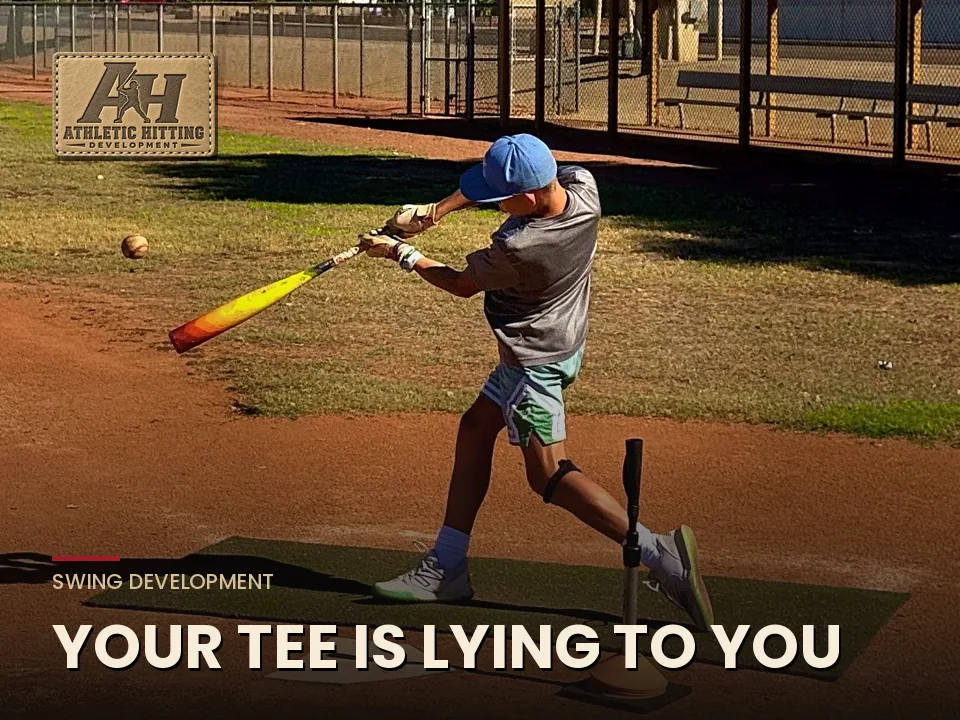
Your tee is telling you a story about your swing. It isn’t the whole truth.
Hitting off a tee isn’t bad, but it isn’t the whole truth: a still ball removes timing and decisions, so hitters move differently than they do against a moving ball. Use the tee with a purpose and make moving-ball reps the backbone of practice.
Train it: Swing Structure & Mechanics Masterclass →Same hitter. Same bat. Different swing.
1. What the study found
Bordelon and colleagues studied 20 youth baseball players, average age about 14. Each hitter swung two ways: off a tee and off front toss. Then the researchers measured how the body moved.
The trunk didn’t move the same way. Off the tee, hitters kept the trunk rotated more toward the back side during the load. And it stayed that way through the first 67% of the acceleration phase of the swing. Both differences were statistically significant (p=.001 and p<0.001).
Put simply: the same hitters organized their swing differently depending on whether the ball was sitting still or coming at them.
Be clear on what this does and doesn’t say. The study shows the two swings are different. It doesn’t crown one of them “correct.” But if the swing you groove in practice isn’t the swing your body uses against a moving ball, that should change how you spend your reps.
2. Why a still ball changes the swing
A tee asks one question: can you hit a ball that isn’t going anywhere? No pitcher. No speed to read. No decision.
A moving ball asks every question at once. That’s the Hitting Processor: See It → Recognize It → Time It → Decide → Attack It. On a tee, the first four steps disappear. All that’s left is Attack It, and even that happens on your schedule.
So the body takes a different route. A moving ball makes your load sync with something outside of you. A tee never does.
The tee trains the swing you want. The moving ball trains the swing you’ll actually use.
That’s Feel vs Real. A hitter who looks great on the tee and falls apart in games isn’t a mystery. He may have been grooving a swing he doesn’t take against a pitch. Video and ball flight tell the truth.
SAME HITTER. DIFFERENT SWING.
TEE ISA TOOL.
- Use the tee for feel.
- Use it as a checkpoint.
- Build your MAA positions on it.
- Prove it on a moving ball.
MOVING-BALL REPS ARE THE BACKBONE.
3. The tee still has a job
I’m not telling you to throw the tee in the trash. I’m telling you to give it a job description.
- Feel work. Isolate one piece, like pulling back the bow with the back elbow or finishing balanced, without a timing problem in the way.
- A checkpoint. Set the tee at one location, like up and in or down and away, and check whether the barrel stays above the ball and works on the plane of the pitch.
- MAA positions. Slow, filmed reps to build Mechanically Advantaged Angles: hip hinge and spine tilt in the setup, a launch above the ball, bat lag and an athletic front side.
Remember, an MAA is an advantage, not a rule. The tee helps you find it. The moving ball tells you whether you can keep it.
4. Build practice around a moving ball
Here’s a simple order that keeps the tee in its lane:
- Tee with a purpose10–15 swings with ONE feel. Say the feel out loud before you start.
- Front tossSame feel, moving ball. Did it survive? If not, that’s your real work.
- Mixed tossChange speed and location so timing and decisions come back into the swing.
- Machine or live armA real release and real speed. Now the whole Hitting Processor is working.
- Video checkFilm one tee swing and one moving-ball swing. Put them side by side. Look at the trunk in the load.
Most swings come from steps 2 through 4. The tee is the appetizer, not the meal.
5. For parents and coaches
Parents: if your hitter’s only home practice is a tee in the garage, that isn’t nothing, but it isn’t enough. Short front toss behind a screen fixes that. And don’t judge his swing by his tee swing. Judge it by what happens when the ball is coming.
Coaches: a team practice with five tee stations and one toss station is upside down. In our team training and at camps & clinics, we flip it. And fix the earliest breakdown first. If the load looks different on toss than on the tee, fix it on toss, because that’s the swing that shows up in the game.
Not sure which piece to work on? The free SwingChecker™ takes about 3 minutes and points to your first priority.
Quick answers
Is hitting off a tee bad for young hitters?
No. It’s a good tool for feel work, checkpoints and building positions. The problem is making it the main course, because the same hitters move differently against a moving ball.
Why does my kid hit great off the tee but struggle in games?
The tee removes timing and decisions. In one study of 20 youth hitters, the trunk moved differently off a tee than off front toss, so a great tee swing doesn’t guarantee a great game swing.
How much tee work versus front toss should a hitter do?
The study didn’t test a ratio. My coaching judgment: start with a short, focused tee round, then spend most of the day’s swings on a moving ball.
Is front toss better than tee work?
Front toss adds timing and a moving ball, so it transfers better to games. The tee is still useful for feel work, checkpoints and building Mechanically Advantaged Angles (MAA).
Research: Bordelon et al., “Kinematics of Hitting in Youth Baseball: Implications for Skill Development,” International Journal of Sports Medicine (2024). This was a small study of 20 youth baseball players, summarized here from the published abstract; it shows the swing changes between tee and front toss but doesn’t test which practice method builds better game hitters.
Don’t collect drills. Build a complete hitter.
Complete Hitters Are Built… It’s Earned!
This article is part of the AHD guide Baseball Hitting Drills by Age. Start there for the full picture and every related article.