By BK, Athletic Hitting Development
Complete Hitters Aren’t Born. They’re Built… and Earned.
All hitters are different. All swings are different. But there are some very familiar movements and moments in the swing process, and in those moments there are plenty of commonalities.
Mechanically Advantaged Angles (MAA) are body and bat angles, like spine tilt, the back elbow slot, bat lag and an athletic front side, that give a hitter leverage. They’re an advantage, not a rule: every MAA a hitter owns stacks the odds in his favor.
Train it: Swing Structure & Mechanics Masterclass →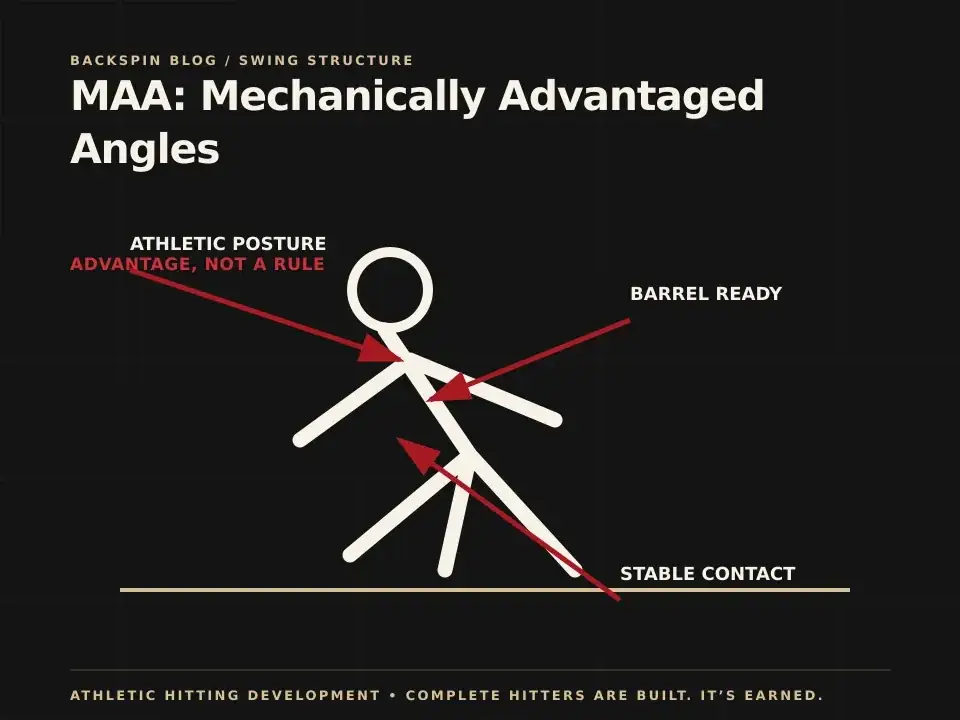

If the hitter has or keeps certain angles, he has an advantage.
1. What is MAA?
MAA stands for Mechanically Advantaged Angles, and they are just that. If a hitter gets into, or keeps, certain angles, he has an advantage. The body and the bat are set up to create leverage, stay on plane longer and deliver force into the ball without having to muscle it.
Sounds like science. It is logical. And when you see it in a swing, it’s a beauty, as they say on the sheet of ice.
2. Every swing is different
I’ve been around this game for 52 years, and nobody swings exactly like anybody else. Body types, strength, timing and style are all different. That’s why AHD doesn’t teach one swing for everybody.
But study enough great swings and the same angles keep showing up at the same moments. That’s not a coincidence. Those angles make hitting easier.
MAA
FIND YOURADVANTAGE.
- Every swing is different
- Angles create leverage
- Advantage, not a rule
ANGLES ARE A TOOL.
3. Find MAAs anywhere in the swing
We can go to any part of the swing process and find MAAs that give hitters an advantage. A few examples from the AHD swing structure:
1. Setup: Athletic posture
Hips hinged and spine tilted so the body can turn and still work to every pitch height.
2. Load: Pull back the bow
The back arm sets an angle that keeps the hands connected and ready to deliver, not flying away from the body.
3. Launch: Above the ball
Hands and barrel stay above the ball’s path coming in, giving the barrel a short, direct route to the hitting zone.
4. Pre-contact: Bat lag
The barrel stays behind the hands, staying inside the ball, so the bat whips through late instead of casting early.
5. Contact: Front-side brace
An athletic front leg stops the body’s forward drift and turns that energy into bat speed.

4. An advantage, not a rule
Here’s the part people miss. Not all hitters have all the MAAs all the time. That’s common, even at the highest levels. Plenty of great hitters lose an angle here or there and still find a way to square it up.
It’s an ADVANTAGE. Not a RULE.
Rule thinking
Every hitter must look exactly like this, or the swing is wrong. Coaches chase positions and players get robotic.
Advantage thinking
Every MAA a hitter owns stacks the odds in his favor. We add the angles that fit his body and his swing, one at a time.
That’s how we use MAA at AHD. We find which angles a hitter already owns, which ones he loses and which ones would give him the biggest edge. Then we build them in so they hold up against real pitching. MAA is one of the have-tos in the AHD swing structure.
5. For players and parents
- Players: film one swing from the side. Pause it at setup, launch and contact, and look for the angles in this article.
- Parents: don’t chase a perfect-looking swing. Ask which angle would give your hitter the biggest advantage right now.
- Coaches: teach the angle and why it helps. A hitter who understands the advantage will keep it under pressure.
6. Build the complete hitter
Don’t collect drills. Build a complete hitter.
Start with SwingChecker™ to find your #1 priority for free. The AHD Academy Swing Structure lessons build these angles one at a time, and the first 3 lessons of every course are free. Want to know which MAAs your hitter owns? See online remote baseball and softball training with BK.

THELESSON.
- Find your angles.
- Keep them through contact.
- Don’t copy a clone.
- Test it on video.
Complete Hitters Are Built…Earned.
Quick answers
What are Mechanically Advantaged Angles (MAA) in hitting?
MAA are body and bat angles that give a hitter a mechanical advantage. If a hitter gets into or keeps certain angles, the body and bat are set up to create leverage, stay on plane longer and deliver force to the ball without muscling it.
Does every good hitter have every MAA?
No. Not all hitters have all the MAAs all the time, even at the highest levels. MAA is an advantage, not a rule. Each angle a hitter owns stacks the odds in his favor.
Where in the swing do MAAs show up?
In every part of the swing process: setup posture, the back elbow in the load, bat lag at launch, staying above and inside the ball before contact, and an athletic front side at contact.
How can I check my hitter’s swing for MAAs at home?
Film one swing from the side. Pause it at setup, launch and contact, and look for the angles: hips hinged with spine tilt, hands and barrel above the ball, bat lag and an athletic front side.
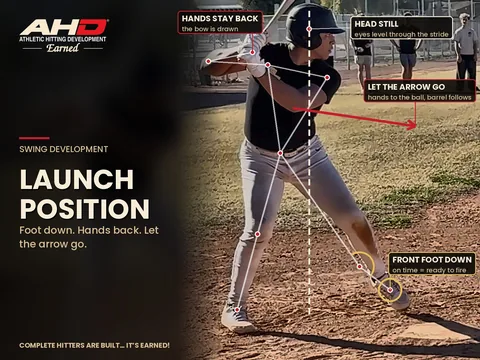
From the 2015 archive: Launch Position in Hitting: The Power-Load Position.
This article is part of the AHD guide Baseball Swing Mechanics. Start there for the full picture and every related article.