By BK, Athletic Hitting Development
Complete Hitters Aren’t Born. They’re Built… and Earned.
Key takeaways
- Blast Motion is the deeper measuring tool: the sensor is $174.99 and full membership is $14.99 a month or $99 a year.
- Diamond Kinetics is built to make kids want to swing: the sensor is about $50, and its best-value bundle with 12 months of DK+ is $150, renewing at $125 a year. It’s iOS only.
- Both read swing data from a sensor on the knob; neither one sees the pitch, the timing or the decision.
- Pick by the hitter: Blast for a serious high school or college hitter with a coach; Diamond Kinetics for a younger hitter who needs reasons to get reps.
Blast Motion is the better choice for a serious hitter who wants detailed swing metrics and a coach to read them. Diamond Kinetics is the better choice for a younger hitter who needs fun, game-style reps. Both cost real money once you add the subscription, and neither replaces knowing what to train.
Blast Motion costs $174.99 plus $14.99 a month or $99 a year and gives deeper swing metrics for serious hitters. Diamond Kinetics costs about $50, or $150 with 12 months of DK+, and is built around games for younger hitters; it’s iOS only.
Train it: Athletic Development → Free tool: Exit Velocity & Bat Speed Calculator →Parents ask me which bat sensor to buy almost as often as they ask which bat. Both of these attach to the knob of the bat, both send swing data to your phone over Bluetooth, and both need a paid plan to unlock the good stuff.
Here’s how they compare, from each company’s own pages (checked November 2026).
1. Blast Motion vs Diamond Kinetics side by side
| Blast Motion | Diamond Kinetics | |
|---|---|---|
| Sensor price | $174.99 | About $50 |
| Subscription | $14.99/month or $99/year; 30-day trial | DK+; $150 bundle with sensor and 12 months, renews at $125/year |
| Phones | Check Blast’s site for your device | iOS only (no Android) |
| Built for | Players, coaches and teams who want swing metrics | Younger hitters: games, missions, MLB-themed content |
| Softball | Yes | Yes |
Blast also calls itself the Official Bat Sensor Technology of Major League Baseball, a deal that goes back to 2016. Diamond Kinetics lets one subscription cover up to four player profiles, which helps a family with more than one hitter.
BAT SENSORS
BLASTOR DK?
- Blast: deeper metrics
- DK: games for kids
- Count the subscription
- Who reads the numbers?
MEASURE IT, THEN TRAIN IT
2. Which bat sensor should I buy?
- High school or college hitter with a coach: Blast. The metrics are deeper, and a coach can use them to check whether a swing change is real.
- Younger hitter who needs reasons to swing: Diamond Kinetics. It’s built to turn reps into games.
- On a budget: Diamond Kinetics costs less up front. Add up a full year of either one before you buy.
- Android family: Diamond Kinetics is iOS only; check Blast’s device list.
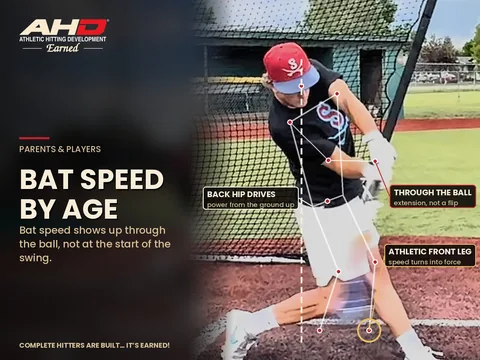
Then ask the real question: who reads the numbers? A sensor shows bat speed and attack angle. It doesn’t tell you why the number is low or what to do about it. Our bat speed by age chart helps with the first part.
3. What a bat sensor can’t see
A knob sensor measures the bat. It can’t see the pitch, so it can’t tell you if the swing was on time, if it was a good pitch to swing at, or if the hitter saw the changeup early. Those decide at-bats.
That’s why I don’t let a hitter chase a number in the cage. Chase the sound. "Ball — powdered." That’s the sound of a barreled ball, and it’s worth more than a pretty number on a swing that missed.
Measure the swing. Train the hitter.
4. How to use a bat sensor the right way
- Set a baseline.Same bat, same tee height, 10 swings at full intent. Write down the average, not the best.
- Pick one number.Usually bat speed. Don’t chase five metrics at once.
- Train the body.Bat speed is built underneath the swing: strength, rotation and speed work.
- Retest the same way.Same bat, same setup, every 4–6 weeks. If the number moved and the game swing didn’t, keep working.
For the training side, see how to increase bat speed and bat speed vs exit velocity. AHD’s Complete Hitter System puts it together with timing, pitch recognition and the mental approach.

THELESSON.
- Pick one number
- Train the body
- Retest the same way
- On time beats fast
Complete Hitters Are Built…Earned.
Want to go deeper? Read Bat Speed by Age: Baseball and Softball Benchmarks (2026 Chart) and Bat Speed vs Exit Velocity: What’s the Difference and Which Matters More?.
Quick answers
How much does Blast Motion cost?
Blast lists the baseball and softball sensor at $174.99, with membership at $14.99 a month or $99 a year for new subscribers (checked November 2026). Sensor purchases include a 30-day membership trial.
How much does Diamond Kinetics cost?
Diamond Kinetics lists its bat sensor at about $50 and a best-value bundle of the sensor plus 12 months of DK+ at $150, renewing at $125 a year (checked November 2026).
Is Blast Motion or Diamond Kinetics better for youth?
For younger hitters who need reasons to swing, Diamond Kinetics is built around games and challenges. For older hitters with a coach reading the data, Blast gives deeper metrics.
Does Diamond Kinetics work on Android?
No. Diamond Kinetics says its bat sensor and app are iOS only.
Sources: Blast Motion: FAQ, sensor and membership pricing (checked Nov 2026) · Blast Motion: Blast Motion Review 2026 (Official Bat Sensor of MLB since 2016) · Diamond Kinetics: the DK bat sensor (checked Nov 2026) · Diamond Kinetics: baseball bundle and DK+ subscription (checked Nov 2026) · Diamond Kinetics: DK+ membership (checked Nov 2026) · Diamond Kinetics: $150 sensor + 12-month DK+ bundle (checked Nov 2026)
Don’t collect drills. Build a complete hitter.
Complete Hitters Aren’t Born. They’re Built… and Earned.