By BK, Athletic Hitting Development
Complete Hitters Aren’t Born. They’re Built… and Earned.
Key takeaways
- To increase bat speed, get stronger and more powerful, especially rotationally, and train the swing to use that power in the right order.
- Swing with INTENT. Hitters who never swing hard in practice don’t swing hard in games.
- Med ball throws, jumps and lifting help most when a hitter is behind in strength and power; they help less once a hitter is already strong and fast.
- Measure bat speed every few weeks, and always check that speed still finds the ball. Bat speed you can’t time is just a fast miss.
To increase bat speed, build a stronger, more powerful body, train it to rotate in the right sequence, and swing with full intent every day you train. Measure it every few weeks so you know what’s working.
Increase bat speed by getting stronger and more powerful, training the body to rotate in the right order, and swinging with full intent in short sets. Measure it every few weeks and make sure the extra speed still finds the ball.
Train it: Athletic Development → Free tool: Exit Velocity & Bat Speed Calculator →Every hitter wants more bat speed, and every week there’s a new gadget promising it. Some of it helps. A lot of it is noise.
Here’s what I’ve seen work over 52 years of playing, coaching and scouting, and where the research agrees.
1. Where does bat speed actually come from?
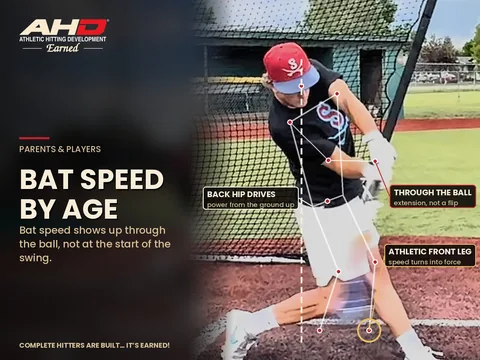
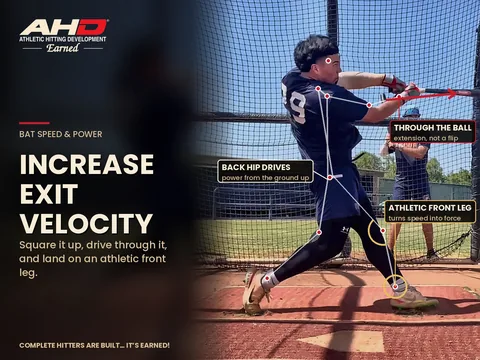
Bat speed is the end of a chain. The ground pushes back, the legs and hips start the turn, the torso follows, and the arms and barrel finish it. If any link is weak or out of order, the barrel pays for it.
- Strength and power. A body that can produce more force, fast.
- Sequence. Lower half first, then torso, then arms and barrel.
- Positions. AHD hitters build Mechanically Advantageous Angles (MAA), so the power they make goes into the barrel instead of leaking out.
- Intent. Training to swing hard, not just swing pretty.
For the engine side of it, read Rotational Power for Hitters and Bat Speed Starts With Athletic Power.
2. What actually increases bat speed?
- Get stronger.A real strength program for the legs, hips, trunk and upper back, done consistently.
- Train rotational power.Med ball throws and jumps teach the body to make force fast and in the right direction.
- Swing with intent.Short, max-effort swing sets with full rest, not 200 tired swings.
- Fix the leaks.A swing that sequences well turns the same strength into more barrel speed.
- Measure and retest.Check bat speed every few weeks so you train what works and drop what doesn’t.
Med ball work is a good example of doing the right thing for the right hitter. In a 2026 case study, 11 college players did med ball side throws with a 3-kg ball twice a week for seven weeks. The players who started with lower swing speed and less strength and power improved. The players who were already fast and powerful didn’t. More on that in Do Med Ball Throws Increase Bat Speed?
BAT SPEED
STRONGER.FASTER.
- Build strength and power
- Sequence: legs, hips, hands
- Swing with intent
- Measure every few weeks
SPEED HAS TO FIND THE BALL
3. What doesn’t increase bat speed?
Plenty of things feel like work and don’t move the number.
- Hundreds of tired swings. Fatigue trains a slower swing.
- A bat that’s too heavy. Swinging something you can’t control teaches you to muscle it.
- Gadgets with no plan. A trainer bat can help inside a plan; on its own it’s a toy.
- Only arm strength. Arms finish the swing. They don’t start it.
- Never measuring. If you don’t test it, you don’t know it moved.
Weighted bats can help when they’re used right. See Weighted Bat Training: Pros and Cons before you buy one.
4. What does a weekly bat speed plan look like?
Keep it simple and consistent. A starting point for a high school or college hitter in the offseason:
| Day | Focus | What it looks like |
|---|---|---|
| Day 1 | Strength | Lower body and trunk lifts, then a few med ball throws |
| Day 2 | Swing intent | Short max-effort swing sets with full rest, measured |
| Day 3 | Power | Jumps and rotational med ball throws, then light tee work |
| Day 4 | Strength | Upper back, hips and trunk, then intent swings off the tee |
| Every day | Hitting Processor | Pitch recognition and timing, so speed finds the ball |
Adjust it to the hitter’s age, training history and season. In-season, cut the volume and keep the intent. For drills to plug in, see Bat Speed Drills That Transfer to Games and, for fastpitch hitters, Softball Bat Speed Drills.
No. The right plan depends on what’s holding the hitter back. A hitter who is strong but sequences poorly needs swing work. A hitter with a clean swing and a weak body needs the weight room. A hitter who swings hard in the cage and soft in games needs the Hitting Processor and the mental side.
- Younger or newer to training: strength, jumps and throws usually move bat speed the most.
- Strong but leaky: clean up the sequence and the positions so the power reaches the barrel.
- Fast in the cage, slow in games: train timing and decisions so you trust the swing.
- Fastpitch hitters: the same principles apply, with less time from 43 feet, so on-time matters even more.
That’s why we test before we train. The med ball study above is a good reminder: the same work helped the hitters who needed it and did little for the ones who didn’t. Find the hitter’s real limiter first, then build the plan around it. "Two choices: A. Do everything in your control. B. Anything but A." Strength, effort and the work you put in every day are all in your control.
5. Is more bat speed always better?
More bat speed is good. More bat speed you can’t time is a fast miss. The swing still has to start on time and match the pitch.
Fast is good. Fast and on time is a weapon.
That’s why we train the Hitting Processor every day alongside the body. Read Bat Speed Isn’t Timing and Is Bat Speed Everything?
And when it all lines up, you’ll hear it. "Ball — powdered." That sound is the barrel arriving fast and on time. Chase that sound, not a pretty swing.
6. How do you know your bat speed is going up?
Measure it the same way every time: same sensor or method, same bat, same warm-up, best of a few swings. Retest every three to four weeks.
Compare your numbers to your age group in our bat speed by age chart, and plug them into the free exit velocity and bat speed calculator. Then run the free SwingChecker to see whether strength, the swing or timing is your real priority.
If the body is the limiter, the Athletic Development course builds strength, speed and rotational power in 24 lessons. Lessons 1–3 are free, starting with Test Day: know your starting point.
THELESSON.
- Power comes from the ground
- Intent beats volume
- Right tool, right hitter
- Test, don’t guess
Complete Hitters Are Built…Earned.
Want to go deeper? Read Bat Speed by Age: Baseball and Softball Benchmarks (2026 Chart) and Bat Speed Drills That Actually Transfer to Games.
Quick answers
What is the fastest way to increase bat speed?
For most young hitters, getting stronger and more powerful while swinging with full intent moves bat speed the most. Measure it every few weeks so you know it’s working.
Do bat speed trainers work?
They can help inside a plan that also builds strength and sequencing. On their own, without measuring, they’re just another bat to swing.
Does lifting weights increase bat speed?
Getting stronger in the legs, hips, trunk and upper back gives the swing more to work with. It helps most when a hitter is behind in strength and power.
How often should you train bat speed?
A few short, high-intent sessions a week beat long, tired ones. Cut volume in-season and keep the intent.
Don’t collect drills. Build a complete hitter.
Complete Hitters Aren’t Born. They’re Built… and Earned.