By BK, Athletic Hitting Development
Complete Hitters Aren’t Born. They’re Built… and Earned.
Key takeaways
- Light eyes do catch more glare. They have less pigment in the back of the eye to soak up extra light.
- The numbers say it doesn’t matter. Studies of big league day and night splits found no real gap tied to eye color.
- Glare is an equipment and routine problem: eye black, tinted lenses, a good hat and a plan to pick up the ball early.
- Eye color is never a reason you can’t hit. Train the Hitting Processor and control what you can control.
No. Light eyes do pick up more glare in bright sun, but when people ran the big league numbers, blue-eyed hitters hit just about the same in day games as they did at night. Glare is real. It’s also fixable, and it’s never an excuse.
No. Light eyes catch more glare in bright sun, but big league studies found blue-eyed hitters hit about the same in day and night games. Fix glare with eye black, tinted lenses, a low hat brim and an early read on the release window.
Train it: Hitting Processor → Free tool: Pitch Recognition Trainer →I’ve heard it at every level. A kid has a bad day game and somebody in the stands says, “It’s the blue eyes. He can’t see in the sun.” It even made the big leagues: back in 2011 Josh Hamilton blamed his blue eyes for his struggles in day games.
So let’s do our homework. Here’s what actually happens inside a light eye, what the numbers say, and exactly what a hitter does about glare.
1. Why do light eyes catch more glare?
Light comes into the eye and lands on the retina, which turns the picture of the pitcher and the ball into a signal for the brain. Whatever light isn’t used gets soaked up by a pigmented layer at the back of the eye.
Dark eyes have a lot of that pigment. Most light eyes have a lot less. A Toronto optometrist explained it to Sportsnet with a simple picture: a black blanket soaks up sunlight, a white blanket bounces it around.
In a light eye, the extra light bounces around inside and hits the retina at odd angles. That makes a hazy glare, kind of like looking through a dirty windshield straight into the sun. It works on a sliding scale: the lighter the eye, the more glare.
The glare is real. The excuse isn’t.
2. Do blue-eyed hitters actually hit worse in day games?
This is where the theory runs into the scoreboard. When Hamilton made his comment, FanGraphs pulled the career numbers of 25 blue-eyed big leaguers. At night they hit .280/.363/.472. In the day they hit .282/.364/.475. Basically the same hitter.
A bigger study at The Hardball Times went further. It graded almost every big league position player’s eye color on a nine-step scale and compared each hitter to himself in day and night games from 2006 to 2014. Blue, green, hazel or brown, no group showed a real difference. The author’s conclusion: eye color was a non-issue across the league.
WHAT THE NUMBERS SAY
BLUE EYES,SAME HITTER.
- Night: .280 / .363 / .472
- Day: .282 / .364 / .475
- 25 blue-eyed big leaguers
- No group gap in 2006–2014 study
GLARE IS REAL. FIX IT.
Fair is fair, so here are the limits. Grading eye color from photos isn’t perfect, and big leaguers already use sunglasses, eye black and other gear to fight glare. That’s actually the point. The guys who handled it handled it with a plan.
3. So why do some hitters swear they can’t see in day games?
Because some of them really are bothered. Not every light-eyed hitter is, and plenty of dark-eyed hitters squint all day. It’s an individual thing, and a hitter who says the ball is hard to see deserves to be taken seriously, not laughed off.
But look at what changes in a day game. A white ball against a bright sky. Shadows creeping across the infield. A late start because the hitter never found the ball out of the hand. Most of that is about where the eyes go and when, which is a Hitting Processor problem. And the Hitting Processor can be trained.
How do you tell glare from timing? Ask exactly what the ball looks like. If it’s hazy or he loses it out of the hand, that’s glare: fix the gear first. If he sees it fine but keeps fouling it back or swinging under it, he’s late, and the sun is just taking the blame. Then film a day at-bat and a night at-bat from the same angle and compare when the load starts. The video doesn’t care what color his eyes are.
Here’s one I tell hitters all the time: “The ball ain’t changing shape, I promise ya that.” Same ball at 1 p.m. as at 7 p.m. Same swing, same plan. What changes is how well you’ve prepared your eyes to find it.
4. How do you beat sun glare when you hit?
Every hitter, light eyes or dark, should have a day-game plan. Here’s mine:
- Eye black, under the eyes.Grease or stickers on the cheekbones cut down the light bouncing up off your face into your eyes.
- Tinted lenses or sport sunglasses.Tinted contacts or sport glasses cut glare, and amber lenses add contrast against green grass and blue sky.
- A hat that fits low.Keep the brim low and straight enough to block the sky above the pitcher without cutting off his release.
- Find the release window early.Settle your eyes on the spot where the ball comes out of the hand before he gets there, so you’re tracking the ball, not hunting for it.
- Hit in the sun on purpose.Take day-time front toss and BP so the sun is normal, not a surprise on game day.
None of this is fancy. Every one of those is something you control, and the hitters who do all of it don’t talk about the sun much.
5. Should eye color change how a hitter trains?
No. Train the same complete hitter. The swing, Athletic Development, the Hitting Processor and the Mental Approach all still decide who hits. AHD hitters build Mechanically Advantageous Angles so the swing holds up, and they train see it, time it, decide, attack it every day, sun or lights.
The mental side matters here too. Once a hitter decides he “can’t see in day games,” he’s already lost the at-bat before he walks up. I’d rather he use one of my favorites: “Two choices: A. Do everything in your control. B. Anything but A.” Eye black, lenses, hat, routine, early eyes. That’s A.

THELESSON.
- Light eyes catch more glare
- The numbers say they still hit
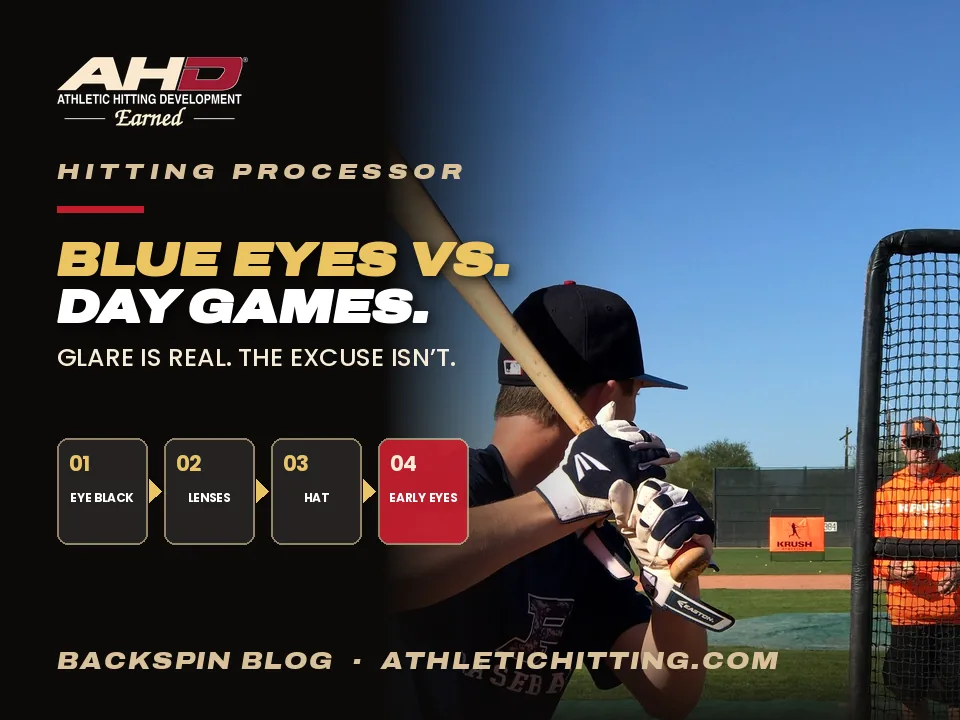
- Eye black, lenses, hat, early eyes
- Never an excuse
Complete Hitters Are Built…Earned.
If you want to know where your hitter really stands, take the free SwingChecker™. It ranks the top priorities across all 4 pillars, and if the eyes and timing are the issue, it’ll show up.
Want to go deeper? Read The Eye Tool Is the Rarest Skill in Hitting and Pitch Recognition Drills: 7 Drills That Actually Show Up in Games.
Quick answers
Do blue eyes make it harder to hit a baseball in the day?
Light eyes can catch more glare in bright sun, but studies of big league hitters found no real difference between day and night performance tied to eye color. Glare is fixable with the right gear and routine.
Why are light eyes more sensitive to sunlight?
Light eyes usually have less pigment at the back of the eye to soak up extra light. That leftover light scatters inside the eye and causes a hazy glare.
Does eye black actually help hitters?
Eye black under the eyes cuts down the light bouncing off the cheekbones into the eyes. It’s a simple, legal way to reduce glare in day games.
What color lenses are best for hitting in the sun?
Amber lenses are a common choice because they cut glare and add contrast against green grass and blue sky. Tinted contacts and sport sunglasses both work; pick what stays comfortable in the box.
Sources: Shannon Proudfoot, “Science of Sport: Why blue-eyed batters have a tougher time in day games,” Sportsnet (July 9, 2017) · Dave Cameron, “Blue-Eyed Players Hit Just Fine in Day Light,” FanGraphs (2011) · Gerald Schifman, “How Does Eye Color Affect Day/Night Splits?,” The Hardball Times (2015)
Don’t collect drills. Build a complete hitter.
Complete Hitters Aren’t Born. They’re Built… and Earned.