
By BK, Athletic Hitting Development
Complete Hitters Aren’t Born. They’re Built… and Earned.
Key takeaways
- Reading gives a hitter the why behind the swing, and understanding the why makes new feels stick faster in the cage.
- The “I’m a visual learner” idea doesn’t hold up in the research. What works for everyone is learning the same thing through more than one channel.
- Reading feeds mental practice, and decades of studies show mental reps help, as long as they’re paired with real reps.
- Read in the classroom, hit in the box. Turn what you read into one simple image or cue and let the swing run free in the game.
Yes. Reading can make you a better hitter, as long as it adds to your reps instead of replacing them. Reading teaches the why behind the swing, and science shows that hitters who understand the why learn the feel faster and keep it longer.
Yes. Reading helps a hitter when it adds to reps, because it teaches the why behind the swing and the approach. Research says hitters learn best through several channels at once, and that the reading belongs in practice while the game is played on simple cues and feel.
Train it: Complete Hitter Masterclass → Free tool: SwingChecker™ →We all learn in different ways. We see it, we hear it, we feel it. Here’s how I put it: reading about a subject can give the athlete or coach another, effective way to learn. It’s one more door into the same room.
So I wanted to know what the science actually says about learning through reading. Some of what I found backs up what I’ve seen in 52 years in this game. Some of it busts a myth a lot of coaches still believe. Here’s the whole thing, straight.
1. How do hitters learn: visual, auditory or feel?
Every hitter takes in information through a few main channels:
- Visual. Watching video, watching a big leaguer, watching a coach demo the move.
- Auditory. Hearing the cue. Hearing the sound of a barrel that got on it right.
- Feel. The reps. Feeling the load, the launch and the finish in your own body.
- Reading. Words on a page that explain what the move is and why it matters.
You’ve probably heard a hitter (or a parent) say, “He’s a visual learner.” The idea is that every athlete has one best channel and you should teach to it. It sounds right. The research says otherwise.
A major 2008 review by Harold Pashler and his colleagues went looking for proof that matching teaching to a person’s “learning style” makes them learn better. They found almost none. People have preferences, sure. But teaching only to the preference doesn’t improve results.
Every hitter learns better through MORE channels, not one.
That’s the real takeaway. The research on multimedia learning, led by Richard Mayer, shows people learn better from words and pictures together than from words alone. So the best plan isn’t “find his style.” It’s “hit him from every angle.” Reading is one of those angles, and most hitters never use it.
2. Why does reading help a hitter get better?
Reading gives a hitter something video and reps alone often don’t: the why. Why the load goes back before the body goes forward. Why the barrel works above and inside the ball. Why an athletic front leg lets the body rotate instead of drifting.
When a hitter understands the why, the cage gets more productive. He knows what he’s feeling for. He can catch a bad rep himself instead of waiting for me to tell him. That’s the start of owning a swing instead of copying one.
It’s also how AHD hitters come to understand Mechanically Advantaged Angles (MAA). You can feel an angle, but you own it when you know why it gives you leverage.
HOW HITTERS LEARN
READ IT.SEE IT. FEEL IT.
- Read it for the why
- Watch it on video
- Hear one simple cue
- Feel it in the cage
- Let it go in the game
MORE CHANNELS. STRONGER HITTER.
3. Can reading help with mental reps and the approach?
Yes, in two big ways.
Mental practice. Seeing the swing in your mind is real training. Studies going back decades, including a well-known 1994 meta-analysis by Driskell and colleagues and a 24-year follow-up published in 2020, found that mental practice improves performance. It works best when combined with real reps, not instead of them. Reading gives the imagination an accurate picture to rehearse.
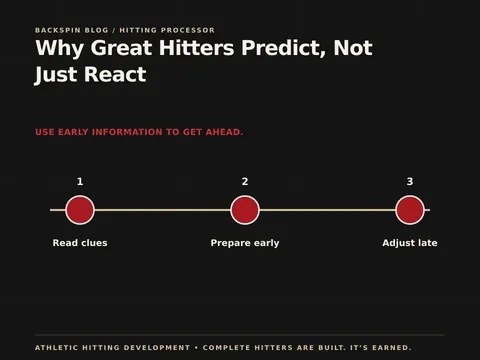
The approach. Great hitters don’t just react. They predict. They know the count, the situation and what a pitcher likes to do. That knowledge lives in the Hitting Processor: see it, time it, decide, attack it. Reading about pitching, sequencing and approach builds it off the field, so it shows up on the field. It’s one reason great hitters always seem a step ahead (more on that in why great hitters predict).
4. Can reading too much about mechanics hurt a hitter?
It can, if he brings the book into the box. This part matters.
Research by Rich Masters and colleagues found that athletes who learn a skill as a long list of step-by-step rules are more likely to break down under pressure. They start thinking their way through a movement that should be automatic. Every coach has seen it: a hitter with a checklist in his head is late to everything.
Two findings show the way out:
- Focus on the result, not the body part. Gabriele Wulf’s research, and later reviews, show that external cues (“drive it through the middle”) beat internal ones (“turn your back hip”) for learning and performing.
- One image beats a list. Liao and Masters found that learning from a single analogy held up under pressure better than learning from a list of rules.
Read in the classroom. Hit in the box.
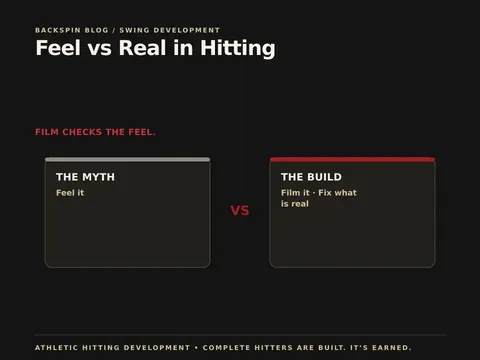
That’s the AHD way. Learn deep, then shrink it down to one picture or one cue. When you step in, be aggressive and athletic and let it go. Controlled violence doesn’t come from a checklist. More on this in feel vs real in hitting and why hitters choke under pressure.
5. How should a hitter read to actually learn?
Not all reading is equal. A big 2013 review of study methods by John Dunlosky and colleagues rated rereading and highlighting as low value. The methods that rated high were self-testing and spreading practice out over time. Here’s how that looks for a hitter:
- Read one idea, not tenTake one lesson or one section at a time, about 10 to 15 minutes.
- Explain it backTell your coach, a teammate or a parent what you read, in your own words.
- Turn it into a cueBoil it down to one picture or one short phrase you can carry into the cage.
- Feel it the same dayGo hit and look for the thing you just read about. Read it, then rep it.
- Quiz yourself laterA few days later, see if you can still explain it without looking.
For coaches, the same rules apply. The more you read, the more ways you have to explain the same move. When one cue doesn’t land with a hitter, you have three more ready. That’s what “different kids learn differently” really means.
6. Where does reading fit in building a complete hitter?
Reading touches every one of the 4 Pillars of a Complete Hitter: The Swing (the why behind the move), Strength & Explosiveness (why the body powers the bat), the Hitting Processor (pitch and count knowledge) and the Mental Approach (routines and belief).
But it’s a tool, not the program. Don’t collect articles any more than you collect drills. Read with a purpose, rep what you read, and keep the hitter’s brain and body learning together.
Not sure where to start? Take the free SwingChecker™. It ranks your hitter’s top priority across the 4 Pillars and points to the free lessons to read and rep first. It’s a great day to hit!!
THELESSON.
- Reading teaches the why
- Learning styles are a myth
- Mental reps help, real reps rule
- One cue beats a checklist
- Read it, then rep it
Complete Hitters Are Built…Earned.
Want to go deeper? Read Feel vs Real in Hitting and Why Great Hitters Predict, Not Just React.
Quick answers
Can reading really make you a better hitter?
Yes, when it adds to your reps. Reading teaches the why behind the swing and the approach, and hitters who understand the why learn new feels faster and can fix themselves.
Is my kid a visual learner or a kinesthetic learner?
Probably both. Research has found little evidence that teaching to one learning style works better. Every hitter learns best when the same idea comes through reading, video, cues and reps together.
Does mental practice help baseball and softball hitters?
Yes. Studies over several decades show mental practice improves performance, especially when paired with physical practice. Reading gives a hitter an accurate picture to rehearse.
Should hitters think about mechanics during a game?
No. Research on pressure shows step-by-step thinking can make athletes break down. Learn mechanics in practice, shrink them to one external cue or image, and play free in the game.
Sources: Pashler et al. (2008), Learning Styles: Concepts and Evidence · Mayer, Multimedia Learning: the multimedia principle (Cambridge) · Does mental practice still enhance performance? A 24-year follow-up of Driskell et al. (1994) · Masters et al., Implicit and explicit control of motor actions · Chua et al. (2021), Superiority of External Attentional Focus (meta-analyses) · Liao & Masters (2001), Analogy learning: a means to implicit motor learning · Dunlosky et al. (2013), Which study strategies make the grade? (APS)
Don’t collect drills. Build a complete hitter.
Complete Hitters Aren’t Born. They’re Built… and Earned.