There is a huge difference between helping a hitter perform better today and actually developing a hitter.
Real development teaches a hitter why his swing works, so he can recognize when something changes without a coach standing next to him. Give him swing checkpoints instead of only cues, use video to ask “what changed?” and build all four pillars so understanding gives him a way back.
Train it: Hitting Coach Certification →A talented athlete can be strong, explosive, coordinated, competitive and gifted enough to succeed for years without completely understanding what makes his swing work. At lower levels, talent can cover a lot. The game eventually gets faster. The pitching gets nastier. The decision window gets smaller. And what used to happen naturally may suddenly stop happening.
Build the swing. Build the processor. Build the approach. Then teach the athlete how to recognize when one of those pieces changes.
Why the Gunnar Henderson conversation matters
A recent Sports Illustrated / On SI column centered on former MLB general manager Dan O’Dowd’s concerns about Baltimore’s player development and Gunnar Henderson’s regression. The piece reported that since the 2025 All-Star break Henderson had produced a .235/.318/.405 line with a .723 OPS and 103 wRC+ over the cited 192-game span.
But the most useful part for hitters and coaches was not the stat line. It was O’Dowd’s observation that Henderson did not appear to be moving in the batter’s box the same way he had when he first established himself in the majors—and his larger question about whether an athlete understands what makes him successful.
We cannot diagnose Henderson from a television screen or an article. That is not the point. The player-development question behind the story is the part worth keeping:
Does the athlete understand his own success well enough to recognize when something has changed?
Great coaching should create less dependence on the coach—not more.
Young hitters often succeed before they understand why
This happens everywhere in youth, high-school and college baseball and softball.
A hitter is stronger than everybody else. Or faster. Or has exceptional hand-eye coordination. Or can wait forever and still get the barrel there. Or has so much bat speed that inefficient movement is hidden by physical talent.
Then the competition catches up.
Velocity exposes a long move. Better spin exposes recognition problems. Command exposes a hitter who can only cover one part of the zone. More sophisticated scouting exposes an approach that never had a real plan behind it.
The athlete suddenly asks, “What happened to my swing?”
Sometimes the better question is: “Did we ever teach the athlete what made the good swing work?”

THEN THE COMPETITION CATCHES UP
TEACH THEWHY.
- Velocity exposes a long move.
- Spin exposes recognition.
- Command exposes one-zone hitters.
DID WE TEACH WHAT MADE IT WORK?
Do not build dependence. Build understanding.
There is a version of private instruction where the hitter becomes dependent on somebody else to interpret every bad swing.
Something feels wrong? Call the instructor. Timing disappears? Schedule another lesson. Barrel starts taking a different route? Wait for somebody to fix it.
That may get the hitter through a Tuesday cage session. It does not help much in the seventh inning Friday night.
There is no instructor standing in the on-deck circle. Eventually the hitter has to be able to recognize patterns, make a simple adjustment and compete.
That is why AHD teaches swing checkpoints instead of only giving swing cues:
Athletic Setup → Gather/Load → Stride/Forward Move → Launch → Contact → Extension → Finish.
The hitter does not need to become a biomechanics professor. The hitter needs landmarks. When the swing gets lost, landmarks help the athlete find the road again.
The goal is not one perfect-looking swing
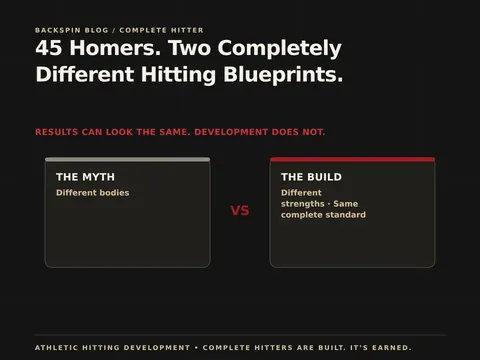
Two swings can look similar at full speed while the athlete underneath them is moving very differently.
- Did the hitter maintain an athletic position?
- Did the head and body stay controlled enough to see and adjust?
- Did the forward move create space or steal it?
- Did the hitter arrive at launch with the hands back and up?
- Did the sequence give the barrel time to work?
- Could the hitter still adjust to velocity, location and spin?
Small movement changes can create major results because hitting happens too fast for the body to waste time recovering from bad positions.
That is why AHD’s swing goal is not to clone somebody else’s mechanics. It is to create the largest margin for error for solid contact while generating maximum force and an effective bat-to-ball angle.
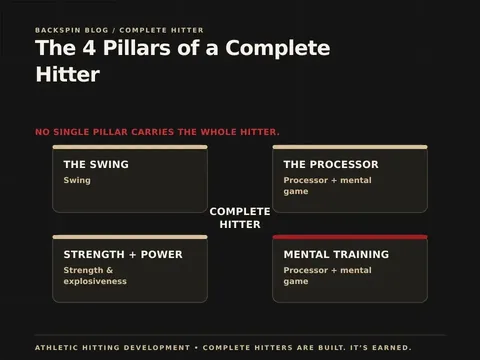
The swing is only one-quarter of the development problem
When a hitter struggles, mechanics get blamed first because mechanics are easy to see on video. But the hitter is an entire system.
A hitter can have a beautiful swing and still fail because the eyes and brain are late. A hitter can see the ball well and lack the strength or explosiveness to turn recognition into damage. A hitter can have both and compete tentatively because the approach has become cloudy. Or the actual movement pattern can change.
Development means identifying which problem you are actually trying to solve.
THE SWING IS ONLY ONE-QUARTER
THE WHOLEHITTER.
- The swing.
- Strength & explosiveness.
- The Hitting Processor.
- Mental training.
FIND THE PROBLEM YOU'RE ACTUALLY SOLVING.
Video should educate, not just criticize
Video becomes powerful when the athlete understands what to look for. It becomes noise when every frame gets covered in lines and the player leaves with twelve new things to think about.
Instead of starting with “What is wrong?”, try starting with “What changed?”
Compare a good swing with the struggling swing. Compare the athletic position. Compare the forward move. Compare launch. Compare where the barrel enters the zone. Compare balance and body control. Then decide which difference matters most.
One priority. One training plan. Then test it again.
Five questions every developing hitter should eventually answer
When hitters can answer those questions, coaching has become something more valuable than instruction.
It has become ownership.
VIDEO SHOULD EDUCATE
WHATCHANGED?
- Compare good vs. struggling.
- Pick the one that matters.
- One priority. One plan.
- Then test it again.
COACHING HAS BECOME OWNERSHIP.
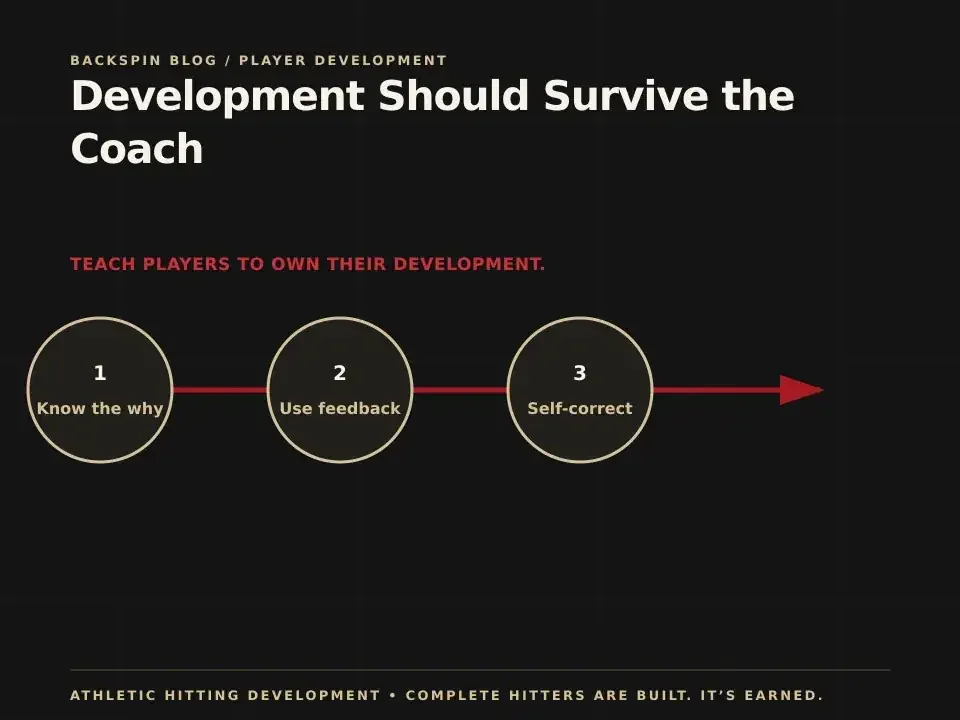
Development should survive the coach
The standard should not be: How good does the athlete look when the instructor is feeding balls and talking after every swing?
The standard should be: What can the athlete do when the game gets hard and nobody is there to rescue him?
Can he recognize that he is late? Can she feel that the forward move is rushed? Can the hitter separate a swing issue from a pitch-recognition issue? Can the athlete return to one cue, one checkpoint or one plan instead of panicking and rebuilding everything?
That is the athlete we are trying to develop.
The ultimate goal of development is not to make the athlete permanently dependent on instruction. It is to give the athlete a repeatable process for learning, adjusting and competing.
AHD Coach’s Take
We do not know from the outside exactly why Gunnar Henderson’s performance or movement has changed. The useful lesson is not to pretend we can diagnose a major-league hitter from afar.
The useful lesson is to ask the same question inside every development program:
Are we simply producing better swings today—or are we teaching athletes enough to keep developing tomorrow?
That is a much higher standard.
Complete Hitters Are Built… Not Given. Earned!
THELESSON.
- Teach the why.
- Landmarks, not just cues.
- Ask what changed.
- One priority. One plan.
- Survive without the coach.
Complete Hitters Are Built…Earned.
Quick answers
Why do talented young hitters suddenly stop hitting?
Talent covers a lot at lower levels. Then the competition catches up. Velocity exposes a long move, better spin exposes recognition problems and better scouting exposes a weak approach. Often nobody ever taught the hitter what made his good swing work in the first place.
How can a hitter fix his swing without a coach?
Give him landmarks, not just cues. AHD teaches swing checkpoints: Athletic Setup, Gather/Load, Stride/Forward Move, Launch, Contact, Extension, Finish. When the swing gets lost, those landmarks help the athlete find the road again and make one simple adjustment instead of rebuilding everything.
How should hitters use video to improve?
Start with what changed, not what is wrong. Compare a good swing with the struggling swing. Look at athletic position, forward move, launch, barrel entry and balance. Then pick the difference that matters most. One priority, one training plan, then test it again.
What are the checkpoints of a baseball swing?
Athletic Setup → Gather/Load → Stride/Forward Move → Launch → Contact → Extension → Finish. The hitter doesn’t need to be a biomechanics professor; he needs landmarks, so when the swing gets lost he can find the road again.
No subscription. No login. Keep learning, then take one priority into training.