
By BK, Athletic Hitting Development
Complete Hitters Aren’t Born. They’re Built… and Earned.
Key takeaways
- Commits' best showcase exit velo averaged about 97 mph (Power 4), 95 (other D1), 92 (D2) and 90 (D3) in one large PBR study.
- The ranges overlap a lot — exit velo gets you noticed, it doesn't sign you.
- Showcase max and game exit velo are different numbers; game averages run much lower.
- Raise it with the whole hitter: swing, strength, timing and intent.
College commits hit it hard: in one large study of PBR profiles, D1 Power 4 commits averaged about 97 mph best exit velo, other D1 about 95, D2 about 92 and D3 about 90. JUCO guidance runs roughly 85–92 mph.
In a large study of PBR profiles, commits' best showcase exit velo averaged about 97 mph for D1 Power 4, 95 for other D1, 92 for D2 and 90 for D3. JUCO guidance runs roughly 85–92 mph.
Train it: Athletic Development → Free tool: Exit Velocity & Bat Speed Calculator →Every parent with a college-bound hitter asks the same question: how hard does my kid need to hit it? Here are the best numbers we could find, where they came from, and what they really mean.
If your hitter is younger, start with Exit Velocity by Age instead.
What exit velocity do college commits have by division?
BaseballPath looked at PBR profiles for the classes of 2024 to 2026, grouped by the level each player committed to, and averaged each player's best recorded showcase exit velo. The typical range is about one standard deviation either side.
| Committed level | Average best exit velo | Typical range |
|---|---|---|
| D1 Power 4 (ACC, Big Ten, Big 12, SEC) | 97 mph | 91–103 mph |
| Other D1 | 95 mph | 89–100 mph |
| NCAA D2 | 92 mph | 87–98 mph |
| NCAA D3 | 90 mph | 85–96 mph |
| JUCO (guidance, not a study) | — | about 85–92 mph |
The JUCO line is one training company's editorial guidance, not measured data. We couldn't find a published JUCO or NAIA study, so treat it as a rough marker.
Look at the overlap. A 92 mph hitter shows up in every row.
Is showcase exit velo the same as game exit velo?
No, and this trips up a lot of families. A showcase number is usually a hitter's single best swing, often off a tee or front toss. Game exit velo averages every ball in play against live pitching.
Baseball America's Division I game data showed average exit velo rising from 82.5 to 86.1 mph between 2022 and 2025, with the 90th percentile just under 102. That's an average of game balls, so it reads much lower than a commit's best showcase swing.
READ THE NUMBER
ONE NUMBER,THREE TESTS.
- Showcase max: best swing
- Tee vs live pitching
- Game average: every ball
ALWAYS SAY WHAT THE TEST WAS
- Max vs average. Your best swing is not your typical swing.
- Tee vs live. A ball sitting still is easier to square up.
- Device and bat. Different radars, sensors and bats (wood or BBCOR) read differently.
When you send numbers to a coach, say what the test was, the device and the date. Honest numbers build trust.
Will a high exit velocity get you recruited?
It gets you looked at. It doesn't get you signed by itself. Coaches still want to see you hit it hard in games, against velocity and spin, with good swing decisions. Read What College Coaches Look For in a Hitter.
"Ball — powdered." That's the sound of a barreled ball, and it's what we chase — not a pretty swing or one lucky number.
A hitter at 88 mph who barrels it in games and lays off bad pitches can out-recruit a 95 mph hitter who can't get to the fastball. The number opens the door. The at-bats walk you through it.
What should a high school hitter do with these numbers?
Use them as a map, not a verdict. Here's how we'd use them with a junior or senior:
- Test the same way every time. Same device, same bat, same setup, so the numbers compare.
- Retest every 6–8 weeks. Track the trend, not one swing on one good day.
- Aim at the right levels. If you're 88 mph today, D2, D3, NAIA and JUCO programs are real targets right now. Build your list around where you fit.
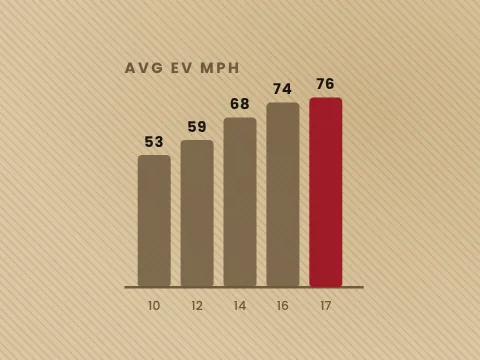
- Keep building. Many hitters gain real exit velo in their late teens as they get stronger, so the number you have at 16 isn't the one you'll have at 18.
And remember who reads the number. A coach sees your exit velo once, on a profile. He sees your at-bats every time he watches you play. Build both.
How can a hitter raise exit velocity for college?
Exit velo isn't one thing. It's bat speed, quality of contact and timing, built on an athlete who can produce force. Train the whole hitter:
- The SwingEfficient sequencing and MAA — Mechanically Advantaged Angles — staying inside and above the ball so the barrel squares it up.
- Strength & ExplosivenessLower-body and rotational power feed bat speed. Build the athlete, not just the swing.
- The Hitting ProcessorBe on time. A late swing never shows its real exit velo.
- Mental ApproachSwing with intent: aggressive and athletic, controlled violence.
"Hard, down the other way means we are on our way!" A hard ball to the opposite field tells you the hitter is on time and staying through it — real exit velo, not a pull-side accident.
For the full plan, see How to Increase Exit Velocity. Check your numbers with the free Exit Velocity & Bat Speed Calculator, find your top priorities with SwingChecker™, and build the engine with Athletic Development, Lessons 1–3 free.

THELESSON.
- Gets you noticed
- Games get you signed
- Overlap is huge
- Build the whole hitter
Complete Hitters Are Built…Earned.
Want to go deeper? Read Exit Velocity by Age: Baseball and Softball Benchmarks (2026 Chart) and How to Increase Exit Velocity: The 4-Pillar Plan.
Quick answers
What exit velocity do you need for D1 baseball?
In one large PBR study, D1 commits outside the Power 4 averaged about 95 mph best showcase exit velo and Power 4 commits about 97 mph, with wide ranges. There is no official cutoff.
What is a good exit velocity for D3 baseball?
The same study found D3 commits averaged about 90 mph best showcase exit velo, with a typical range of roughly 85 to 96 mph.
Why is my game exit velocity lower than my showcase number?
A showcase number is usually your single best swing, often off a tee or front toss. Game exit velo averages every ball in play against live pitching, so it runs much lower.
Does exit velocity matter more than batting average for recruiting?
Coaches use exit velo to find hitters, then watch game at-bats to decide. Hitting it hard in games with good swing decisions is what gets offers.
Sources: BaseballPath — What Numbers Do You Need to Play D1, D2, or D3 Baseball? (PBR profiles, classes 2024–2026; updated Oct 2026) · WIN Reality — Exit Velocity Needed for College Baseball (JUCO guidance; Baseball America D1 game exit velo 2022–2025; Sept 2026)
Don’t collect drills. Build a complete hitter.
Complete Hitters Aren’t Born. They’re Built… and Earned.