By BK, Athletic Hitting Development
Complete Hitters Are Built… It’s Earned!
Key takeaways
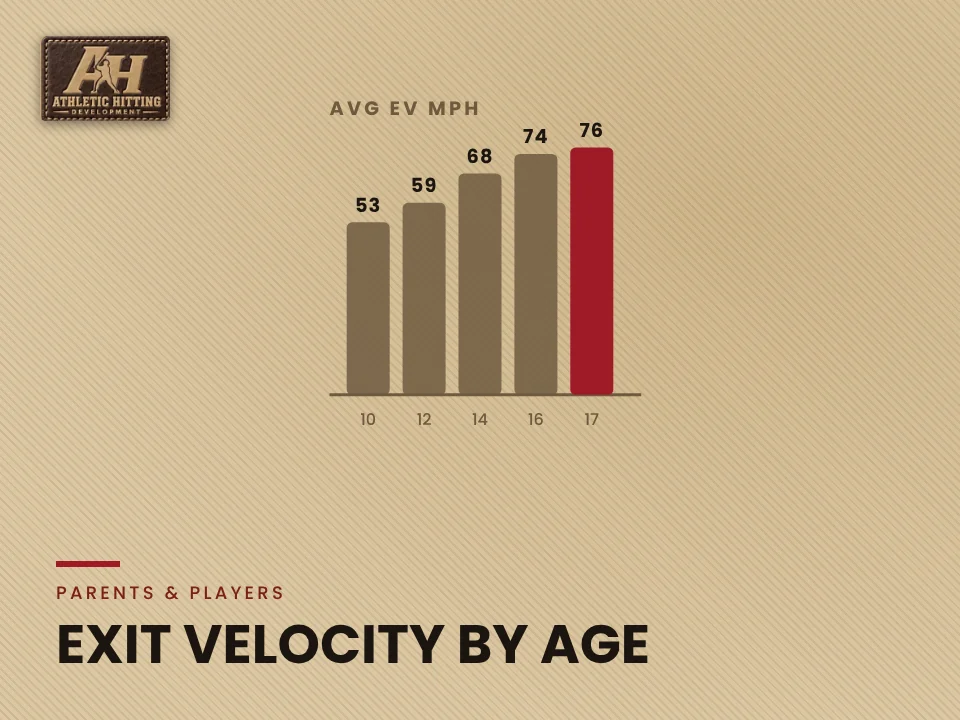
- Rapsodo’s published averages run from about 53 mph at age 10 to 68 mph at 14 and 79 mph at 18 on live BP.
- Perfect Game showcase averages are higher: 75 mph at 14U and 83 mph at 17U. Different players, different test.
- Softball has far less published data. Blast says it has no age chart, and one HitTrax/Rapsodo data set lists tee-max ranges like 45–60 mph at 13–14.
- Exit velo comes from the Strength & Explosiveness pillar plus the swing. Compare your hitter to the same method and to himself.
Published Rapsodo averages put baseball exit velocity at about 53 mph for 10-year-olds, 59 mph at 12, 68 mph at 14, 74 mph at 16 and 79 mph at 18 on live batting practice. Perfect Game’s showcase averages run higher, from 75 mph at 14U to 83 mph at 17U.
Rapsodo’s published live-BP averages are about 53 mph at age 10, 59 at 12, 68 at 14, 74 at 16 and 79 at 18. Perfect Game showcase averages run higher, from 75 mph at 14U to 83 mph at 17U, because the players and test differ.
Train it: Athletic Development →🛠️ Want to see where your hitter lands? Plug the numbers into the free exit velocity calculator and bat speed calculator.
Every parent with a radar app wants to know if their kid’s number is good. The internet is full of exit velo charts with no source and no method. I didn’t want to add another one.
So every number below comes from a company or scouting service that published it. If I couldn’t find solid data for an age, I left it out. Want to raise the number? That’s a different post: How to Increase Exit Velocity. This one is the benchmarks.
1. What is the average exit velocity by age in baseball?
Two published sources, side by side. Rapsodo analyzed data from more than 35 million hits and pitches captured by its camera-and-radar units and published averages by age for live BP, soft toss and tee. Perfect Game published averages from all workout numbers at its 2024 showcase circuit, measured with Pocket Radar.
| Age | Rapsodo live/BP avg (mph) | Rapsodo tee avg (mph) | Perfect Game showcase avg (mph) |
|---|---|---|---|
| 10 | 53 | 52 | Not published |
| 12 | 59 | 57 | Not published |
| 14 | 68 | 66 | 75 (14U) |
| 15 | 71 | 70 | 78 (15U) |
| 16 | 74 | 74 | 81 (16U) |
| 17 | 76 | 77 | 83 (17U) |
Rapsodo also lists 79 mph at age 18 and 80 mph for college on live BP, with 86 mph for pros. Its soft-toss averages land within a few mph of the live and tee numbers at every age.
Why is Perfect Game higher? Showcase players are a select group, and it’s a different device in a different setting. Neither number is “wrong.” They just answer different questions.
EXIT VELO BY AGE
KNOW THETEST.
- Age 12: 59 mph live (Rapsodo)
- Age 14: 68 mph live (Rapsodo)
- 14U showcase avg: 75 (PG)
- Age 17: 76 mph live (Rapsodo)
SAME AGE. DIFFERENT TEST.
2. What is a good exit velocity for a 14-year-old?
On Rapsodo, the average 14-year-old hits about 68 mph in live BP and 66 mph off the tee. At Perfect Game showcases, the 14U average is 75 mph, “plus” is 82 and “elite” is 84.
So if your 14-year-old sits in the mid-to-high 60s on a Rapsodo, he’s right with his age group. If he’s posting mid-70s at a showcase, he’s average for the kids who attend showcases. That’s a tougher crowd.
For a 12-year-old, Rapsodo’s averages are 59 mph live and 57 mph off the tee. I could not find a solid, sourced 12U number from a showcase service, so I left that column blank instead of guessing.
Same age. Different test. Different number.
3. What is the average exit velocity by age in softball?
Honest answer: there is far less published softball exit velo data. Blast Motion says outright that it has not published age-specific softball exit velocity benchmarks. Its softball guide points parents to bat speed instead. Here are the bat speed benchmarks by age.
The one sourced softball data set I found comes from Bat Digest. It says its numbers come from over 50,000 swings tracked over 7 years on HitTrax and Rapsodo. These are tee-work maximums, not averages of every swing.
| Fastpitch age / level | Typical tee-max range (mph) |
|---|---|
| 10–12 | 35–50 |
| 13–14 | 45–60 |
| 15–16 (HS) | 55–70 |
| 17–18 (HS) | 60–75 |
| College | 65–80 |
The same source lists baseball tee-max ranges of 60–75 mph at 13–14 and 75–90 mph at 17–18. Those are wider and higher than Rapsodo’s averages because a max is your best swing, not your typical one. Bat Digest adds that game-speed exit velo usually runs 5–10 mph below those tee maximums.
4. Why is my kid’s exit velocity different on different days and devices?
Because the method changes the number a lot. Before you compare your hitter to any chart, know what the chart measured.
- Average vs. max. One best swing can be 5–10 mph above the average of all swings.
- Tee vs. front toss vs. live. The tee removes timing. Live pitching adds it back. Read Your Tee Is Lying to You.
- Device. Rapsodo, HitTrax and Pocket Radar each measure differently. Don’t compare one to another.
- Ball and bat. A different ball or a different bat is a different test.
- Who’s in the data. Showcase averages include only the kids who attend showcases.
Rule of thumb: compare your hitter to a chart only if it used the same method, and compare him to himself most of all.
5. Is a higher exit velocity always better?
No. A bigger kid usually hits the ball harder at 13. That doesn’t make him a better hitter. Bat Digest notes teen hitters typically gain 3–5 mph per year, so early-maturing kids can look miles ahead for a season or two.
Exit velo is built from the Strength & Explosiveness pillar plus The Swing. Strength raises the engine. An efficient swing with Mechanically Advantaged Angles (MAA) delivers it to the ball squarely. The Hitting Processor and Mental Approach decide whether it shows up in a game.
A 70 mph line drive on time beats a 90 mph pop-up. Want to know what feeds the number? Start with Bat Speed by Age, then follow the plan in How to Increase Exit Velocity.
6. How should we track exit velocity?
Pick one device and one setup, log the average of 10 or more swings plus the top few, and retest every 4–6 weeks. The full testing checklist is in How to Increase Exit Velocity.
In the AHD Academy we use the AHD PR Board. Players log exit velo, bat speed, 60-yard and vertical with a proof clip. Coach verifies it. Only verified PRs go on the board.

THELESSON.
- Same device, same setup
- Average, not one swing
- Know what the chart measured
- Clip every PR
Complete Hitters Are Built…Earned.
Not sure which pillar is holding your hitter’s exit velo back? Run the free SwingChecker™. It takes about 3 minutes and ranks the top priority across the 4 pillars. If strength is the gap, the bat speed training program is 24 lessons for $139, scaled to age.
Want to go deeper? Read How to Increase Exit Velocity: The 4-Pillar Plan and Your Tee Is Lying to You.
Quick answers
What is a good exit velocity for a 14 year old?
Rapsodo’s published average for 14-year-olds is about 68 mph on live BP and 66 mph off the tee. At Perfect Game showcases, the 14U average is 75 mph, with 82 rated plus and 84 elite.
What is the average exit velocity for a 12 year old?
Rapsodo’s published averages for 12-year-olds are 59 mph on live BP, 57 mph on soft toss and 57 mph off the tee.
What is a good softball exit velocity by age?
Published softball data is limited. One HitTrax and Rapsodo data set lists typical tee-max ranges of 45–60 mph at ages 13–14 and 60–75 mph at 17–18.
Is tee exit velocity higher than live exit velocity?
Not always on average. Rapsodo’s tee and live averages are within a few mph at most ages, but a single max swing off the tee can run well above a hitter’s typical game exit velo.
Sources: Rapsodo — Baseball Hitting Averages by Age (PDF guide) · Rapsodo — Baseball Hitting Averages by Age (download page) · Perfect Game — FAQ Showcase Questions: Part 3 (2024 showcase averages, Pocket Radar exit velocity) · Bat Digest — Exit Velocity by Age Chart (HitTrax and Rapsodo tee-max data) · Blast Motion — Softball Exit Velocity by Age: What’s Actually Good (Aug 2026)
Don’t collect drills. Build a complete hitter.
Complete Hitters Are Built… It’s Earned!
This article is part of the AHD guide Bat Speed & Power Training. Start there for the full picture and every related article.