By BK, Athletic Hitting Development
Complete Hitters Are Built… It’s Earned!
Key takeaways
- College coaches first look for bat speed and exit velocity — the tools that say the swing can play at the next level.
- Then they watch quality of at-bats, swing decisions and adjustability, because tools without decisions don’t hit.
- Athleticism and makeup matter: run times, how the body moves, and how a player acts after an 0-for-4.
- No one can promise a roster spot — but what you control now (measurable progress, clean video, how you compete) is what gets you evaluated fairly.
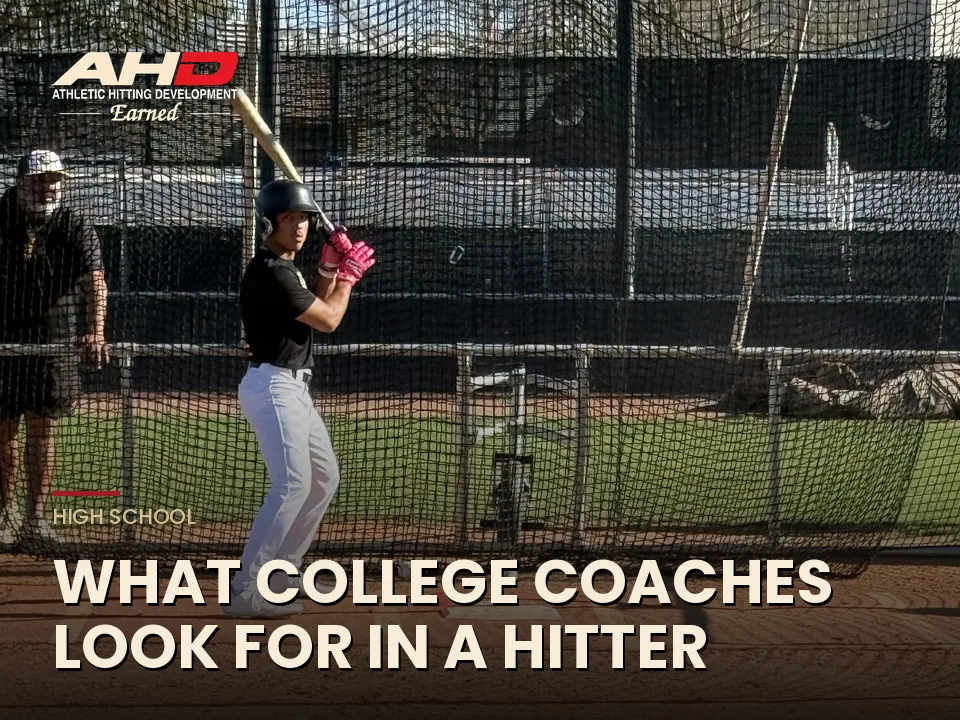
College coaches look for hitters with real bat speed and exit velocity, good swing decisions, the ability to adjust, athleticism, and makeup they can trust. The tools get you noticed; the rest gets you a serious look.
I’ve spent 52 years playing, coaching and scouting this game. I’ve sat behind a lot of backstops with a radar gun and a notebook. Here’s what I was looking for — and what I tell every high school hitter I work with.
One honest note before we start. Nobody can promise you a scholarship or a roster spot. Not me, not a showcase, not a recruiting service. What you CAN do is become the kind of hitter that’s worth evaluating.
1. Do college coaches care about exit velocity and bat speed?
Yes. It’s usually the first filter. Bat speed and exit velocity tell a coach whether your swing has the raw power to compete against better pitching.
Exit velocity is how hard the ball leaves the bat, usually measured off a tee or front toss with a radar or ball-tracking device. Bat speed is measured with a bat sensor or tracking system at contact. Know which one you’re reporting and how it was measured.
Here’s what scouts know: the number is a snapshot. A coach also wants to see where the power comes from. Hitters with Mechanically Advantaged Angles (MAA) — the positions that let the body transfer force into the barrel — tend to keep that power when the pitching gets better. That’s what we build at AHD. Read more on where bat speed really comes from.
THE COLLEGE LOOK
WHAT COACHESSEE FIRST.
- Bat speed and exit velo
- Swing decisions
- Adjustability
- Athleticism and run times
- Makeup after an 0-for-4
TOOLS + DECISIONS + MAKEUP
2. What else do coaches watch besides how hard you hit it?
Quality of at-bats. I want to see a hitter who knows what he’s looking for, takes the pitcher’s pitch early, and doesn’t give away strikes with two strikes.
Tools get you noticed. Decisions get you in the lineup.
- Swing decisions. Does he chase? Does he take hittable fastballs? See why swing decisions are a skill.
- Adjustability. When he’s early on a breaking ball, can he keep the barrel in the zone and still put it in play?
- Two-strike approach. Does the at-bat change, or does he just hope?
- Against velocity. Is he on time when someone throws hard?
This is the Hitting Processor — see it, time it, decide, attack it. It’s the pillar most high school hitters never train, and it’s the one that shows up in a game.
3. Does athleticism and attitude really matter in recruiting?
Absolutely. Coaches recruit athletes. Run times — a 60-yard dash and home-to-first — tell them about your speed. How your body moves tells them how much room you have to grow.
Then there’s makeup. I always watched what a hitter did between pitches and between innings, especially after a bad day. Does he slam the helmet? Does he sulk in the dugout? Or does he pick up his teammate and get ready for the next one?
How you act after an 0-for-4 says more about you than a 3-for-4. Coachability counts too. If a coach gives you a cue, do you listen and try it, or argue? That gets noticed, and so does how you treat your parents in the parking lot.
4. What should a recruiting video for a hitter include?
Keep it clean, short and honest. A coach is busy. Make it easy to see your swing and believe your numbers.
- Lead with your infoName, grad year, position, school and team, height and weight, and contact info on the first frame.
- Show the swing from two anglesSide view and behind or in front, chest high, landscape, the whole body and bat through the finish.
- Show real swingsA handful of tee or front-toss swings, then live or game at-bats if you have them.
- Back up your numbersIf you list exit velo, bat speed or a 60 time, show how and when it was measured.
- Update itFresh video every few months shows growth — that’s a story coaches like.
Our swing analysis page has a full filming checklist you can use for recruiting video too.
5. What can a high school hitter control right now?
More than you think. You don’t control who shows up to your game. You control what they see when they do.
- Your measurables. Track them and get better. At AHD we use a PR Board: players log exit velo, bat speed, 60-yard time and vertical with a proof clip, and I verify it. Real numbers, real progress.
- Your strength and speed. The Athletic Development course builds the engine behind the swing.
- Your approach. Train your eyes and decisions daily, not just in games.
- Your makeup. Effort, body language and how you treat people are free.
Start with the free SwingChecker to find your top priority. Then build the whole hitter with the Complete Hitter Masterclass, or work with me directly through 90-Day Private Hitter Development.

THELESSON.
- Numbers open the door
- Decisions win the at-bat
- Makeup earns trust
- Control what you can now
Complete Hitters Are Built…Earned.
Want to go deeper? Read Swing Decisions Are a Skill and Which Gym Numbers Actually Track Bat Speed.
Quick answers
What exit velocity do college baseball coaches look for?
It depends on the level, position and program, so there is no single number. Coaches use exit velocity as a first filter, then watch swing decisions, adjustability and athleticism.
How do college coaches evaluate hitters?
They look at tools like bat speed and exit velocity, the quality of game at-bats, how well a hitter adjusts, athleticism and run times, and makeup and coachability.
What should I put in a baseball recruiting video as a hitter?
Your info up front, clean side and behind views of your swing, a mix of tee or front toss and live or game swings, and proof of any numbers you list. Keep it short and update it often.
Can hitting lessons get me recruited?
No coach can promise recruiting results. Good training can help you become a better hitter with measurable progress, which gives you the best chance to be evaluated fairly.
Don’t collect drills. Build a complete hitter.
Complete Hitters Are Built… It’s Earned!