By BK, Athletic Hitting Development
Complete Hitters Are Built… It’s Earned!
Key takeaways
- Exit velocity comes from bat speed plus squared-up contact — miss either and the number drops.
- Strength and explosiveness raise the ceiling; swing efficiency and MAA let the bat use it.
- Timing and intent matter as much as muscle: on-time contact out front, swinging to do damage.
- Measure fairly — same tee, same ball, same device — or you’re chasing noise.
To increase exit velocity, raise bat speed and square the ball up more often. That takes four things working together: strength and explosiveness, an efficient swing, on-time contact out front and the intent to hit the ball hard.
Every hitter wants a bigger exit velo number. Most chase it the wrong way — heavier bats, more tee swings, random drills off the internet.
Here’s how I build it, pillar by pillar, with a plan you can follow for the next 6–8 weeks.
1. What actually creates exit velocity?
Two things, at the moment of contact: how fast the barrel is moving and how squarely it hits the ball.
A fast swing that clips the bottom of the ball produces a weak number. A perfectly squared ball off a slow bat does too. You need both.
Bat speed is the engine. Squared-up contact is the transmission.
That’s why exit velo is a 4-pillar number, not a swing number. Each pillar feeds speed, contact or both.
THE EXIT VELO FORMULA
SPEED +SQUARED UP.
- Strength & explosiveness
- Efficient swing & MAA
- On-time contact out front
- Intent to do damage
4 PILLARS. ONE NUMBER.
2. Does getting stronger increase exit velocity?
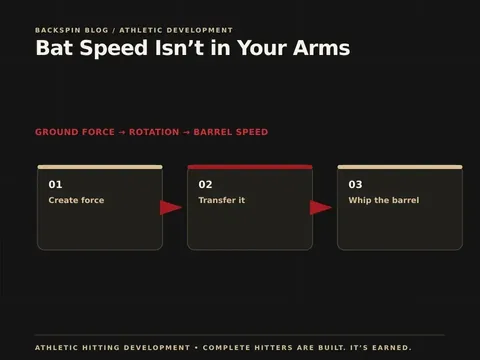
Yes — strength and explosiveness raise the ceiling on bat speed. But bat speed isn’t in your arms. It comes from the ground, the hips and the trunk, delivered in sequence. Read Bat Speed Isn’t in Your Arms.
Track the gym numbers that actually connect to the swing. Rotational med ball throws are a great one — see The Med Ball Test That Tracks Bat Speed and Which Gym Numbers Actually Track Bat Speed.
Age matters here. Strength work should be scaled to the hitter’s age and maturity, with an adult present. Young hitters build with bodyweight, jumps, med ball throws and good movement. I don’t prescribe loads by the number in a blog post, and nobody should. Here’s the age-by-age guide: Strength Training for Young Hitters.
3. How does the swing affect exit velocity?
A strong hitter with a leaky swing loses speed before the barrel ever gets to the ball. Efficiency is how much of the body’s energy reaches the bat.
AHD hitters work into Mechanically Advantaged Angles (MAA) — positions that let the body transfer force into the barrel and keep it on the plane of the pitch longer. More time on plane means more squared-up contact. Learn more: MAA: Mechanically Advantaged Angles.
- Casting the hands away early bleeds speed and makes contact harder.
- Arm-only swings cap bat speed no matter how strong the hitter is.
- Poor balance means the body can’t deliver force in order.
Here’s the good news: swing efficiency is often the quickest gain. A hitter who stops casting doesn’t need to get stronger to hit the ball harder — they just stop wasting what they already have. That’s why we find the biggest leak first instead of adding drills.
4. Why do timing and intent matter for exit velo?
Timing. The hardest-hit balls are usually caught on time and out front, where the barrel has reached full speed and is square. Late contact gets jammed. Early contact rolls over. That’s the Hitting Processor at work — see it, time it, decide, attack it — and it gets trained DAILY.
One honest note: a tee number and a game number aren’t the same. The tee doesn’t test timing. Read Your Tee Is Lying to You.
Intent. The mental side is real. Hitters who step in to do damage swing faster than hitters trying not to miss. Train with intent on purpose: every measured swing is a max-effort, on-time swing, not a lazy rep.
Intent also means swinging at pitches you can drive. The hardest-hit balls come off good pitches in the hitter’s zone. A hitter who chases the pitcher’s pitch will always post a lower game number than his tee number. Swing decisions are part of exit velo too.
5. What is a good 6–8 week plan to increase exit velocity?
- Week 1: BaselineTest exit velo off the tee and front toss with the same setup you’ll retest with, and run the free SwingChecker to find the biggest leak.
- Weeks 1–8: Strength 2–3 days a weekAge-appropriate jumps, rotational med ball throws and basic strength, scaled to the hitter with an adult present.
- Weeks 1–8: Swing 4–5 days a week10–20 minutes on the one swing priority you found — not ten different drills.
- Daily: Processor workA few minutes of timing and pitch recognition so speed shows up on time, out front.
- Every session: Intent roundsEnd with a short round of max-effort, measured swings and rest between them.
- Weeks 4 and 8: RetestSame tee, same ball, same device, same setup — compare averages, not one lucky swing.
Keep total swings reasonable. Quality beats volume — 40 focused, full-intent swings beat 200 tired ones. Rest a day when the body is sore, and stop any session if something hurts.
Expect the number to move unevenly. Some weeks it jumps, some weeks it stalls while a swing change settles in. That’s normal. Judge the 8-week trend, not Tuesday.
Want a full structured path? The bat speed training program is 24 lessons for $139, and the Complete Hitter Masterclass covers all four pillars.
6. How should you measure exit velocity fairly?
- Same tee height and location every test.
- Same ball type — different balls read differently.
- Same device in the same spot. Don’t compare one radar to another.
- Same warm-up and rep count. Track the average and the top few, not one outlier.
- Film it. A number without a clip is a rumor.
In the AHD Academy, players log exit velo on the PR Board with a proof clip, and Coach verifies it. Same idea at home: prove it, then celebrate it.

THELESSON.
- Same tee, same ball
- Same device, same spot
- Average, not one swing
- Clip every PR
Complete Hitters Are Built…Earned.
Not sure which pillar is holding your exit velo back? Run the free SwingChecker™ first. In about 3 minutes it ranks your hitter’s top priority across the 4 pillars.
Want to go deeper? Read Bat Speed Isn’t in Your Arms and The Med Ball Test That Tracks Bat Speed.
Quick answers
What is the fastest way to increase exit velocity?
Fix the biggest leak first. For some hitters that is timing or squared-up contact, which can raise exit velo quickly, while strength gains take steady work over weeks and months.
Does a heavier bat increase exit velocity?
Not automatically. If the heavier bat slows the swing or hurts timing, exit velocity can drop, so judge any bat by measured results with the same setup.
Should kids lift weights to hit the ball harder?
Strength work can be safe and helpful when it is scaled to age and maturity with an adult supervising. Younger hitters do best with bodyweight, jumps and med ball throws before heavier lifting.
Is tee exit velocity the same as game exit velocity?
No. The tee removes timing, so game exit velocity is usually lower and depends on being on time and swinging at good pitches.
Don’t collect drills. Build a complete hitter.
Complete Hitters Are Built… It’s Earned!
This article is part of the AHD guide Baseball Swing Mechanics. Start there for the full picture and every related article.