By BK, Athletic Hitting Development
Complete Hitters Are Built… Not Given. Earned!
Key takeaways for hitters
- Going oppo is one move: contact the ball with the barrel behind the hands.
- That’s geometry, not a feel. If the barrel is behind the hands at contact, the ball has to go oppo.
- Timing makes it possible: let the ball get into the Oppo Nitro Zone.
- Two cues, one swing: a physical cue and a visual/mental cue.
- Staying inside the ball is the first half of going oppo. It also frees the hands to handle any pitch in the zone.
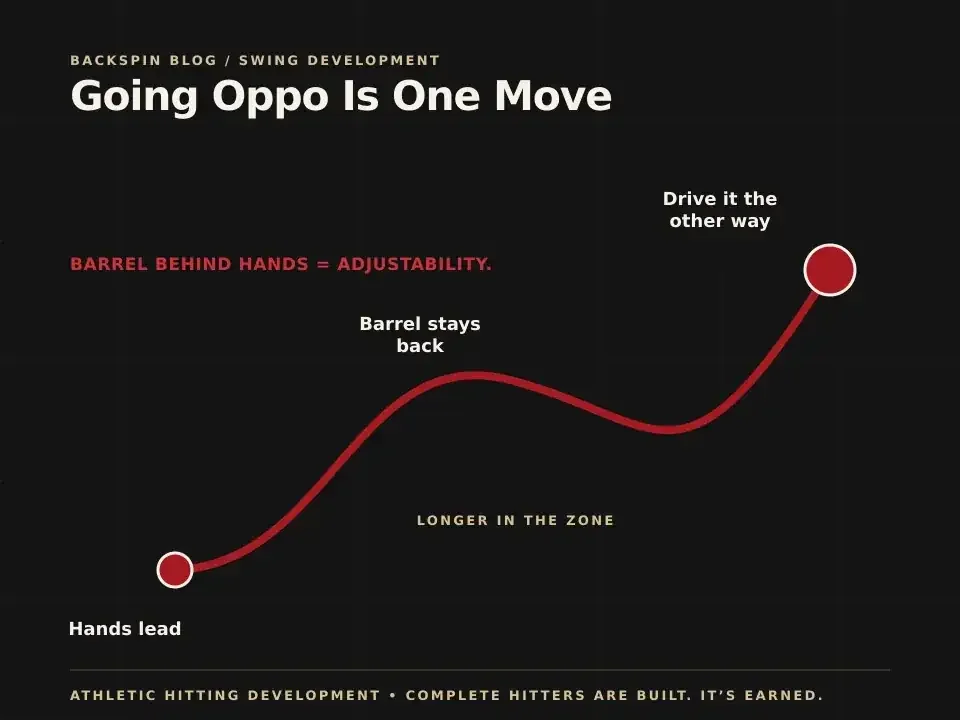
Going the other way is not a dozen moving parts. It’s one thing: hit the ball with the barrel behind your hands.
To hit the ball to the opposite field, make contact with the barrel behind your hands. Let the ball travel deeper into the zone and stay inside it, and the geometry sends the ball the other way.
Train it: Swing Structure & Mechanics Masterclass →Most hitters are taught to “go oppo” with a pile of tips. Stay inside it. Let it travel. Push your hands. Wait longer. Some of that is true, but it misses the point. Opposite-field hitting isn’t a feel or a mindset first. It’s geometry. Get the geometry right at contact and the ball has no choice where it goes.
1. The physics: barrel behind the hands = oppo
At contact, picture a line running from the knob of the bat to the end of the barrel. Where the barrel sits relative to your hands decides the angle of the bat face. That angle decides direction.
- Barrel out in front of the hands (closer to the pitcher): the bat face points to the pull side. The ball goes pull.
- Barrel even with the hands: the bat face points up the middle.
- Barrel behind the hands (closer to the catcher than the knob): the bat face angles to the opposite field. The ball has to go oppo.
That’s not a tendency. It’s the angle. If the barrel is behind the hands when it meets the ball, the ball leaves on that angle every time.
Hit every ball with the barrel behind the hands. You’ll go oppo every time.
GOING OPPO IS ONE MOVE
BARREL BEHIND THEHANDS.
- Barrel out front: pull.
- Barrel even: up the middle.
- Barrel behind: oppo.
IT'S GEOMETRY, NOT A FEEL.
2. Timing: let the ball into the Oppo Nitro Zone
You can’t put the barrel behind your hands on a ball you’ve already hit out front. The ball has to get deep enough to meet the barrel there. That deeper contact point is what we call the Oppo Nitro Zone.
Getting the ball there takes more than patience. The hitter has to be organized and on time with how they present the swing: loaded on time, sequenced, and ready to deliver the barrel when the ball arrives, not before. At AHD we sum all of that up in one word: timing.
Early hitters can’t go oppo. They meet the ball out front, the barrel gets ahead of the hands, and the ball gets yanked. Fix the timing and you give the barrel a chance to stay behind the hands.
3. Two cues, one swing
Everything above boils down to two cues a hitter can actually carry into the box:
| Cue | Type | What it does |
|---|---|---|
| Contact the ball behind the hands | Physical | Sets the bat angle so the ball must go oppo |
| Let the ball into the Oppo Nitro Zone | Visual / mental | Builds in the timing that gets the ball deep enough |
One cue is for the body. One is for the eyes and mind. Neither works alone. A hitter thinking only “barrel behind the hands” without the timing will cut the swing off or push at the ball. A hitter thinking only “let it travel” without the physical cue will let it get deep and still roll the barrel over. Together they lock in.

TWO CUES, ONE SWING
LET ITIN.
- Contact it behind the hands.
- Let it into the Oppo Nitro Zone.
- One for the body.
- One for the eyes.
EARLY HITTERS CAN'T GO OPPO.
4. Stay inside: the first half of going oppo
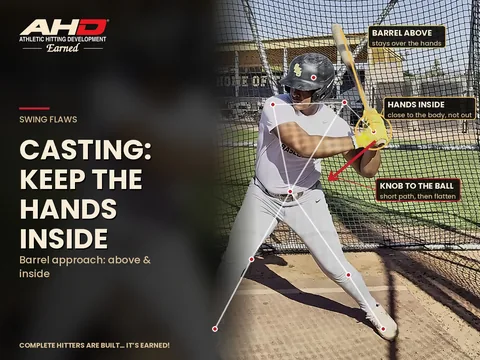
Every hitter has heard “stay inside the ball,” and for good reason. Staying above and inside the pitch plane is a primary skill for hitting the ball the other way. It’s roughly the first half of mastering the opposite field. Contacting the ball with the barrel behind the hands is the second half.
Staying inside does a lot more than help you go oppo:
- It sets up the oppo contact. Hands work inside the ball and the barrel trails, so the barrel is already in position to meet the ball behind the hands.
- It frees up the hands. With the hands inside, they can handle any pitch in the zone, not just the one you were looking for.
- It removes wasted movement. Staying inside eliminates inefficient hand and barrel movement, so there’s no long loop and no barrel dumping away from the body.
- It has you ready for the heater in. Looking away and get a heater in? Your hands and barrel are already in great position to be on time for the fastest pitch, even the heater inside.
| Half | The skill | What it gives you |
|---|---|---|
| First half | Stay above and inside the pitch plane | Free hands, no wasted movement, on time for any pitch |
| Second half | Contact the ball with the barrel behind the hands | The bat angle that sends the ball oppo |
Stay inside is the first half. Barrel behind the hands finishes it.
5. Why this builds a complete hitter
Here’s the hidden payoff. A swing built to contact the ball behind the hands keeps the barrel over the plate, on the ball’s plane, for a long time. That’s a forgiving swing.
- More margin for error on timing. If the barrel lives in the zone longer, being a hair early or late still finds the ball.
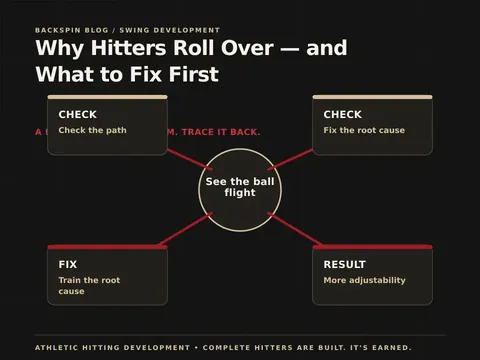
- Better adjustability. Off-speed that would have been a rollover out front becomes a line drive the other way.
- Pull power stays. Once the barrel can work behind the hands, catching a ball out front is an adjustment, not a different swing.
- A whole-field hitter. Defenses can’t shade you when you drive the ball to all fields.
When you have one physical cue that keeps the barrel over the plate and a timing cue built right in, you don’t just have an oppo drill. You have a world-class topic, cue and drill series for becoming a complete hitter.

WHY IT BUILDS A COMPLETE HITTER
A FORGIVINGSWING.
- More margin on timing.
- Better adjustability.
- Pull power stays.
- Defenses can't shade you.
BUILD A WHOLE-FIELD HITTER.
6. The drill series
Build it in this order. Each step adds one variable. Move on only when the current step is consistent.
- Tee: deep contactSet the tee back, even with or slightly behind the front hip. Hit line drives oppo. Feel the barrel trailing the hands at contact.
- Tee: freeze at contactSame setup. Swing to contact and hold. Check it: is the knob ahead of the barrel? If not, reset and repeat.
- Front toss to the Oppo Nitro ZoneTosses on the outer third. Say “let it in,” then hit it with the barrel behind the hands. This is where the timing cue joins the physical cue.
- Front toss, mixed locationsInside, middle, away. Keep contacting behind the hands. The ball goes oppo or up the middle, never yanked.
- Machine or live BP, oppo roundsFull speed. Score each round: line drives and hard ground balls to the opposite side count.
- Game-speed rounds with a situationTwo strikes, runner on second. Oppo becomes a situational weapon, not a drill.
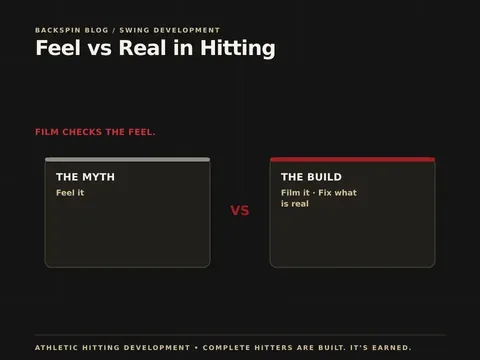
Rushing the progression is how early timing creeps back in. And remember: feel isn’t real. Film the freeze-at-contact reps and prove the barrel is really behind the hands.
7. Common mistakes
- Pushing the hands at the ball. Barrel behind the hands is not an arms-only swing. The body still turns; the barrel just meets the ball deeper.
- Letting it travel without a plan. Waiting on the ball while out of time just makes you late. Timing comes from being organized early, not from freezing.
- Casting the barrel. If the barrel gets out away from the body early, it beats the hands to the ball and you’re back to pull. (See Casting.)
- Judging by direction only. A weak flare the other way isn’t the goal. Hard contact with the barrel behind the hands is.
THELESSON.
- Barrel behind the hands.
- Let it into the zone.
- Stay inside the ball.
- Don't push the hands.
- Film it. Feel isn't real.
Complete Hitters Are Built…Earned.
Quick answers
How do you hit the ball to the opposite field?
Contact the ball with the barrel of the bat behind the hands, closer to the catcher than the knob. That bat angle points the face of the bat to the opposite field, so the ball has to go oppo. Then let the ball travel deep enough to meet the barrel there.
What is the Oppo Nitro Zone?
It’s AHD’s name for the deeper contact point where the barrel can still be behind the hands. Letting the ball get into the Oppo Nitro Zone takes timing: the hitter has to be organized and on time with the swing, not early.
How does staying inside the ball help you go oppo?
Staying above and inside the pitch plane is roughly the first half of mastering the opposite field. It frees the hands to handle any pitch in the zone and removes wasted hand and barrel movement, so you can still be on time for a heater inside. Contacting the ball with the barrel behind the hands is the second half.
Does this work for fastpitch softball hitters?
Yes. The bat angle at contact decides direction in both sports. Fastpitch hitters have less time, so the timing cue of letting the ball into the Oppo Nitro Zone matters even more.
Is hitting to the opposite field a good approach?
Yes. A hitter who can drive the ball the other way can handle the outside pitch and adjust to off-speed, which makes him much harder to pitch to.
Don’t collect drills. Build a complete hitter.
Want a coach’s eyes on your contact point? Start with SwingChecker™ for free, train it every day in the AHD Complete Hitter Masterclass, or contact Coach about online remote baseball and softball training.
Complete Hitters Are Built… Not Given. Earned!
This article is part of the AHD guide Baseball Swing Mechanics. Start there for the full picture and every related article.