
By BK, Athletic Hitting Development
Complete Hitters Aren’t Born. They’re Built… and Earned.
Key takeaways
- A K-Vest uses four sensors (pelvis, upper back, lead arm, lead hand) to measure how fast each part turns and in what order.
- Force plates sit under each foot and measure how hard, which way and when the hitter pushes the ground.
- Together they show the whole chain, from the feet to the hands. Neither measures the eyes, decisions or the barrel.
- The tech serves the swing. Use it to answer ONE question: where is my energy leaking?
A K-Vest tells you HOW your body turns. A force plate tells you how you push the ground. Neither one tells you if you can hit.
A K-Vest uses four body sensors to measure how fast the pelvis, torso, lead arm and hand rotate and in what order. Force plates measure how each foot pushes the ground. Together they show how energy moves from the feet to the hands.
Train it: Swing Structure & Mechanics → Free tool: Online Swing Analysis + Filming Checklist →Parents ask me about both all the time now. A kid comes back from a showcase or a big facility with a printout full of colored lines and degrees per second, and Mom wants to know if it's good news or bad news. Fair question.
I've had hitters and families bring me every product, every hitting and athletic development tool, and printouts from every high-tech tool out there... listen, every tool can help. But what truly helps a hitter reach his or her potential is understanding the 4 pillars of the development ecosystem and addressing EACH one.
1. How does a K-Vest work for hitters?
A K-Vest (K-Motion's system, sold for baseball as K-Baseball) is four small motion sensors strapped to the hitter. One sits on the tailbone (pelvis), one on the upper back (torso), one on the lead arm above the elbow, and one on the back of the lead hand inside the batting glove. The hitter swings off a tee, flips, a machine or a live arm, and the sensors stream 3D data to a tablet in real time.
It measures how fast each of those four body parts spins, in degrees per second, and WHEN each one hits its top speed. It also tracks posture: how much the pelvis and torso bend, tilt and turn through the swing.
- Kinematic sequenceThe order the four parts hit peak speed: pelvis 1, torso 2, lead arm 3, hand 4. The textbook pattern is 1-2-3-4, ground up. A 2-1-3-4 means the torso beat the pelvis, and that hitter usually has to start early and commit too soon.
- Peak speedsThe top rotational speed of each part. Every link should be faster than the one below it, with the hand fastest.
- Speed gainsHow much speed each link adds to the next. A small gain is a leak: energy came up the chain and didn't get passed on.
- Separation and timingThe time between each peak. Too little and the parts fire as one block. Too much and the energy dies before it gets to the barrel.
Here's the deal in cage language. The K-Vest is measuring the bump, the energy transfer in the middle of the swing. It shows whether the hips hand off to the shoulders, the shoulders to the arms, and the arms to the hands... or whether somebody drops the baton.
WHAT THE TECH SEES
FEET TOHANDS.
- Force plates: load, shift, brake
- K-Vest: pelvis, torso, arm, hand
- Order of peak speeds
- Speed added link to link
THE NUMBER IS A FLASHLIGHT
2. How do force plates work for hitters?
Force plates are two flat plates, one under the back foot and one under the front foot. Each has sensors in the corners that read how hard, which direction and exactly when the foot pushes into the ground. Scientists call that ground reaction force. I call it where the swing starts.
- Vertical. Pushing down into the ground. This shows the load (sitting into the back side) and the drive.
- Front to back. Pushing toward the pitcher, then braking against it. This is the weight shift moving forward and the front side stopping it.
- Side to side. The stabilizing forces that keep the hitter balanced and on line.
On the printout you'll see a force curve for each leg (when each foot loads, peaks and lets go), peak force as a percent of body weight, timing compared to contact, and a left/right balance.
The big one is the front side. A strong, athletic front leg after the front foot lands is a brake, and a good brake is what turns forward motion into rotation. A back leg that peaks too early dumps its energy before the barrel gets there. A front leg that shows up late can't hold the hitter steady through contact.
Video shows you the motion. Force plates show you the push behind it.
3. What can't a K-Vest or force plate tell you?
Put them together and you get the whole chain. The force plates show what happens between the feet and the ground. The K-Vest picks it up at the pelvis and follows it to the hands. If the vest shows a weak pelvis, the plates can often tell you why: the hitter never loaded the back side, or the front leg never braked.
Now the other side of it. Here's what neither tool measures:
- The eyes. You can have a perfect 1-2-3-4 sequence and still strike out. If the ball looks white and fuzzy, good luck.
- Decisions. Neither tool knows if you swung at a heater or a hanger, or a slider in the dirt.
- The barrel. The sensors stop at the hand. Bat path, the Mechanically Advantageous Angles (MAA) AHD hitters build, and contact quality need other tools and a coach's eye.
- The athlete. Every hitter makes speed a little differently. Chasing a textbook graph can turn a kid into a robot, and there are no robots allowed in my cage.
"Ball — powdered." That's the sound of a barreled ball. Chase that sound, not a prettier graph.
The data is only as good as the coach reading it.
4. How should a hitter use K-Vest or force plate data?
The tech serves the swing. The swing doesn't serve the tech. AHD builds complete hitters on four pillars: The Swing, Athletic Development, the Hitting Processor and the Mental Approach. These tools only touch the first two. The Hitting Processor and the Mental Approach still have to be built rep by rep.
- Ask one question"Where is my energy leaking?" Less is more. Don't walk out with ten things to fix.
- Get exact"Your pelvis peaks late" is a start. Ask what that looks like on video and what drill fixes it.
- Retest the same waySame setup, same pitch speed, a few weeks apart. A number only means something next to the last one.
- Keep hitting real pitchesA better graph off a tee that doesn't show up against a live arm is just a better graph.
No vest at home? No problem. Most of what these tools catch shows up on good slow-motion video if you know where to look: a back side that never loads, a front side that never braces, hands that start before the hips. Run SwingChecker™ free to see your hitter's top priorities, or send side and rear video to AHD Swing Lab for a coach's review.

THELESSON.
- One question per test
- Get exact: video + drill
- Retest the same way
- Prove it on live pitching
Complete Hitters Are Built…Earned.
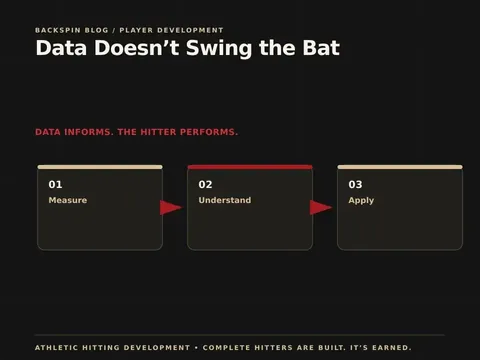
Want to go deeper? Read Data Doesn’t Swing the Bat and Caveman vs. Tech: Hitting Drills That Build Real Skill.
Quick answers
What does a K-Vest measure in a baseball swing?
A K-Vest uses four sensors on the pelvis, upper back, lead arm and lead hand to measure how fast each part rotates, the order they reach peak speed (the kinematic sequence) and the hitter's posture through the swing.
What is a good kinematic sequence for hitters?
The textbook pattern is pelvis, torso, lead arm, then hand (1-2-3-4), with each part faster than the one before it. Hitters create speed a little differently, so the pattern is a guide, not a rule.
What do force plates show for hitters?
Force plates show how hard, which way and when each foot pushes the ground: the load into the back side, the move forward and the front leg braking it into rotation.
Does my hitter need a K-Vest or force plate session?
No. They can help find energy leaks, but they don't measure vision, decisions or the barrel. Good slow-motion video and a trained coach catch most of the same problems.
Don’t collect drills. Build a complete hitter.
Complete Hitters Aren’t Born. They’re Built… and Earned.