By BK, Athletic Hitting Development
Complete Hitters Are Built… It’s Earned!
1. The short version
- Late barrel adjustability is not simply touching a ball you were late on.
- It is the ability to make a small, late correction in timing or pitch location while preserving posture, turn, barrel accuracy, and force.
- Chase DeLauter is an outstanding film-study example: tight across-the-body adjustment inside; long, powerful extension the other way.
A lot of hitters can make a late adjustment. Far fewer can make one and still hit the ball hard.
That is what jumps out when you watch Chase DeLauter. He has the strength and intent to do damage, but his swing is not married to one exact contact point. When he is a tick late on a pitch in, he can keep the hands tight and work them straight across his body to get the barrel to the ball. When he is a tick early on a pitch away, he can stay through it and create massive extension to the other side.
That is not an “inside-out” survival swing. It is a powerful swing that is still organized late.
2. The difference: adjustability vs. contact-only
Higher-average, lighter-hitting players are often excellent at finding the barrel late. They may let the ball travel, manipulate the barrel, and take what the pitcher gives them. That can be a real skill.
But there is another level: a hitter who can adjust late and still create force. The difference is not that one hitter cares about contact and the other cares about power. The difference is whether the swing has enough organization underneath it to preserve the attack.
That is why late adjustability belongs in the complete hitter conversation. It connects the swing to strength, athleticism, pitch recognition, timing, and the confidence to stay aggressive.
3. The swing mechanism: stay organized long enough to decide late
There is no single hand path that fits every hitter or every pitch. But the best adjusters tend to protect the same things. They do not throw the barrel early, lose their posture, or abandon the turn because the pitch surprised them.
They hold athletic position. The head and torso stay controlled enough for the hands and barrel to have options. Losing balance or body control removes those options fast.
They keep the barrel close enough to the turn. A cast or early dump makes the route too long. A connected barrel gives the hitter a chance to still enter the ball late.
They let the barrel match the pitch instead of forcing one contact point. The swing keeps moving with intent, but it can tighten inside or travel through the opposite-field window.
They preserve force. The correction is a small route adjustment—not a panic reach, a push, or a rollover.
That is a huge distinction for coaches: do not praise a result just because a hitter found a way to touch the ball. Ask whether the hitter kept an athletic position, maintained the barrel, and produced a usable line drive. Ball flight tells the truth.
4. Two pictures: late in and early away
Pitch in · hitter a tick late
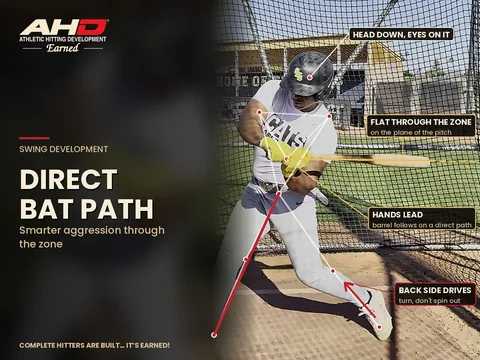
Pull the hands tight across the body
DeLauter can keep the barrel from leaking and work the hands across his torso to get to an inside pitch. The contact may be a touch deeper than his perfect contact point, but the turn and barrel stay organized enough to hit it hard.
Not: casting the barrel, bailing out, or flicking at it.
Pitch away · hitter a tick early
Stay through it with real extension
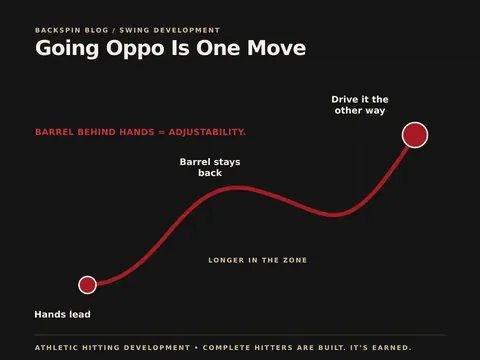
Instead of cutting the swing off or rolling over, he can let the barrel travel through the pitch and extend through the other side. It is an aggressive opposite-field adjustment, not a push.
Not: reaching, shoving the hands, or trying to guide the ball.
Those are two different pictures, but the principle is one: an organized swing creates options. The hitter who loses position early has no options. The hitter who keeps the barrel alive can keep deciding later.
5. How to build more late adjustability
You do not build this by telling a hitter to “use your hands” or “just stay inside.” Build the ingredients, then train the problem.
1. Inside pitch: late-but-strong rounds
Set a front toss or machine target slightly inside. The hitter’s job is to let it get a little deeper, keep the barrel tight, and hit a hard line drive without spinning out. Grade the rep by posture, barrel accuracy, and ball flight—not just whether it was fair.
2. Away pitch: stay-through-the-window rounds
Move the target away. Start the hitter on time for the heater, then have them let the barrel travel through the ball for a firm opposite-field line drive. The cue is “through it,” not “push it.”
3. Mixed-location decision rounds
Use inside/middle/away pitches with changing speed. The goal is not a pre-planned hand path. The goal is to See It → Recognize It → Time It → Decide → Attack It while keeping the same athletic position long enough to adjust.
4. Use video to find the first leak
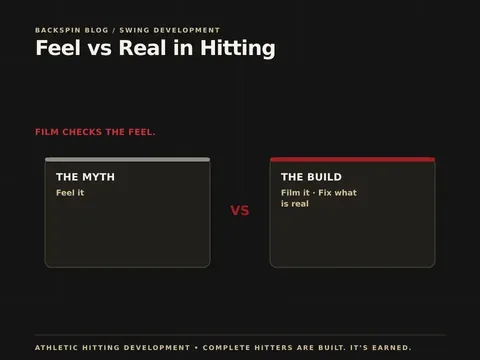
If the barrel cannot adjust, do not assume the hands are the cause. Check setup, gather, stride/forward move, posture, launch, and whether the barrel dumped or cast before contact. Fix the first breakdown—not the last symptom.
Start with a good enough physical pattern, then challenge it with real information. A hitter who only sees perfect flips does not get enough chances to learn how to solve imperfect timing.
6. Do not confuse adjustability with passivity
Some coaches talk about adjustability like it means the hitter should wait, slap, or give away his best swing. No. Great hitters are ready to attack the heater in their zone. The better their swing is organized, the less a small timing error has to turn into a weak out.
That is the bigger lesson from DeLauter’s swing: build enough force to matter, then build enough athleticism and barrel control to use that force on more than one perfect pitch.
Force that can still adjust. That is a dangerous hitter.
Film note: This article uses Chase DeLauter as a coaching observation and film-study example, not as a claim that every successful swing or every pitch follows one exact pattern. The lesson is the transferable movement principle: preserve posture, turn, and barrel options as long as possible.
Quick answers
Is late barrel adjustability just good hand-eye coordination?
Hand-eye coordination matters, but it is not enough. The hitter also needs a usable athletic position, a barrel route that is not too long, timing, and enough strength to keep the adjustment from becoming a weak rescue swing.
Can young hitters train this?
Yes—at an age-appropriate speed. Start with a simple athletic setup and controlled mixed-location toss. As the hitter owns posture and barrel control, add more velocity, movement, and decision-making.
What is the first red flag?
If the hitter has to cast, dump, lose balance, or roll over to get to a pitch, the swing has run out of options before contact. That is the first issue to assess.
This article is part of the AHD guide Baseball Swing Mechanics. Start there for the full picture and every related article.