By BK, Athletic Hitting Development
Complete Hitters Are Built… It’s Earned!
Key takeaways
- A direct bat path is a tool, not the whole diagnosis.
- Direct does not mean rushed. The hitter still has to hold an athletic position and let the pitch tell him what it is.
- Random aggression is just swinging more. Good aggression is a plan.
- Grade three things together: athletic position, decision quality and barrel route.
A direct bat path is not enough.
A direct bat path is a tool, not the whole answer. It only pays off when the hitter holds an athletic position, recognizes the pitch early and attacks the right pitch with a plan, not random aggression.
Train it: Swing Structure & Mechanics Masterclass →Every coach wants one. We want the barrel to get to the ball efficiently. We want the hitter to stay connected, avoid casting and give himself the largest margin for error possible. That is real.
But a direct path is not the whole answer. It is a tool. And like any tool, it only works when it’s used at the right time, on the right pitch, from a good athletic position.
1. What the pros are working on
Baseball America’s September org reports named the things young pro hitters were building: more bat speed (Marek Houston, Twins), more separation (Jake Munroe, Angels), a more direct bat path (Bryan Rincon, Phillies, and Brandon Compton, Marlins), a shorter stride and better use of the backside (Caleb Bonemer, White Sox), and more aggression (Rincon again).
Every one of those is a reasonable thing to develop. The danger is treating any one of them as the entire diagnosis.
The better question is not, “Is his path direct?” The better question is, “Can he get into an athletic position, see the pitch early enough, make the right decision, and then deliver a direct barrel to the correct location?”
That is complete hitting.
2. Direct does not mean rushed
A hitter can have a direct path and still be early. He can have a direct path and still chase. He can have a direct path and still pull off the ball because he never held his athletic position long enough.
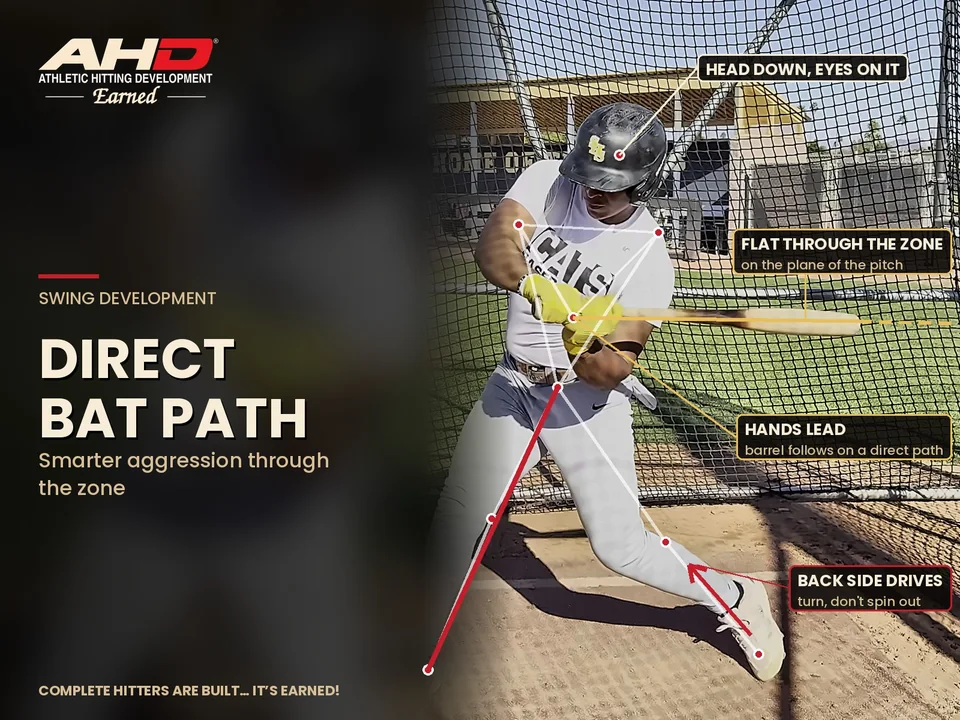
Direct does not mean “throw the hands.” It means the barrel has a short, useful route from launch to contact. That route comes from Mechanically Advantaged Angles (MAA): the body and barrel in positions that let the hitter stay organized, let the pitch tell him what it is, then attack with speed and adjustability.
That is why AHD puts the Hitting Processor right beside the swing:
See It → Recognize It → Time It → Decide → Attack It.
If the processor is late, the swing often looks like the problem. A hitter fooled by spin may dump the barrel, lose posture, straighten up early or cast. Those moves may need coaching, but they can also be the body’s last-second response to bad information.
POSITION. PLAN. PATH.
DIRECTIS A TOOL.
- Hold the athletic position.
- See it early. Decide.
- Then deliver the barrel.
- Direct ≠ rushed.
THE PATH ONLY WORKS ON THE RIGHT PITCH.
3. Aggression has to be earned
“Be more aggressive” is one of the most misused phrases in hitting. Random aggression is not confidence. It’s just swinging more.
Good aggression is a plan. It sounds like this:
- “I’m ready for the fastball in my heater zone.”
- “If I see the hanger, I adjust and attack it.”
- “If it starts outside my plan, I let it go.”
That’s the AHD Heater/Hanger approach. Anticipate and react when the situation gives you a pitch you can damage. Just react when you don’t have enough information to hunt. Either way, the hitter isn’t guessing blindly.
A direct path attacking poor pitches isn’t maximized. It’s wasted.
4. The 3-part AHD test
When we look at a hitter on video, we evaluate three things together.
1. Athletic position
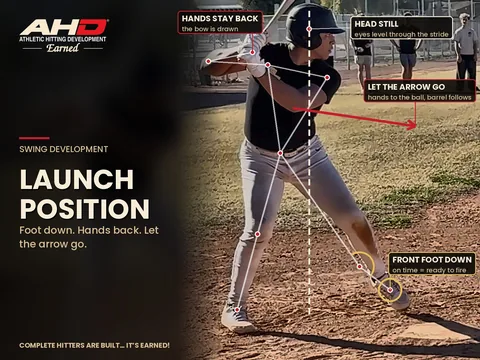
Does the hitter hold balance and body control long enough? Does the front knee stay bent into contact? Is the head quiet enough for the eyes to work? A hitter who leaks early makes every later move harder.
2. Decision quality
Was this a pitch to attack? Was he on time for the fastball? Did he recognize spin soon enough to adjust? Never grade a swing as if the pitch didn’t exist.
3. Barrel route
Once he decides to go, does the barrel stay above the ball long enough? Does it work through the intended contact window? Can he cover in, middle and away without changing his entire move?
Only after all three can we decide what to fix first. Not sure which one is your hitter’s first priority? SwingChecker™ ranks it free.
5. A practice plan for this week
- Dry swingsHold the athletic position through launch and contact. Start with the barrel above the ball. Finish balanced. No ball needed.
- Front toss with one attack zoneAnything outside the zone is a take. The goal isn’t volume. It’s good decisions followed by a clean barrel route.
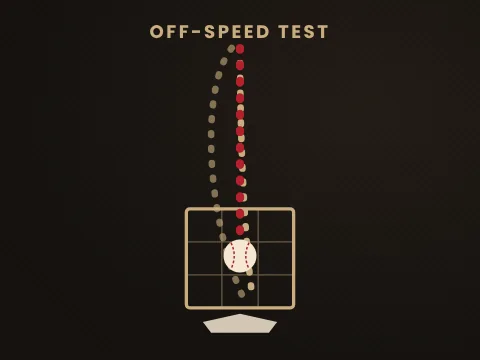
- Mixed speeds, machine or live armThe hitter calls “heater” or “spin” as early as he can, then competes.
- Review 3 clips onlyOne good decision, one miss, one adjustment. That’s it.

THELESSON.
- Athletic position first.
- A plan, not random aggression.
- Heater zone. Hanger adjust.
- Then a direct barrel.
- That’s complete hitting.
Complete Hitters Are Built…Earned.
Quick answers
Is a direct bat path the most important part of the swing?
No. A direct path is a tool. It only pays off when the hitter holds an athletic position, recognizes the pitch early and attacks the right pitch. Grade position, decision and barrel route together.
What does “be more aggressive” mean for a hitter?
It means having a plan, not swinging more. Be ready for the fastball in your heater zone, adjust and attack the hanger, and let everything outside the plan go.
Can a hitter have a direct path and still struggle?
Yes. A hitter with a direct path can still be early, chase, or pull off the ball if he loses his athletic position or reads the pitch late.
How do I practice a direct bat path the right way?
Start with dry swings holding the athletic position, then front toss with one attack zone, then mixed speeds where the hitter calls fastball or spin early. Review only a few clips.
Does a short swing mean throwing the hands at the ball?
No. Direct doesn’t mean “throw the hands” or rush. It means the barrel has a short, useful route from launch to contact, built from Mechanically Advantaged Angles so the hitter stays organized and adjustable.
Inspired by: Baseball America, “10 MLB Prospects Who Caught Our Attention In September 2026 Org Reports” (Oct. 2, 2026). The pro development notes are used as coaching prompts, not as universal mechanical prescriptions.
Don’t collect drills. Build a complete hitter.
Complete Hitters Are Built… It’s Earned!
This article is part of the AHD guide Baseball Swing Mechanics. Start there for the full picture and every related article.