By BK, Athletic Hitting Development
Complete Hitters Aren’t Born. They’re Built… and Earned.
Key takeaways
- The best softball bat speed drills build usable speed: speed she can produce while still finding the ball at game timing.
- Speed comes from the body first. Legs and hips start it, the torso builds it, the hands deliver it.
- Six drills cover it: intent swings, light overload/underload, rotational med ball throws, high tee intent, fast front toss and a swing-or-take round.
- Train speed early in a session, 2–3 times a week, measure it the same way every time, and prove it against a moving ball.
The best softball bat speed drills train her body to rotate hard, in sequence, with full intent, and then prove that speed against a moving ball at game timing. Intent swings, light overload and underload bats, rotational med ball throws and fast front toss build speed that actually shows up in games.
The best softball bat speed drills are intent swings, light overload and underload bats, rotational med ball throws, high tee intent and fast front toss. Train them early in a session two or three times a week and finish with a moving ball so the speed shows up in games.
Train it: Athletic Development → Free tool: Exit Velocity & Bat Speed Calculator →Every week a softball parent asks me how to make her daughter swing faster. Great question. But here’s the honest part first: a lot of fastpitch hitters who look slow in games aren’t slow. They’re late. That’s a different fix.
So this post does two things. It shows you how to tell if bat speed is really the problem, and it gives you the six drills I trust to build speed she can take into a game. Don’t collect drills. Build a complete hitter.
1. What does bat speed mean in fastpitch?
In most high school and college softball the pitcher throws from 43 feet, and a 70 mph pitch gives her roughly the reaction time of a mid-90s baseball fastball. She doesn’t have time to muscle the bat around. Speed has to be built into the swing, not added at the last second.
The best speed is USABLE speed.
Usable speed comes from the ground up. The legs and hips start it, the torso builds it, and the hands and barrel deliver it. When that order is right, the bat gets fast without her forcing it. That’s controlled violence: aggressive and athletic, but organized.
It’s also why AHD hitters work into Mechanically Advantaged Angles (MAA): an athletic setup, a loaded back side, the barrel behind the hands and an athletic front leg, so the body can actually deliver the force it builds.
USABLE SPEED
FAST ANDON TIME.
- Legs and hips start it
- Torso builds it
- Hands deliver it
- Proven against a moving ball
THE BEST SPEED IS USABLE SPEED
2. Is it really bat speed, or is she late?
Test before you train. Watch what happens off the tee versus in a game.
| What you see | What it usually means |
|---|---|
| Rips it off the tee, fouls hard pitches late in games | Timing. Train her start first. |
| Slow off the tee AND in games | Real bat speed. Train the drills below. |
| Fast early in practice, slow late in a tournament | Strength and conditioning. Build the engine. |
| Fast swing, weak or topped contact | Path or contact point. Check the swing. |
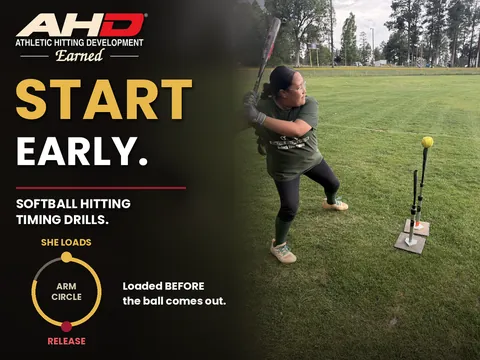
If timing is the issue, start with Softball Hitting Timing Drills. Not sure which one she has? Run the free SwingChecker™. It ranks her top priority across all 4 Pillars in about three minutes.
3. Six softball bat speed drills that carry into games
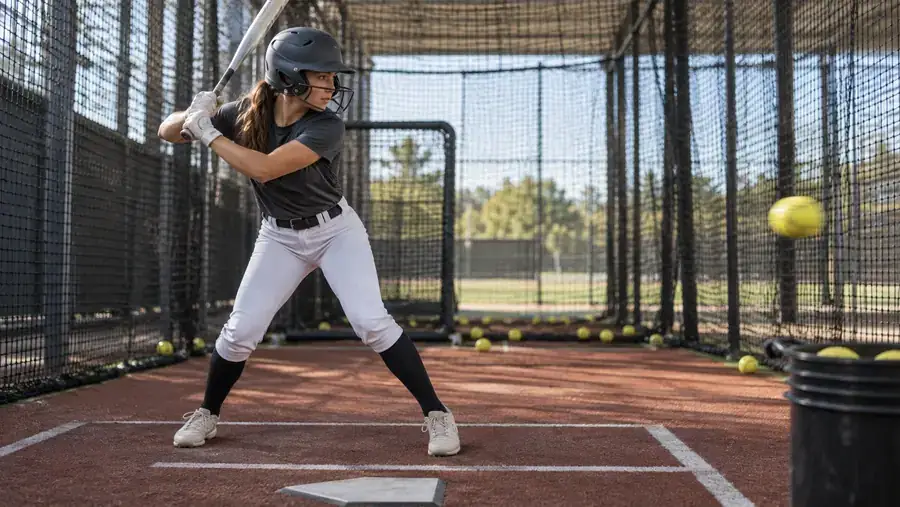
- Intent swings off the teeFive swings at 100 percent, rest 30–45 seconds, 3 sets. Most hitters never practice swinging at full speed. Stop the set when the speed drops.
- Light overload / underloadAlternate a slightly heavier bat, a slightly lighter bat and her game bat: 3 swings each, 3 rounds, always finish with the game bat. Keep the weight changes small so the swing doesn’t change.
- Rotational med ball throwsA light med ball thrown hard into a wall from her hitting stance, 5 throws a side, 3 sets. It trains the hips and torso to fire in order without a bat in her hands.
- High tee intentTee at the top of the zone, full intent, 3 sets of 5. Rise-ball pitchers live up there. She has to get on top of the ball with speed, not chop down at it.
- Fast front tossFrom a short distance behind a screen, firm tosses at a quick rhythm, 4 rounds of 6. Speed only counts if she can be on time and still swing fast.
- Swing-or-take roundMachine or live arm at game speed with a few pitches below the zone. Full speed on strikes, take the low ones. 4 rounds of 6. This is speed plus a decision, like a real at-bat.
Before every intent set I want her thinking "See that wall… knock it down!" That means big intent, with control. She isn’t trying to swing pretty. She’s trying to swing with purpose and still be on balance at the finish.
On the swing-or-take round, the drop ball is the test. Drop balls are thrown down through the zone with topspin, and hitters who chase them beat them into the ground. A fast swing at a bad pitch is still a ground ball.
Keep it safe: a protective screen for every toss, soft or bounce balls at short range, and stop if anything hurts. For more on heavy and light bats, read Weighted Bat Training: Pros and Cons.
4. How often should she train bat speed?
Two or three times a week is plenty for most high school and travel hitters. Put the speed work early in the session, after a real warm-up, while she’s fresh. Speed trained tired isn’t speed. It’s just effort.
- Pick three drills a day. Intent swings plus two others. About 15 minutes.
- Quality over volume. When the swings slow down, the set is over.
- Finish with a moving ball. End every speed day with fast front toss or the swing-or-take round.
- Build the body too. Bat speed lives in Strength & Explosiveness, one of the 4 Pillars. A softball strength plan feeds every drill here.
5. How do you know if her bat speed is improving?
Measure it the same way every time. One swing sensor, mounted the same way, same warm-up, same tee height. Take her best few full-intent swings, not the average of tired ones. Retest every four to six weeks.
Then check the part that matters: is she hitting the ball harder in games? Listen for it. "Ball — powdered." That’s the sound of a barreled ball. Chase that sound, not a pretty number on an app.
For a fuller test, build a softball bat speed profile across two or three bat weights, and log her numbers in the free Exit Velocity & Bat Speed Calculator.
THELESSON.
- Train speed early, fresh
- Intent swings every time
- Stop when the speed drops
- Finish with a moving ball
Complete Hitters Are Built…Earned.
6. What if the drills aren’t working?
If her numbers stall for six weeks, the drill usually isn’t the problem. It’s a swing that leaks energy, a body that needs more strength, or a late start. That’s why I look at the whole hitter, not one number.
Start with the free SwingChecker™. Try Athletic Development Lesson 1 free, then build her engine in the full Athletic Development course. Want my eyes on her swing? That’s what my online softball hitting lessons are for. It’s a great day to hit!!
Want to go deeper? Read The Softball Bat Speed Profile and How to Hit a Softball Farther (and Harder): A Fastpitch Power Guide.
Quick answers
What is the best drill to increase bat speed in softball?
Intent swings off the tee are the best place to start, because most hitters never practice swinging at full speed. Pair them with rotational med ball throws and finish with fast front toss so the speed carries to a moving ball.
Do weighted bats help softball bat speed?
Slightly heavier and lighter bats can help when the weight changes are small and she always finishes with her game bat. Big jumps in weight tend to change the swing, which defeats the purpose.
How often should a softball player do bat speed drills?
Two or three times a week, early in the session after a warm-up. Stop each set when her swings slow down, because tired speed work builds effort, not speed.
Why is my daughter fast off the tee but slow in games?
Usually she is late, not slow. Have her start her load earlier with the pitcher and train timing with mixed-speed front toss before adding more speed work.
Sources: OHSAA: 2010 NFHS softball rule changes (pitching distance to 43 feet)
Don’t collect drills. Build a complete hitter.
Complete Hitters Aren’t Born. They’re Built… and Earned.