
By BK, Athletic Hitting Development
Complete Hitters Aren’t Born. They’re Built… and Earned.
Key takeaways
- In fastpitch, a lot of what looks like a swing problem is really a timing problem. Fix the start and the swing often cleans itself up.
- Good timing starts early. She loads with the pitcher’s windmill so she is ready before the ball is released.
- Timing is trained with changing speeds, not the same pitch over and over. Same-speed reps build a groove, not a hitter.
- Timing is part of the Hitting Processor: see it, time it, decide, attack it. Train it DAILY, a few minutes at a time.
The best softball hitting timing drills teach a hitter to start her load early with the pitcher, stay balanced and ready, and adjust when the speed changes. Front toss with mixed speeds, a call-the-pitch drill and short quick-toss reps do more for timing than another hundred swings off the tee.
The best softball timing drills teach her to load early with the pitcher’s windmill and adjust to changing speeds. Start with mixed-speed front toss, a call-the-pitch drill and short quick toss, a few minutes every day.
Train it: Hitting Processor → Free tool: Load & Launch Timing game →I’ve watched a lot of fastpitch hitters get a “new swing” from somebody, and the problem never went away. Why? Because the swing wasn’t the problem. She was late. Late hitters cast, pull off and roll over because they’re trying to catch up.
So let’s train the thing that actually decides the at-bat. Here are six timing drills I use, with the reps, the cue and how to make each one harder.
1. Why is timing the first thing to fix in fastpitch?
The pitcher is close and the ball gets on her fast. In most high school and college play the pitching distance is 43 feet, and a 70 mph fastpitch pitch gives a hitter roughly the reaction time of a mid-90s baseball fastball. There isn’t time to start late and hope.
You can’t swing on time if you start late.
That’s why I teach timing before I tinker with mechanics. When she starts early and gets to a balanced launch position, she has a chance to be aggressive and athletic. When she’s late, everything breaks down, no matter how pretty her tee swing is.
If you want the full breakdown of reading the windmill, start with How to Time a Fastpitch Pitcher. This post is the drill work that makes it stick.
2. How do you know if she is late or early?
Watch the ball and watch her body. The misses tell you the story.
| What you see | What it usually means |
|---|---|
| Fouls hard pitches to the opposite side, jammed on the hands | Late on the fastball |
| Swinging through the high pitch | Late and trying to catch up |
| Pulls foul, out on her front foot, rolls over | Early, or lunging at the changeup |
| Load and stride happen as the ball arrives | Starting too late, so there’s no time to decide |
LATE OR EARLY?
STARTEARLY.
- Load with the windmill
- Land balanced before release
- Hands wait for the pitch
- Then attack it
TIMING FIRST. THEN MECHANICS.
Film one round from the side. If her front foot isn’t down and she isn’t loaded when the pitcher releases, you’ve found the fix.
3. Six softball timing drills that actually work
- Mixed-speed front tossTosser varies speed without warning: 6 rounds of 6. Cue: “Start early, wait with your hands.” Harder: shorten the distance and mix in more slow ones.
- Load with the circlePartner does a full windmill motion from a short distance, then tosses. She starts her load when the hands separate. 5 rounds of 5. Harder: tosser speeds up or slows the arm circle.
- Call the pitchBefore each toss she says “hard” or “soft” out loud as soon as she sees it, then swings or holds. 4 rounds of 8. Harder: add a third call for the changeup.
- Two-ball color callTosser holds two different colored balls, tosses one, and calls which color she must hit. She takes the other. 4 rounds of 6. Harder: call the color later.
- Short quick tossFrom a safe short distance behind a screen, quick tosses at a fast rhythm. She has to be loaded early to keep up. 3 rounds of 10. Harder: shorten the time between tosses.
- Game-speed mixMachine or live arm at game speed with a changeup mixed in at random. 5 rounds of 5. Harder: let the pitcher pick the order and count balls and strikes.
Notice what every drill has in common: the speed or the decision changes. That’s on purpose. A hitter who only sees the same pitch at the same speed learns a rhythm, and the first pitcher who changes speeds takes that rhythm away. These drills teach her to start early, read the pitch and adjust, which is exactly what a game asks her to do.
Start with the first two drills for a week. When she squares up most of a round, add the call-the-pitch and color drills. Save the game-speed mix for when her start is consistent. Progress the drill, not just the number of swings.
Keep it safe: use a protective screen for every toss drill, soft or bounce balls for the close-range work, and stop if anything hurts.
4. How do these drills help her hit the changeup?
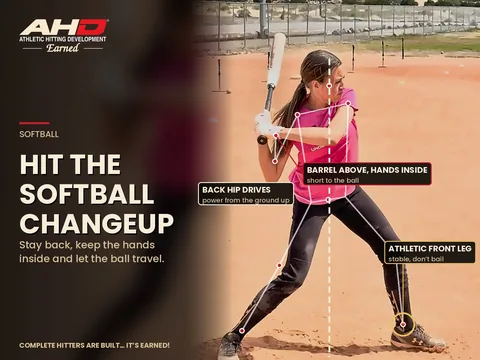
Here’s the secret: you don’t hit the changeup by waiting for it. You hit it by being on time for the fastball and staying loaded long enough to adjust. Start early. Land balanced. Let the hands wait.
- Gear to the fastball. Be early for the hard one, then adjust down.
- Stay loaded. If her hands go with her stride, she’s out of bullets for the slow pitch.
- Mix the speeds every day. Same speed builds a groove. Mixed speeds build a hitter.
For more on that pitch, read How to Hit a Changeup in Softball.
5. How often should she do timing drills?
Timing is part of the Hitting Processor, the third of my 4 Pillars: see it, time it, decide, attack it. It gets trained DAILY, not once a week before a tournament.
Ten minutes is plenty. Pick two drills, track how many she squares up, and change the drills when she owns them. Don’t collect drills. Build a complete hitter.
THELESSON.
- Two timing drills a day
- Mix the speeds
- Call the pitch out loud
- Track square-ups
Complete Hitters Are Built…Earned.
Want a plan built for her timing? Start with the free SwingChecker™ to find her top priority, train it in the Hitting Processor course, or work with me directly through online softball hitting lessons. It’s a great day to hit!!
Want to go deeper? Read How to Time a Fastpitch Pitcher: Softball Hitting Timing Made Simple and How to Hit a Changeup in Fastpitch Softball.
Quick answers
What is the best drill for timing in softball?
Mixed-speed front toss is the best place to start because it forces her to load early and adjust to different speeds. Add a call-the-pitch drill once she is comfortable.
Why is my daughter always late on the fastball?
Usually she is starting her load too late. Have her begin loading when the pitcher’s hands separate so she is balanced and ready before the release.
How do you practice softball timing at home?
Use soft or bounce balls with a partner, short distances and a screen. Mixed-speed tosses and the two-ball color call work well in a backyard or garage.
Should she time the changeup or the fastball?
Gear her timing to the fastball and stay loaded long enough to adjust to the changeup. Waiting for the slow pitch makes her late on everything else.
Sources: OHSAA: 2010 NFHS softball rule changes (pitching distance to 43 feet)
Don’t collect drills. Build a complete hitter.
Complete Hitters Aren’t Born. They’re Built… and Earned.