By Athletic Hitting Development
Complete Hitters Are Built… It’s Earned!
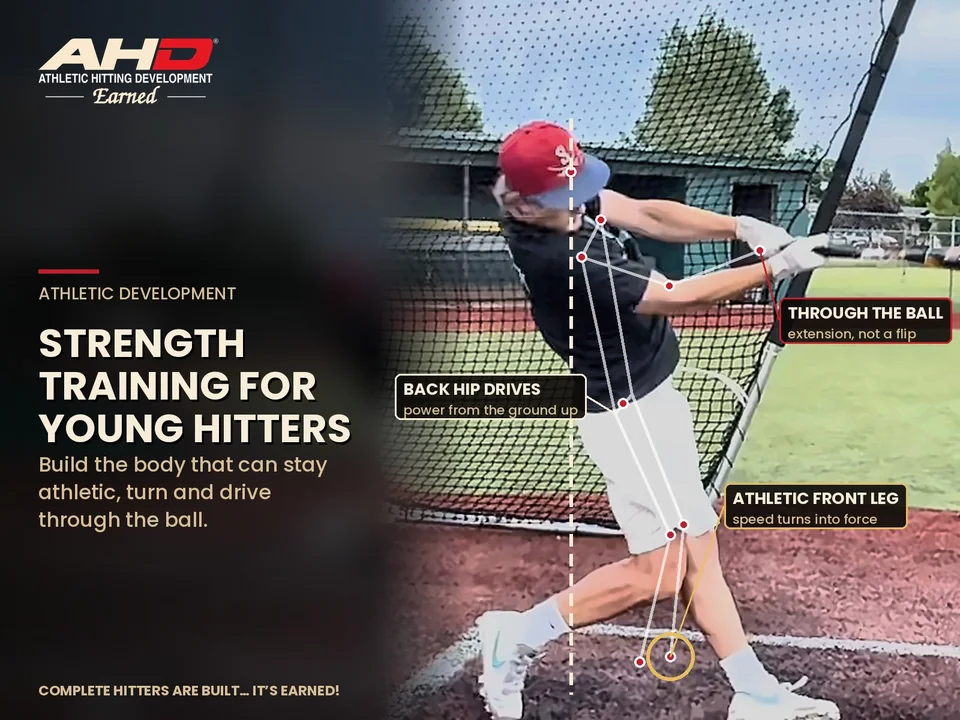
Every off-season, a lot of young hitters get bigger and somehow swing slower. Other kids never train at all because someone told their parents lifting weights would stunt their growth.
Focus on movement and play at 6–9, body-weight strength at 10–12, learning to lift with light loads at 13–14, and progressive strength and power at 15–18. Keep it supervised and technique-first, add load only when the movement is clean, and test before you train.
Train it: Athletic Development Masterclass →Both miss the point. Training has four jobs: keep the athlete healthy, make them stronger, make them faster and make them more explosive. Done right, at the right age, it’s one of the best things a young hitter can do.
Test, then train. Never the other way around.
1. Is strength training safe for kids?
Pediatric and strength-coaching organizations, including the American Academy of Pediatrics and the National Strength and Conditioning Association, agree that supervised, well-designed strength training is safe for children once they can follow instructions, often around age 7 or 8. The risk isn’t the weight; it’s poor technique, poor supervision and doing too much too soon.
Good youth training is coached, focused on technique and progressed slowly. Body weight comes first. Load comes later, and only when the movement is clean.
2. What it should look like by age
| Age | Focus | What it looks like |
|---|---|---|
| 6–9 | Movement and play | Running, jumping, landing, skipping, crawling, throwing. Games that build balance and coordination. No heavy lifting. |
| 10–12 | Body-weight strength | Squats, lunges, push-ups, hangs and planks with great form. Sprint and jump technique. Light medicine-ball throws. |
| 13–14 | Learn to lift | Technique with light loads: the hinge, the squat, presses and pulls. Arm care. More sprint and jump work. |
| 15–18 | Build strength and power | Progressive strength training, rotational power with the medicine ball, sprint speed. Off-season build, in-season maintain. |
| 19+ | Train like an athlete | A full training year: build, convert to speed, maintain in-season, recover. |
SIX NUMBERS
TEST.THEN TRAIN.
- Jump & sprint
- Med-ball throw
- Push-ups & pull
- Balance
HEALTH. FORCE. SPEED.
3. Train the athlete, not the mirror
Size that doesn’t move fast is decoration. Strength you can’t express in a fraction of a second doesn’t show up in a game. If you list every exercise in your athlete’s current program and fewer than a quarter of them build speed or power, the program is missing the part that builds bat speed.
Health first. Force second. Speed always.
4. The 6-number athlete profile
This is the Test Day that opens the AHD Athletic Development course. It takes about 25 minutes. Warm up for eight minutes, then take 2–3 attempts at each test with full rest and keep the best. Use the same surface and shoes every time you retest.
- Broad jump: two-foot takeoff and landing, measured to the back heel.
- 10-yard sprint: start from an athletic stance, timed from first movement.
- Rotational med-ball throw: hitting stance, throw for distance (ball weight by age below).
- Push-ups in 60 seconds: chest to a fist-height target.
- Upper-body pull: ages 6–12, a flexed-arm hang (chin above the bar) for time; 13 and up, max chin-ups.
- Single-leg balance: hands on hips, up to 30 seconds on each side.
5. Benchmarks by age
First number = Solid. Second number = Strong. Below Solid = needs work. These are for baseball players and boys; see the note below for softball and girls.
| Age | Solid / Strong |
|---|---|
| Ages 6–9 | Broad jump 48 / 60 in 10-yd sprint 2.40 / 2.20 s Med ball (2 lb) 15 / 22 ft Push-ups 8 / 15 Flexed-arm hang 5 / 12 s Balance 15 / 30 s |
| Ages 10–12 | Broad jump 60 / 72 in 10-yd sprint 2.15 / 2.00 s Med ball (4 lb) 20 / 28 ft Push-ups 12 / 20 Flexed-arm hang 10 / 20 s Balance 25 / 30 s |
| Ages 13–14 | Broad jump 66 / 78 in 10-yd sprint 2.00 / 1.85 s Med ball (4 lb) 28 / 36 ft Push-ups 18 / 28 Chin-ups 3 / 7 Balance 30 s / 30 s + 10 s eyes closed |
| Ages 15–18 | Broad jump 72 / 86 in 10-yd sprint 1.80 / 1.65 s Med ball (6 lb) 32 / 42 ft Push-ups 25 / 38 Chin-ups 6 / 12 Balance 30 s / 30 s + 10 s eyes closed |
| Ages 19+ | Broad jump 78 / 90 in 10-yd sprint 1.72 / 1.60 s Med ball (6 lb) 38 / 48 ft Push-ups 30 / 45 Chin-ups 8 / 15 Balance 30 s / 30 s + 10 s eyes closed |
Softball and girls: same tests. Broad jump about 15% shorter, sprint about 0.10 seconds slower, push-ups about 60% of the counts above, flexed-arm hang through age 14, and a 4 lb medicine ball at 15 and up (Solid 26 ft, Strong 34 ft). Hand-timed sprints read 0.1–0.2 seconds faster than electronic timing.
6. Read the profile
- Speed-limited: the power tests (jump, sprint, med ball) are low while strength (push-ups, pull) is Solid. Train speed and power.
- Force-limited: strength is below Solid. Build strength first; it’s the container for power.
- Stability-limited: balance is below Solid on either side. Fix the base before adding load.
An athlete who is strong but slow needs different training than one who is fast but weak. Guessing wastes off-seasons. For the bat-speed side specifically, read how to increase bat speed with rotational power.
7. Go deeper: the Strength, Speed & Power Program
Ninety lessons in the right order: durability and arm care, the six strength patterns, sprint speed, rotational power and a full training year — retested every block against your Test Day numbers.
The first three lessons are free. Start with Lesson 1: Test Day: Your Athlete Profile — it takes about ten minutes and gives you a score to retest against.
See the full Strength, Speed & Power Program →

THELESSON.
- Body weight first.
- Technique before load.
- Train the athlete, not the mirror.
- Retest each block.
Complete Hitters Are Built…Earned.
Quick answers
At what age can kids start strength training for baseball or softball?
Supervised, well-designed strength training is considered safe once a child can follow instructions, often around age 7 or 8. Young athletes should start with body-weight movements and technique, and add load gradually as they get older and their form is consistent.
Does lifting weights stunt growth?
There is no good evidence that properly supervised strength training stunts growth. The real risks come from poor technique, lack of supervision and too much load too soon.
How can I tell what my young athlete needs to train?
Test before you train. Six simple tests (broad jump, 10-yard sprint, rotational med-ball throw, push-ups, an upper-body pull and single-leg balance) show whether an athlete is limited by speed, strength or stability.
What is a good 10-yard sprint time for a youth baseball player?
It depends on age. As a guide, about 2.15 seconds is solid for ages 10–12, 2.00 seconds for 13–14 and 1.80 seconds for 15–18, with strong times roughly 0.15 seconds faster. Hand timing reads faster than electronic timing.
What medicine ball weight should a young hitter use?
On AHD’s Test Day, ages 6–9 throw a 2 lb ball, ages 10–14 a 4 lb ball and ages 15 and up a 6 lb ball. Softball players and girls stay with a 4 lb ball at 15 and up.
This article is part of the AHD guide Bat Speed & Power Training. Start there for the full picture and every related article.