COMPLETE HITTERS ARE BUILT… NOT GIVEN. EARNED!
At its core, hitting is a collision problem powered by athletic movement and limited by time. The hitter has to create force, transfer it through the body, accelerate the barrel, put that barrel on a useful path, recognize a moving pitch, time it, make a decision and create a high-quality collision—in roughly four-tenths of a second against high-level velocity.
That is exactly why Athletic Hitting Development does not treat hitting as “just a swing.” The swing matters enormously, but the swing is only one piece of the system. A complete hitter must move well, create force, see and recognize the pitch, control time, make decisions, adjust the barrel and compete.
Create the largest margin for error for solid contact while generating maximum useful force and an effective bat-to-ball angle. That means we are not chasing a pretty swing. We are building a swing that survives the real game.
The Entire Hitting Problem in Two Time Scales
A high-velocity pitch can travel from release to the hitting area in about four-tenths of a second. The actual bat-ball collision lasts only around one thousandth of a second. The first number is the hitter’s information-and-movement problem. The second is the collision problem.
≈ 0.4 seconds
See the baseball, recognize what it is, estimate where it is going, time it, decide and get the barrel there.
≈ 0.001 seconds
The bat and ball collide. The ball’s velocity changes dramatically, then it is gone.
Everything AHD trains before contact exists to improve one of those two problems: arrive better, collide better.

HITTING IS A COLLISION PROBLEM
LIMITED BYTIME.
- About 0.4 seconds to arrive.
- About 0.001 seconds to collide.
ARRIVE BETTER. COLLIDE BETTER.
1. The Swing Starts With the Ground
The swing is not created by the hands alone. The hitter interacts with the ground first. When the athlete applies force into the ground, the ground applies an equal and opposite force back into the athlete. Those ground reaction forces help the hitter move, stabilize, redirect momentum and rotate.
This is why AHD starts with Athletic Setup, not with a bat-path drill. The hitter needs a body position capable of producing force, accepting force and changing direction without losing posture or body control.
Start athletic. Stay athletic. Finish athletic. Balance does not mean standing still. It means controlling your center of mass while the body is moving aggressively.
2. Torque Creates Rotation
Rotational force is called torque. Torque is produced when force acts at a distance from an axis of rotation. In the swing, the body creates torque around the hips, trunk, shoulders, elbows and wrists.
A powerful hitter does not simply “spin.” The athlete creates and manages force so rotation happens in useful positions and in a useful sequence.
3. Sequence Is How the Body Transfers Energy
AHD teaches the swing as one connected movement. A simplified kinetic chain looks like this:
The larger body segments help create and transfer energy toward smaller, faster-moving segments. This is one reason the barrel can become so fast without the hitter trying to make every body part move at maximum speed simultaneously.
Think less about “fire everything” and more about organize → sequence → accelerate.
4. Why Compact Early Can Become Explosive Late
Moment of inertia describes how resistant a rotating system is to changes in rotational speed. When mass is kept closer to the rotational axis, the system is generally easier to accelerate. When the barrel gets away from the hitter too early, the rotational demand increases prematurely.
That gives us a physics explanation for a common trait of efficient swings:
This is not about forcing every hitter into one shape. It is about preserving the athlete’s ability to accelerate and adjust.

THE SWING STARTS WITH THE GROUND
COMPACTEARLY.
- Ground. Legs. Pelvis.
- Torso. Arms. Hands. Bat.
- Organize. Sequence. Accelerate.
COMPACT EARLY. EXPLOSIVE LATE.
5. The Barrel Wins Because Radius Matters
For rotational motion, linear speed increases with angular velocity and distance from the rotational axis.
The barrel travels farther from the body’s axis than the hands do. That allows the barrel to achieve tremendous linear speed. The hands help organize and direct the bat; the barrel is the part of the system we ultimately want arriving fast and accurately.
6. Momentum, Impulse and the Collision
Momentum is the product of mass and velocity.
The pitch is already carrying momentum toward the hitter. At contact, the bat applies a very large force over a very short time and the baseball’s momentum changes direction.
This is also why the phrase “push through the baseball” has to be understood correctly. The ball is in contact with the bat for only about a millisecond. Extension matters as part of the overall movement and barrel path, but the hitter is not physically pushing the baseball forward for several feet after contact. The collision is already over.
7. Bat Speed Matters—But It Is Not the Whole Answer
Kinetic energy increases with the square of velocity:
That makes bat speed extremely valuable. A 10% increase in velocity corresponds to roughly a 21% increase in kinetic energy in the moving object, all else equal.
That is why AHD has an entire Strength & Explosiveness pillar. Force, speed, power and athleticism can raise the hitter’s physical ceiling.
But bat speed without barrel accuracy is not enough. The game rewards useful bat speed: speed delivered to the correct place, at the correct time, with the barrel oriented for a productive collision.
8. Collision Efficiency Is Why Centered Contact Wins
Exit velocity is not determined by bat speed alone. It is influenced by incoming pitch speed, bat speed, where the baseball hits the bat, the relative direction of the bat and ball, the effective mass presented at impact and the elastic properties of the bat-ball collision.
Contact near the bat’s most effective region transfers energy more efficiently than a collision near the handle or extreme end of the barrel.
Harder is not automatically better. The goal is bat speed + barrel accuracy + timing + collision quality. That combination creates damage.
9. Bat Path Is Really a Margin-for-Error Problem
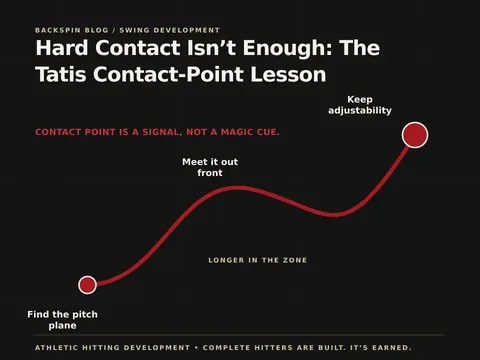
A pitched baseball is usually descending when it reaches the hitting area. The bat travels on a curved three-dimensional path. If the barrel’s path cuts across the pitch path for only a tiny instant, the hitter needs nearly perfect timing. If the barrel travels through a useful section of space that matches the pitch trajectory more effectively, the hitter creates a larger collision window.
That is the heart of the AHD idea of building the largest margin for error for solid contact.
It is also why “swing down” and “uppercut” are both incomplete coaching ideas. The real question is:
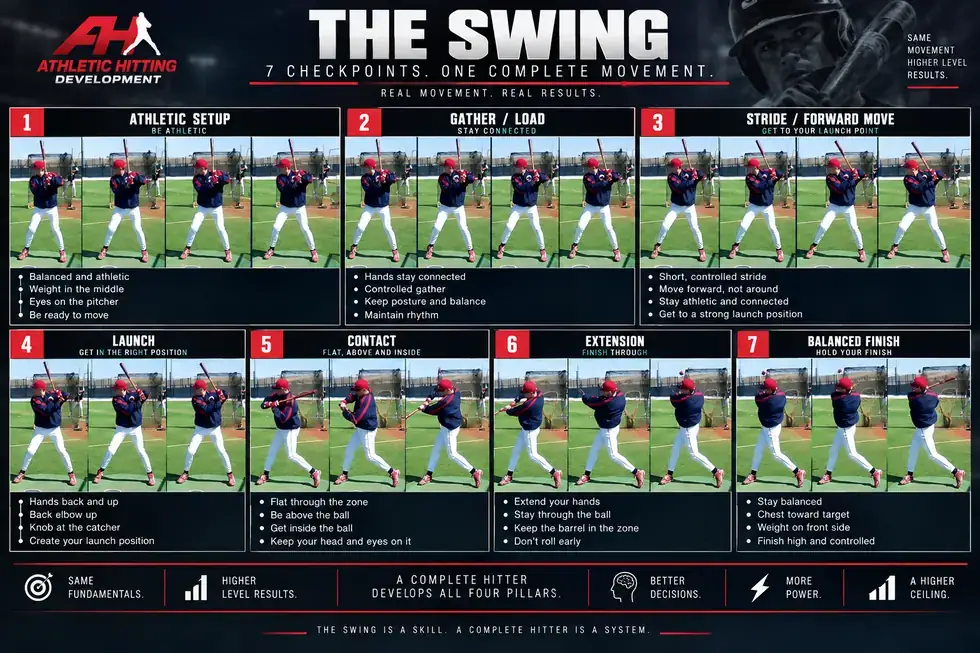
The Physics Behind the 7 AHD Swing Checkpoints
Athletic Setup
Establish a controllable base of support, posture and center of mass so the athlete can produce and redirect force.
Gather / Load
Organize the body, control mass, create rhythm and prepare muscles and connective tissue to produce force.
Stride / Forward Move
Create controlled linear momentum while moving into a position that can accept force and rotate.
Launch
Organize the hitter for rotation and barrel acceleration: athletic position, hands back/up, back elbow up, knob at the catcher and the bat head even with or behind the head, creating the connected “choke effect” AHD wants at launch.
Contact
Deliver useful bat speed, barrel direction, posture and effective mass into the baseball at the right place and time.
Extension
Allow the bat and body’s momentum to continue through the hitting area after the approximately millisecond-long collision is complete.
Finish
Complete the movement with body control. The hitter should be able to hold the athletic position through the swing, not fall out of it.
THE 7 AHD SWING CHECKPOINTS
ONEMOVEMENT.
- Setup ↓ Gather ↓ Stride ↓
- Launch ↓ Contact ↓
- Extension ↓ Finish
PATH MUST SERVE THE PITCH.
10. Ball Flight: Exit Velocity, Launch Direction and Spin
Once the baseball leaves the bat, the hitter’s job is over and projectile motion plus aerodynamics take over. The key launch conditions include exit velocity, launch angle, horizontal direction and spin.
Launch angle by itself is not a hitting philosophy. The same launch angle at 60 mph and 105 mph produces completely different outcomes. AHD wants hitters to create quality contact first, then use ball flight as feedback about the swing and collision.
Spin matters too. Backspin, topspin and sidespin alter aerodynamic forces on the baseball, including the Magnus effect. But more spin is not automatically better. The complete flight depends on the entire launch condition.
11. Balance Is Dynamic Control, Not Stillness
The hitter’s center of mass moves during the gather, stride and swing. That is not a flaw. Athletic movement requires motion. The question is whether the athlete can control that motion while maintaining posture, visual stability and the ability to rotate and adjust.
This is why AHD lists Losing Balance / Body Control as a major swing fault. A hitter who cannot control the body has a harder time controlling the barrel.
12. The Best Swing Is Not Just Powerful. It Is Adjustable.
A baseball swing is not a laboratory movement performed against a stationary target. The pitcher changes velocity, location, movement, height and arrival time. The hitter therefore needs a movement solution that can continue adapting late.
A swing that produces enormous bat speed on one predetermined pitch may be less useful than a slightly lower peak-speed swing that can cover multiple pitch locations and speeds.
Power + Accuracy + Timing + Adjustability. The goal is not the hardest possible practice swing. The goal is the most dangerous game swing the athlete can repeat and adjust.
The Most Valuable Physics Variable Might Be Time
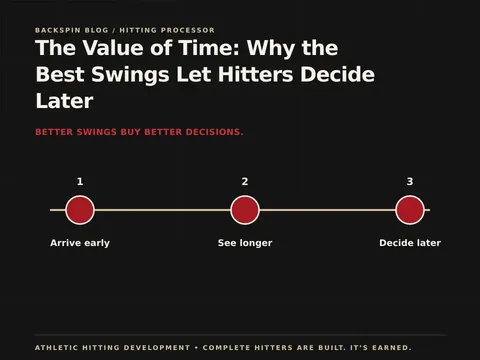
You cannot make a 95 mph fastball travel slower. But you can build a hitter who gathers information earlier, recognizes the pitch better, moves more efficiently and requires less time to deliver the barrel.
That is why the AHD Hitting Processor is organized in this order:
A beautiful swing that launches on the wrong pitch at the wrong time is still a bad at-bat. The physical swing and the information-processing system have to work together.
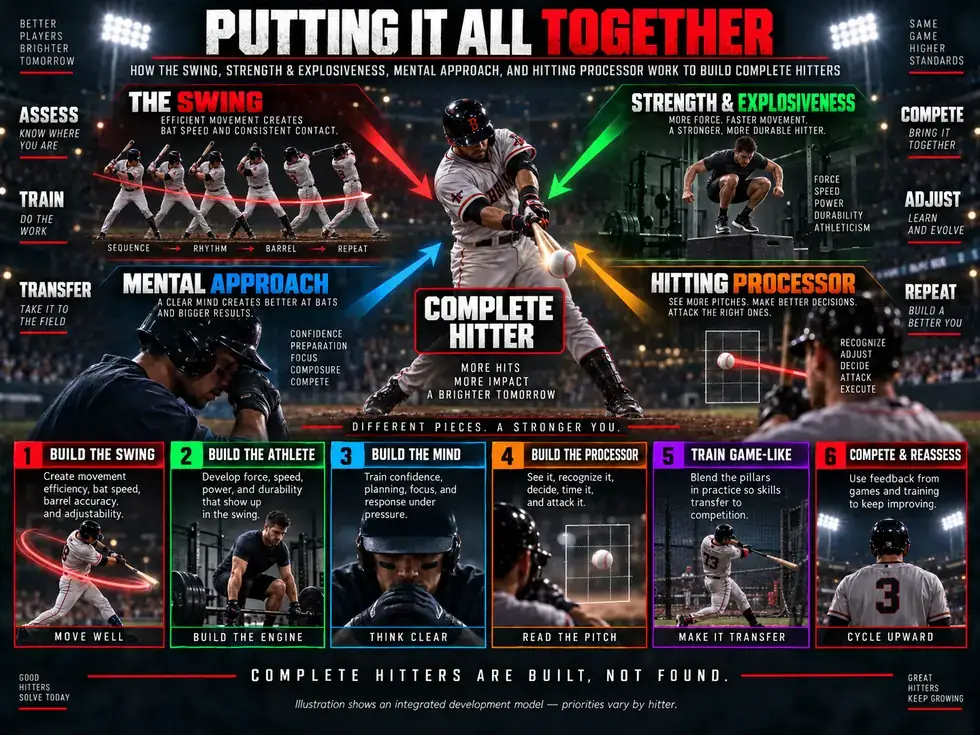
Why AHD Has Four Pillars
1. The Swing
Movement • Sequence • Bat Path • Adjustability
How efficiently the athlete transfers force and delivers the barrel.
2. Strength & Explosiveness
Force • Speed • Power • Athleticism
How much physical capacity the athlete has available to the swing.
3. The Hitting Processor
See It → Recognize It → Time It → Decide → Attack It
Whether the hitter can put the physical swing on the right baseball at the right time.
4. Mental Training
Confidence • Approach • Focus • Resilience
Whether the athlete can trust preparation, commit and compete under pressure.
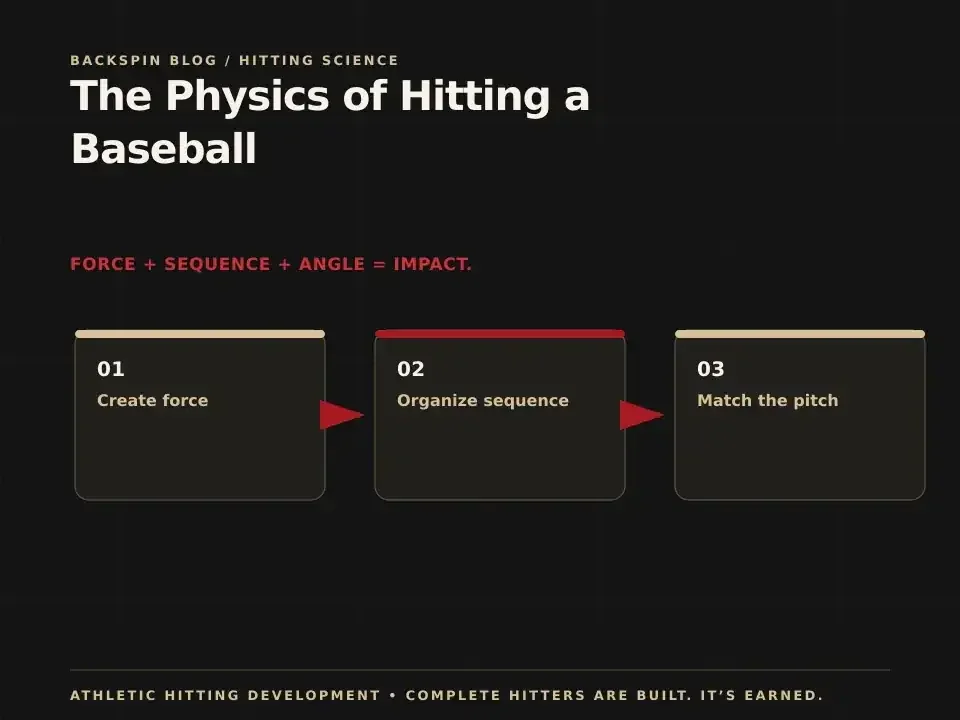
The AHD Physics Formula
This is not a formal physics equation. It is our coaching model for what creates useful game performance:
That is why AHD does not want hitters collecting random drills. Every drill should solve a specific problem inside the larger system.
What Every Hitter Must Know
- The swing starts with the athlete and the ground—not just the hands.
- Force is valuable only when the body can transfer it efficiently.
- Bat speed matters, but centered contact and collision geometry determine how useful that speed becomes.
- Bat path should create margin for error, not chase one generic “perfect” shape.
- Balance means controlling movement, not eliminating movement.
- The best swing preserves adjustability because the pitch is not predetermined.
- Time connects the swing to vision, recognition, timing and decision-making.
- The complete hitter is a system: Swing + Strength & Explosiveness + Hitting Processor + Mental Training.

THELESSON.
- Start with the ground.
- Sequence the force.
- Center the contact.
- Build margin for error.
- Control the movement.
- Stay adjustable.
Complete Hitters Are Built…Earned.
How AHD Turns the Physics Into Training
The physics only matter if the hitter can use them. AHD takes these principles and turns them into an assess → train → transfer → reassess process.
SwingChecker™ helps identify the first priority instead of guessing. The AHD courses then teach the athlete what is happening, why it matters, what to work on and how to track it. The AHD Complete Hitter Masterclass connects the swing, athletic development, processor and mental training into one development path.
Start with SwingChecker™, train the priority, then reassess. If you want the complete system, explore the AHD Whole System or start the AHD Complete Hitter Masterclass.
Quick answers
What is the physics behind hitting a baseball?
Hitting is a collision problem powered by athletic movement and limited by time. The hitter uses ground force, creates torque, sequences energy from legs to pelvis to torso to arms to bat and accelerates the barrel. Then he has to recognize the pitch and create a quality collision in about four-tenths of a second.
Does bat speed matter most in hitting?
Bat speed matters a lot because energy rises with the square of velocity. But it is not the whole answer. Exit velocity also depends on where the ball hits the bat, pitch speed and the direction of the collision. The game rewards useful bat speed delivered to the right place at the right time.
Should a hitter swing down or uppercut?
Both are incomplete coaching ideas. The pitch is usually descending, and the bat moves on a curved path. If the barrel only crosses the pitch path for an instant, you need perfect timing. The real question is where the pitch is and what barrel path gives this hitter the best collision window.
This article is part of the AHD guide Baseball Swing Mechanics. Start there for the full picture and every related article.