Successful hitting is a performance system. The hitter has to move athletically, deliver the barrel efficiently, see and recognize the pitch, organize timing, make a decision, adjust when the pitch changes and compete with confidence.
Great hitting is a performance system: the hitter has to move athletically, deliver the barrel efficiently, see and recognize the pitch, organize timing, decide, adjust and compete with confidence. Improving one piece helps, but the biggest gains come from training how those pieces work together.
Train it: Complete Hitter Masterclass →That is why AHD does not teach hitting as one mechanical move. We teach the hitter as a complete athlete solving a very fast problem.
Great hitting is built when movement, information, timing, decision-making and intent work together.
1. Rhythm begins before the pitcher releases the ball
Good hitters are not waiting for the pitch to start moving. Their preparation is already alive. Rhythm gives the body a repeatable way to organize movement without becoming stiff or rushed.
- Build athletic movement before release.
- Use rhythm that is repeatable, not forced.
- Stay balanced enough to change speed or direction.
- Let preparation create freedom rather than tension.
AHD principle: Rhythm is preparation in motion.
2. The gather creates power and buys timing
The gather or load is not just a power move. It also creates usable time. A hitter who gathers well can move early enough to avoid being rushed while staying adjustable long enough to make a better decision.
- Gather without drifting out of control.
- Keep the head and body organized.
- Use the lower body to store energy.
- Be ready to move forward without committing the barrel too early.
3. The turn transfers force without losing posture
Rotation should move force through the body, not pull the hitter away from the pitch. Strong hitters transfer energy while keeping enough posture and body control to deliver the barrel accurately.
Ground → legs → pelvis → torso → arms → bat.
The goal is not simply to rotate hard. The goal is to transfer force efficiently and stay athletic through the swing.
4. Bat path creates margin for error
A great swing gives the hitter the largest possible margin for solid contact while still producing force and an effective bat-to-ball angle. The barrel has to work through the hitting zone in a way that can cover real pitches, not only perfect batting-practice locations.
- Keep the barrel organized into launch.
- Avoid dumping the barrel too early.
- Stay connected without becoming rigid.
- Build a path that can adjust to pitch height and location.
- Hold athletic position through the swing.
WHAT A GREAT SWING GIVES YOU
MARGIN FORERROR.
- Keep the barrel organized.
- Don't dump it early.
- Connected, not rigid.
- Adjust to height and location.
COVER REAL PITCHES, NOT JUST BP.
5. Pitch tracking is a foundational hitting skill
A beautiful swing cannot rescue poor information. The hitter has to see the ball early enough and clearly enough to recognize what is happening.
That means training release-point awareness, head and body tracking position, pitch flight, spin and location—not just taking more swings.
At high levels, the quality of the hitter’s information can determine whether the swing ever gets a chance to matter.
6. Timing organizes movement around the pitch
Timing is not simply “being on time.” It is the hitter’s ability to organize movement around the speed, shape and location of a pitch.
Predictable preparation creates adaptable execution. The hitter should prepare early enough to avoid panic, but remain athletic enough to delay the final decision.
This is the value of time: the less time the hitter needs to execute, the more of the ball’s flight can be used to gather information.
7. Recognition must lead to a committed decision
Seeing the pitch is not enough. The hitter has to turn information into action. AHD’s Hitting Processor gives that process a clear order:
See It → Recognize It → Time It → Decide → Attack It.
Each step matters. If recognition is late, timing gets rushed. If timing is poor, the decision becomes harder. If the decision is uncertain, the attack loses intent.

SEEING THE PITCH IS NOT ENOUGH
RECOGNIZE IT.COMMIT.
- Late recognition rushes timing.
- Poor timing clouds the decision.
- Uncertainty kills intent.
TURN INFORMATION INTO ACTION.
8. Usable bat speed matters more than empty bat speed
Bat speed matters when it can be applied to a hittable pitch. Raw speed that destroys adjustability or accuracy is not the goal.
The hitter needs enough strength, explosiveness and movement efficiency to swing hard with control—and enough processor skill to apply that speed to the right pitch.
9. Adjustability is a skill
The game does not give hitters the same pitch over and over. Practice should become progressively less predictable because the game is unpredictable.
- Change velocity.
- Change pitch height and location.
- Train spin and speed change.
- Use competitive decision-making.
- Make the hitter solve problems instead of memorizing one movement.
The goal is not a robotic swing. The goal is a hitter who owns enough movement quality to adapt.
10. Confidence should come from evidence
True confidence is not a slogan. It grows when the hitter understands the work, sees improvement, handles failure and knows how to make adjustments.
That is why development should survive the coach. The athlete should know what good feels like, why it works, what breaks down and what to do next.

THELESSON.
- Rhythm before release.
- Gather to buy time.
- Turn without losing posture.
- Track the pitch.
- Usable bat speed.
- Confidence from evidence.
Complete Hitters Are Built…Earned.
The complete hitter
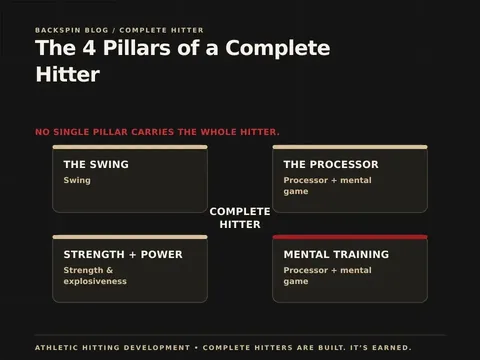
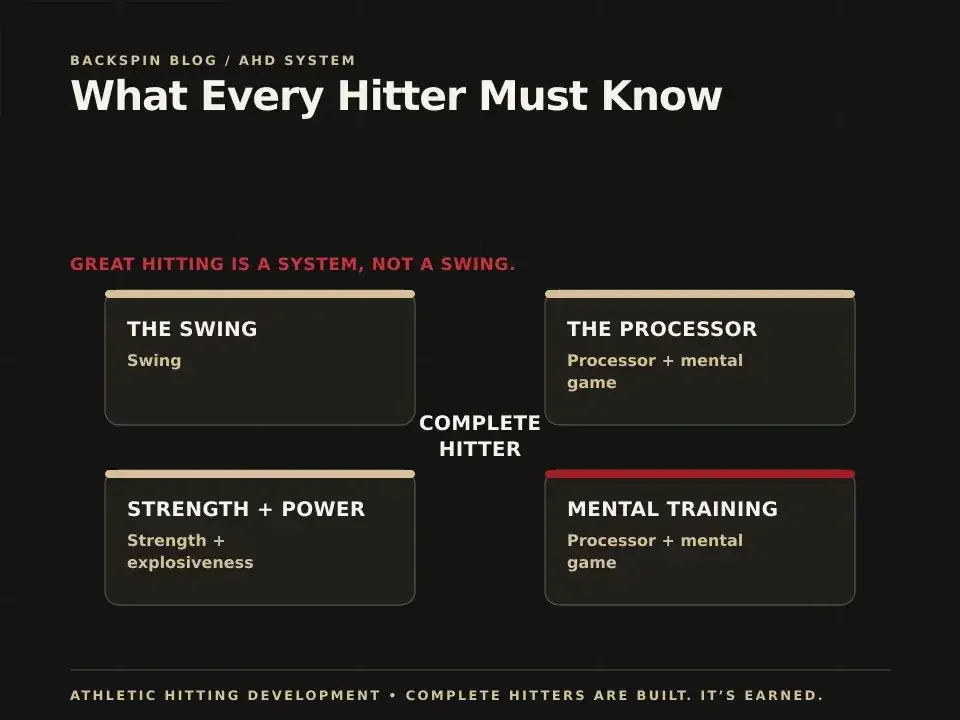
AHD organizes development around four connected pillars:
- The Swing — Movement • Sequence • Bat Path • Adjustability
- Strength & Explosiveness — Force • Speed • Power • Athleticism
- The Hitting Processor — See It → Recognize It → Time It → Decide → Attack It
- Mental Training — Confidence • Approach • Focus • Resilience
You can improve one piece and help the hitter. But the largest gains come from understanding how the pieces interact.
Use SwingChecker™ to identify priorities, then build the complete system through the AHD Complete Hitter Masterclass.
Quick answers
What are the fundamentals of good hitting?
Hitting is a system, not one move. The hitter has to move athletically, deliver the barrel efficiently, see and recognize the pitch, organize timing, decide, adjust when the pitch changes and compete with confidence. Great hitting is built when movement, information, timing, decision-making and intent work together.
Is bat speed the most important thing in hitting?
No. Usable bat speed matters more than empty bat speed. Raw speed that destroys adjustability or accuracy is not the goal. A hitter needs enough strength, explosiveness and movement efficiency to swing hard with control, plus enough processor skill to apply that speed to the right pitch.
How do you improve timing as a hitter?
Timing is organizing movement around the speed, shape and location of a pitch. Prepare early enough to avoid panic, but stay athletic enough to delay the final decision. Rhythm and a good gather help. The less time you need to execute, the more of the ball’s flight you can use to gather information.
What does the gather or load do in a swing?
It’s not just a power move. A good gather stores energy in the lower body and creates usable time, so the hitter moves early enough to avoid being rushed while staying adjustable long enough to make a better decision.