By BK, Athletic Hitting Development
Complete Hitters Are Built… Not Given. Earned!
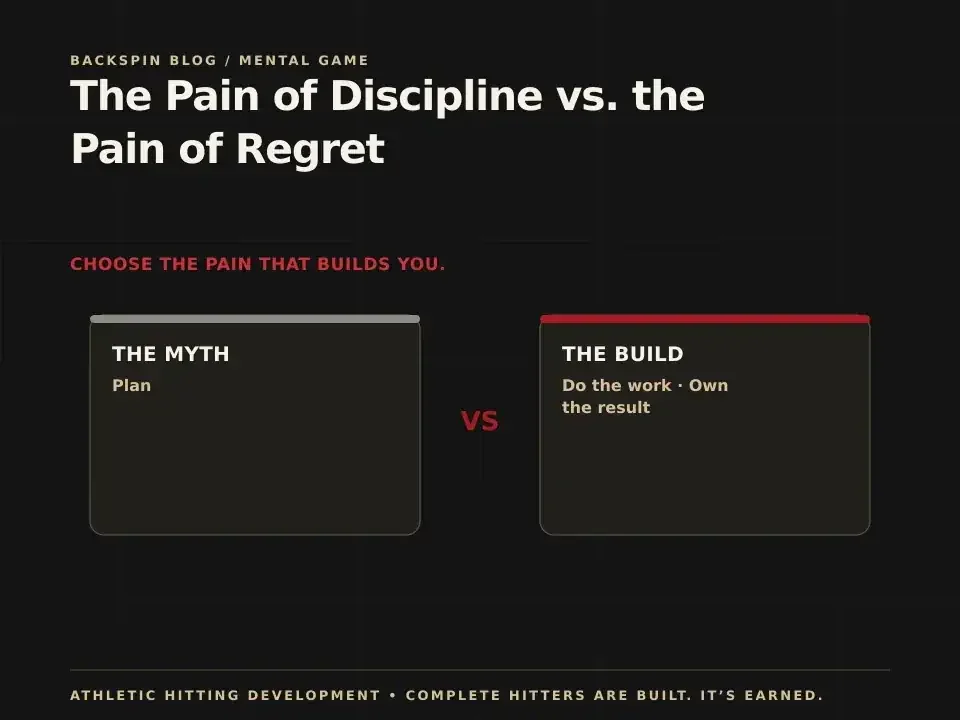
There are two kinds of pain in development.
Discipline hurts now and regret hurts later, and a hitter usually pays one of them. Doing the priority work in the swing, the body, the processor and the mental approach compounds over months, while skipping it lets the game expose what practice allowed you to ignore.
Train it: Mental Approach Masterclass →The pain of discipline.
And the pain of regret.
You usually do not get to avoid both.
Discipline hurts now. Regret hurts later.
Discipline is getting the work in when nobody is watching. Regret is walking back to the dugout knowing the exact weakness that just beat you was something you had months to address.
Discipline is repeating something that is not exciting because it matters. Regret is realizing six months from now that the same problem is still there.
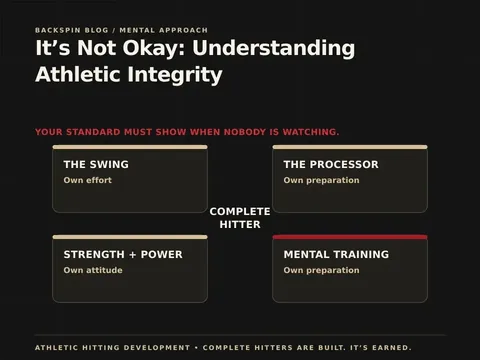
At Athletic Hitting Development, that difference reaches far beyond “working hard.” It applies to how you build the swing, how you build the athlete, how you train the hitting processor and how you build the mental approach.
Discipline
Small, intentional discomfort today: honest feedback, focused repetitions, strength work, pitch tracking, recovery and doing the priority instead of the fun thing.
Regret
Missing the pitch, losing the job, getting exposed by better competition or looking back on an offseason and knowing you left development on the table.
The game eventually exposes what practice allowed you to ignore.
The swing: fix it before the game finds it
A swing flaw can hide for a while. A talented 13-year-old can compensate. A strong high-school hitter can still crush mistakes. A college hitter can survive a mechanical inefficiency until velocity, command and better sequencing make the margin for error smaller.
That is why the AHD swing model is not about creating one pretty-looking swing. The goal is to give the hitter the largest margin for error for solid contact while still generating force and an effective bat-to-ball angle.
Film the swing. Admit the barrel is dumping early. Work the launch position and path until the hitter can control it.
Keep taking random swings because the hitter still gets hits—then meet better velocity and discover the old compensation no longer works.
Own the Athletic Setup → Gather/Load → Stride/Forward Move → Launch → Contact → Extension → Finish sequence.
Wait until a slump to ask why balance, timing and body control disappear when the game speeds up.
Train adjustability. Learn how the path changes by pitch height and location while the hitter stays athletic.
Build one rehearsed batting-practice swing and hope every competitive pitch shows up in the same place.
Strength & explosiveness: you cannot cram an offseason
Power is one of the easiest things to want and one of the slowest things to build correctly.
Everybody loves the result: more bat speed, more exit velocity, a ball driven into the gap, the strength to keep the barrel stable against velocity.
But the result comes from months of athletic development: force, speed, power, movement quality, recovery and consistency.
Train when nobody is posting the workout. Build strength gradually. Sprint. Jump. Throw. Recover. Sleep. Repeat.
Show up in season wanting another ten miles per hour of exit velocity and discover there is no emergency workout that can manufacture six months of development.
There is also discipline in not overtraining. A smart athlete does not confuse exhaustion with progress. Recovery, movement quality and staying healthy are part of the work.

YOU CANNOT CRAM AN OFFSEASON
NO EMERGENCYWORKOUT.
- Sprint. Jump. Throw.
- Recover. Sleep. Repeat.
- Build strength gradually.
DON'T CONFUSE EXHAUSTION WITH PROGRESS.
The hitting processor: the pitch does not wait for you
At higher levels, physical skill alone is not enough. The hitter has to gather information and act on it while the ball is moving toward the plate.
This is where discipline becomes brutally obvious. A hitter can spend years making the swing look better while barely training the skill that determines whether the swing gets used on the correct pitch at the correct time.
Track pitches. Train the eyes. Learn spin and shape. Practice timing. Learn the strike zone and the hitter’s damage zone.
Recognize the slider right after swinging over it and say, “I knew it was a slider,” after the decision window was already gone.
Train the processor even when there is no satisfying crack of the bat.
Own a beautiful swing that repeatedly attacks the wrong pitch.
The eye tool matters because better pitching keeps taking time away. The discipline is developing the ability to get useful information earlier so the hitter can make a better decision later.
Read more: The Eye Tool — The Rarest Skill in Hitting →
Heater, Hanger: discipline before the pitcher moves
One of the simplest AHD mental-approach ideas is Heater, Hanger.
Know the heater you want to destroy. Be ready for it. Then recognize and adjust to the hanger.
The disciplined hitter makes that plan before the pitch. The undisciplined hitter starts figuring out what he wanted after the at-bat.
“This is my zone. I am ready for the heater here, and I can adjust to the mistake.”
“I do not even know what I was looking for.”
Read more: Heater, Hanger — Simplifying the Mental Approach →
The mental game: discipline is what happens after failure
Mental toughness is not pretending failure does not bother you. Hitting is supposed to bother you sometimes.
You are going to strike out. You are going to get jammed. You are going to smoke a ball directly at somebody. You are going to get a call you hate. You are going to have games where nothing feels right.
The discipline is what happens next.
- Can you reset before the next pitch?
- Can you stay committed to the approach after two ugly at-bats?
- Can you separate your preparation from your results?
- Can you stay confident without lying to yourself about what needs work?
- Can you keep competing when the game becomes uncomfortable?
True confidence is not “I know I am going to get a hit.” True confidence is “I know what I have done to prepare for this moment.”

DISCIPLINE IS WHAT HAPPENS NEXT
AFTERFAILURE.
- Reset before the next pitch.
- Stay committed to the plan.
- Compete when it's uncomfortable.
KNOW WHAT YOU DID TO PREPARE.
Two hitters. Same talent. Different price.
Imagine two hitters with similar physical talent at the beginning of an offseason.
Pays the discipline price
Uses video. Identifies the biggest swing priority. Gets stronger. Tracks pitches. Trains timing and decision-making. Builds an approach. Records progress. Recovers. Shows up again.
Nothing magical happens Tuesday morning. But the work compounds.
Defers the price
Hits only when motivated. Takes random swings. Avoids weaknesses. Chases quick fixes. Trains what looks good on video. Does very little pitch-recognition work.
Nothing terrible happens Tuesday morning either. That is the trap.
One week later, the difference may be invisible.
One month later, it might be small.
One hundred days later, the two hitters can be very different.
That is development. The daily choice is tiny. The accumulated result is not.
The dangerous thing about regret is the delay
Skip one workout and nothing happens.
Skip one pitch-tracking session and nothing happens.
Take lazy swings today and you may still get three hits Saturday.
Ignore the same movement flaw and you may still dominate younger competition.
That is why discipline is hard: the consequence is usually delayed.
But development compounds in both directions.
- Good movement compounds.
- Strength compounds.
- Pitch recognition compounds.
- Better decisions compound.
- Confidence built on evidence compounds.
- Bad habits compound too.
Discipline is not doing more. It is doing what matters.
This is important, especially for young athletes.
Discipline does not mean 500 swings every night. It does not mean training seven days a week. It does not mean turning a 10-year-old into a professional athlete.
It means doing the right thing for the athlete, at the right time, for the right reason.
What discipline can look like this week
- Swing: 20 deliberate repetitions attacking one priority instead of 150 random swings.
- Strength: complete the planned training session with quality instead of chasing fatigue.
- Processor: spend ten focused minutes on pitch recognition or tracking.
- Mental approach: write the plan for the next game before arriving at the field.
- Recovery: sleep, eat and recover well enough to improve tomorrow.
WHAT DISCIPLINE LOOKS LIKE
DO WHATMATTERS.
- 20 swings on one priority.
- Quality strength sessions.
- 10 minutes of pitch tracking.
- Write the plan. Sleep.
DISCIPLINE IS NOT DOING MORE.
For the younger hitter
Young players should hear this message without having the joy squeezed out of the game.
The goal is not to scare a 9-, 10-, 11- or 12-year-old with regret. The goal is to teach a powerful connection:
I worked on something. I got better at it. My work changed what I can do.
That is one of the healthiest forms of confidence a young athlete can develop.
At 46/60 Academy, we reduce it to three ideas:
Learn the right things.
Practice the right way.
Play the right way.
All four AHD pillars require the same decision
They look different. They train different skills. But they all ask the athlete the same question:
Will you do the work before you need the result?

THELESSON.
- Choose the work.
- Fix it before the game does.
- Train the processor.
- Plan before the pitch.
- Reset after failure.
- Do what matters.
Complete Hitters Are Built…Earned.
You will pay one of them
There will be days when you do not feel like training. Days when the video shows something you do not want to see. Drills that expose weaknesses. Teammates who are ahead of you. At-bats that embarrass you. Slumps that make you question everything.
That is the game.
The question is not whether development will ever be uncomfortable.
The question is which discomfort you choose.
THE PAIN OF REGRET CAN LAST A LOT LONGER.Choose the work.
Someday there will be another tryout. Another season. Another tournament. Another championship game. Another coach watching. Another 3-2 pitch.
And eventually there will be a final at-bat.
You do not get every opportunity back.
So prepare for the ones still ahead of you.
Build the swing. Build the athlete. Build the processor. Build the mental approach. Build the confidence.
Stop guessing. Build the complete hitter.
Quick answers
What does the pain of discipline vs. regret mean for athletes?
Discipline hurts now. Regret hurts later. Discipline is getting the work in when nobody is watching. Regret is walking back to the dugout knowing the weakness that just beat you was something you had months to fix. You usually do not get to avoid both, so choose the work.
How much should a youth hitter practice?
Discipline is not doing more. It does not mean 500 swings every night or training seven days a week. It means doing the right thing at the right time. That can be 20 deliberate swings on one priority instead of 150 random ones, plus ten focused minutes of pitch recognition.
Can you build hitting power quickly before the season?
No. There is no emergency workout that can manufacture six months of development. Power comes from months of building force, speed, movement quality and recovery. Sprint, jump, throw, build strength gradually and sleep. Do not confuse exhaustion with progress, because staying healthy is part of the work.
What is true confidence for a hitter?
True confidence isn’t “I know I am going to get a hit.” It’s “I know what I have done to prepare for this moment.”
No subscription. No login. Learn one thing, train it, and own it.
This article is part of the AHD guide The Mental Game of Hitting. Start there for the full picture and every related article.