By BK, Athletic Hitting Development
Complete Hitters Aren’t Born. They’re Built… and Earned.
Key takeaways
- In a 2026 study of 96 young hitters (average age about 14), med-ball throw power was the strongest predictor of bat speed.
- Jump power didn’t predict bat speed directly. It showed up through the throws: jump, then throw, then swing.
- Build the whole athletic power profile: jumps and landings, sprints, rotational and overhead throws, strength and recovery.
- Power only counts when it reaches the barrel. Go back to the bat and check that it shows up in the swing.
Jumping can help bat speed, but not directly. In a 2026 study of 96 young hitters averaging about 14 years old, jump power connected to bat speed through med-ball throw power: the jump builds the engine, the throw moves it to the hands, the swing uses it.
Jumping can help bat speed, but indirectly. In a 2026 study of 96 youth hitters averaging about 14, med-ball throw power predicted bat speed and jump power connected to it through the throws, so train jumps, throws and the swing together.
Train it: Athletic Development → Free tool: Free Hitter Combine →Everybody wants bat speed. The better question is: what gives a high school hitter the ability to create it?
Not a magic drill. An athlete who can push into the ground, organize his body, rotate with control and deliver the barrel. That’s the jump-to-throw-to-swing pathway, and it’s how I want parents and coaches to think about power.
1. What Did the 2026 Youth Bat Speed Study Find?
Researchers tested 96 male youth baseball players with an average age of 13.9, so mostly 13 to 15 years old. That’s right in the middle of the hitters we work with. Bat speed was measured with a sensor on standardized tee swings.
The players did three med-ball throws (rotational, backward overhead and seated) and a countermovement jump on a force plate.
- The throws predicted bat speed. As a group, they accounted for about 65% of the differences in bat speed between players in the model.
- Two throws led the way. The backward overhead throw and the rotational throw carried the most weight.
- The jump worked through the throws. Jump power did not predict bat speed directly, but it had a significant indirect effect through throw power.
Honest notes. This was one snapshot of one group of boys, so it shows an association, not proof that training the throw or the jump raises bat speed. And tee swings aren’t game swings. What follows is how I use it as a coach.
If you read our post on the rotational med-ball test in college hitters, this is a different study and a different question. That one asked which single test tracks bat speed. This one shows how the pieces connect in younger hitters.
2. Why Would Jump Power Show Up Through the Throw?
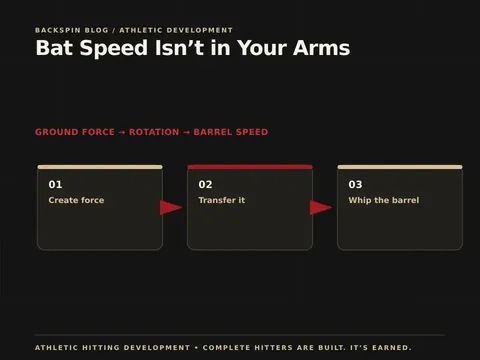
Because that’s how a swing works. Bat speed isn’t just hands. Force starts in the ground, the legs create it, the hips and trunk transfer it, and the hands deliver it.
The jump builds the engine. The throw connects it. The swing uses it.
A jump measures how much force the legs can make. A med-ball throw asks whether that force can travel through the hips and trunk and out the hands. The swing adds a bat, a moving pitch and a decision.
So a hitter can jump well and still swing slow if the force never makes it to the barrel. That’s why I don’t judge power by one test.
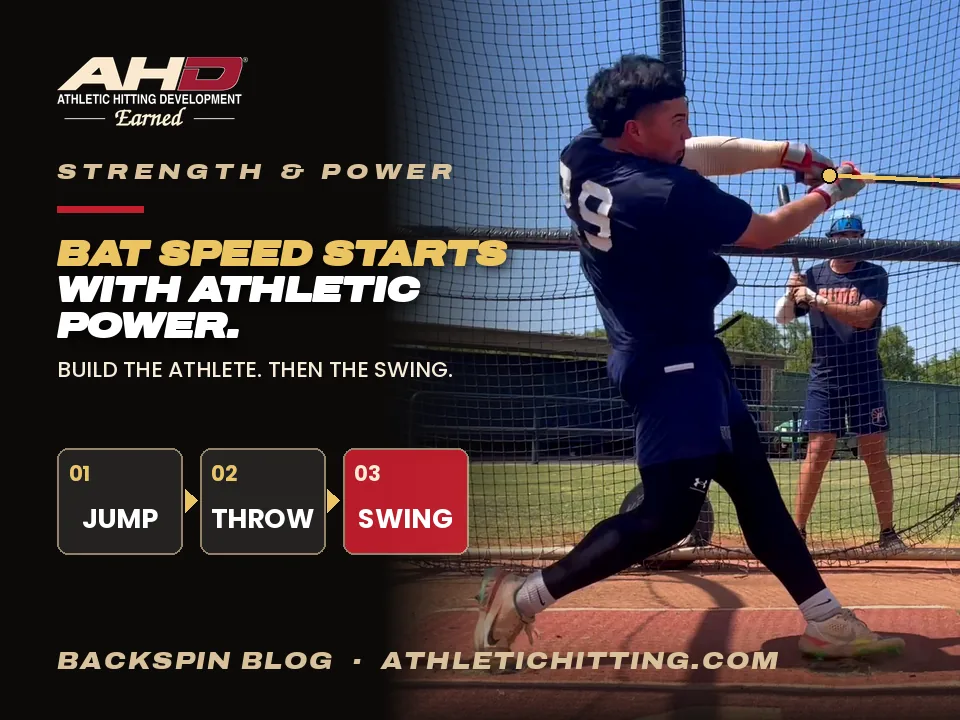
THE POWER PATHWAY
JUMP. THROW.SWING.
- Jump: the legs build force
- Throw: the trunk moves it
- Swing: the barrel uses it
- Check it in the swing
POWER HAS TO REACH THE BARREL
3. What Should a High School Hitter’s Power Training Include?
Build the whole profile, not one exercise. For a 13 to 18-year-old hitter, smart power work includes:
- Jumps and landing skill. Learn to land soft and balanced before you jump for height.
- Sprinting and acceleration. Short, fast, full-recovery reps.
- Rotational and overhead throws. The two throws that led the study.
- Strength. Bodyweight first, then age-appropriate resistance training with good coaching.
- Trunk control, mobility and recovery. Sleep and eating count as training.
The goal isn’t to make a freshman train like a professional. It’s to build a durable athlete who can move faster, stop better and repeat a swing under pressure. Hitters grow at different times, so progress the load by the athlete in front of you, not the birthday. Our guide to strength training for young hitters by age lays that out.
4. How Do You Make Power Training Carry Into the Swing?
Medicine balls are a tool, not the answer. The transfer has to be earned. Here’s how I like to run a jump-throw-swing block, two or three days a week:
- Jump3 sets of 3 countermovement jumps. Full intent, stick every landing, rest between sets.
- Throw3 sets of 4 rotational throws from your hitting stance each way, then 3 sets of 3 backward overhead throws. Use a ball light enough to throw fast.
- SwingRight after, take 6 to 8 full-intent swings off the tee. Same aggression, now with a bat.
- CheckDid he stay balanced? Did the barrel get on plane? Did the ball come off differently?
"See that wall… knock it down!" That’s the intent on every throw and every swing: big and controlled. Not wild.
Then make it compete. Take it into front toss and live rounds. Power that disappears the minute a pitch has to be timed isn’t helping your hitter yet.
And the swing still has to be built right. AHD hitters deliver the barrel with Mechanically Advantaged Angles (MAA), so the force the body creates actually gets to the baseball. If you want more throw progressions, see how to increase bat speed with rotational power.
5. What Should You Measure, and What Does It Mean?
A higher jump is a good sign of athletic development. It is not a guarantee of more bat speed. Track a few checkpoints every 4 to 6 weeks, same setup every time:
- Med-ball throw distance. Same ball, same stance, best of 3.
- Jump and sprint. Same surface, same method.
- Bat speed trend. Same sensor, same bat.
- Ball flight. How many line drives and hard ground balls out of 10.
- Video. Side and behind, same angles, so you can compare his best swings over time.
| What you see | What it usually means |
|---|---|
| Jump up, throw flat | Force isn’t traveling through the trunk to the hands yet |
| Throw up, bat speed flat | The swing isn’t using the power. Check the move. |
| Everything up, still late in games | Likely timing, not bat speed |
That last row is common. Read why late can look like slow before you buy another training bat.
6. Where Does Power Fit in a Complete Hitter?
Strength & Explosiveness is one of the 4 Pillars of a Complete Hitter. The Swing, the Hitting Processor and the Mental Approach still have to carry it to the game. Bat speed begins with a better athlete. Then it has to be organized into a better hitter.
Find out which pillar needs your hitter most with SwingChecker™. It’s free, takes about 3 minutes and ranks his top priorities with cues, drills and free lessons.
If power is the gap, the Athletic Development course is 24 lessons, $139, with lessons on power from the ground up, jumps and bounds, and heavy, fast and bat speed. Lesson 1, Test Day, is free and gives you his starting numbers.
THELESSON.
- Build the athlete first
- Train jumps, throws, sprints
- Go back to the bat
- Measure it the same way
Complete Hitters Are Built…Earned.
Want to go deeper? Read The Med Ball Test That Tracks Bat Speed and Which Gym Numbers Actually Track Bat Speed.
Quick answers
Does vertical jump help bat speed?
Indirectly. In a 2026 study of 96 youth hitters, jump power did not predict bat speed on its own, but it connected to bat speed through med-ball throw power. Train jumps as part of a full power profile, not as a bat speed shortcut.
What is the best med ball throw for bat speed?
In the 2026 youth study, the backward overhead throw and the rotational throw were most closely tied to bat speed. Do both, from an athletic stance, with a ball light enough to throw fast.
Is power training safe for a 14-year-old hitter?
With good coaching and age-appropriate loads, yes. Start with landing skill, bodyweight strength and light med-ball throws, and progress by the athlete’s development, not his birthday.
Why is my son strong but his bat speed is still slow?
Usually the force isn’t reaching the barrel, because the swing isn’t sequencing it, or he’s late and it looks like slow bat speed. Check his throws, his swing on video and his timing before adding more lifting.
Don’t collect drills. Build a complete hitter.
Complete Hitters Aren’t Born. They’re Built… and Earned.