By BK, Athletic Hitting Development
Complete Hitters Aren’t Born. They’re Built… and Earned.
Key takeaways
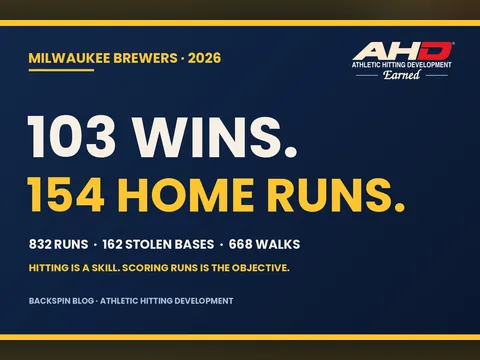
- By late July 2026 the Brewers were fifth in MLB in runs with the fewest home runs, and they went on to win the World Series.
- They had the lowest swing rate in baseball and rarely swung at the first pitch, but did big damage on the first pitches they did swing at.
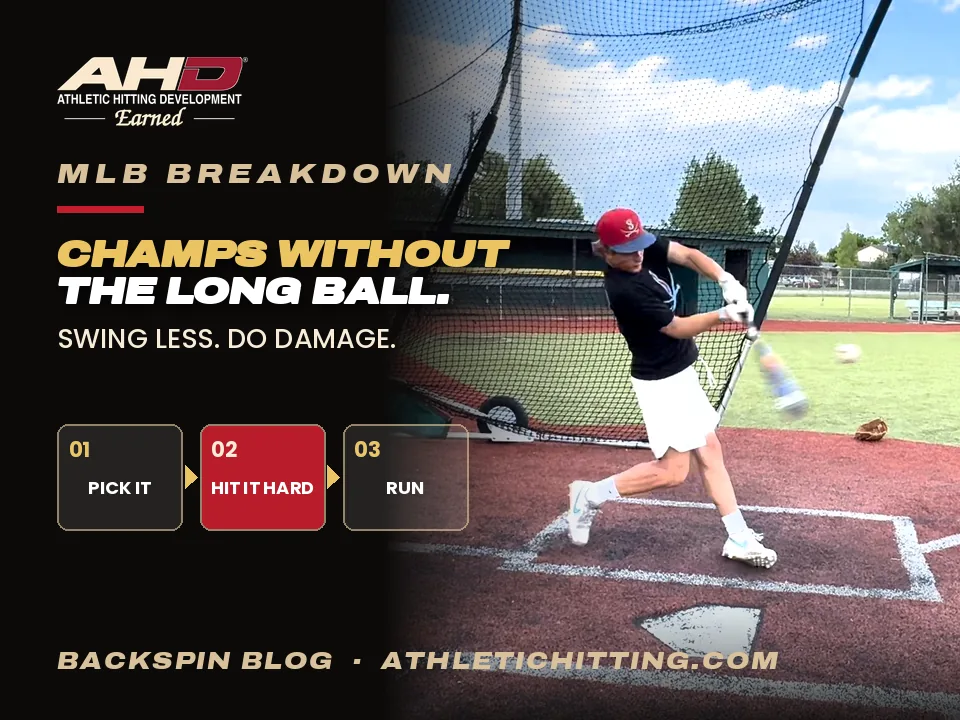
- Patience isn’t passivity. Swing less. When you swing, do damage.
- Power still matters. The lesson is fit: know who you are as a hitter and build your approach around it.
Yes, you can build a hitting approach without big power. The 2026 Brewers were fifth in MLB in runs with the fewest home runs by late July, then won the World Series, on one idea: swing less, and do damage when you swing.
You can build a strong hitting approach without big power by swinging less and doing damage when you do swing. The 2026 Brewers were fifth in runs with the fewest homers by late July, then won the World Series.
Train it: Hitting Processor → Free tool: At-Bat Approach Trainer →Most young hitters hear one message: pull it and lift it. For some hitters, that’s exactly right. For a lot of others, it’s a plan built for somebody else’s body.
Milwaukee showed there’s more than one way to score. Let’s look at what they actually did, what it doesn’t prove, and how to train it.
1. How did the Brewers score without home runs?
On July 23, 2026, MLB.com broke down the five stats behind Milwaukee’s scrappy but elite offense. At that point in the season:
- Fifth in MLB in runs while hitting the fewest home runs.
- The highest ground-ball rate and the highest opposite-field rate in baseball.
- The lowest overall swing rate in MLB.
- The second-fewest first-pitch swings, yet big damage on the first pitches they did swing at.
- Elite team speed.
Then they won the World Series. That’s not a lucky offense. That’s a plan.
Be fair about it, though. That was a midseason snapshot of one roster. It doesn’t prove ground balls beat home runs, and I’m not going to pretend it does.
2026 BREWERS
SWING LESS.DO DAMAGE.
- Fewest homers, fifth in runs
- Lowest swing rate in MLB
- Few first-pitch swings, big damage
- Oppo, ground balls and speed
DECISIONS BUILT THIS OFFENSE.
2. Should every hitter try to pull and lift?
No. Milwaukee is proof that one universal command isn’t the only way to build an offense. An offense should be built around the hitters you actually have, and so should a hitter’s approach.
Power still matters. A hitter who can drive the ball in the air is dangerous, and I want every hitter as strong and explosive as he can get. The point is fit. Don’t swing for a profile you don’t have yet. Build the one you do.
Know who you are as a hitter.
How do you figure out who you are? Watch three things over a few weeks of games: where his hardest balls go, whether they’re on the ground, on a line or in the air, and whether he can run.
A hitter who drives the ball in the air to the pull side needs a different plan than a hitter whose hard contact is low line drives into the opposite gap. Neither one is wrong. The mistake is giving them both the same plan.
If your hitter is a gap-to-gap guy who can run, his best at-bat might be a hard line drive the other way and a stolen base. Here’s how I say it: “Hard, down the other way means we are on our way!” A hard ball to the opposite field means he was on time and stayed through it. I teach the how in How to Hit Opposite Field.
3. Is a patient hitter a passive hitter?
This is where people get the Brewers wrong. Lowest swing rate in baseball sounds like a team standing there taking. Look at the first-pitch number again. They rarely swung at pitch one, but when they did, they did damage.
Swing less. When you swing, do damage.
Patient is about WHICH pitches you swing at. Passive is taking the one you should crush. Patient hitters still hunt. They just hunt a smaller zone.
Gotta swing it to hit it. When the heater or hanger shows up in his zone, the patient hitter should be the most aggressive guy on the field. More on that in A Better Approach Is Not Passive.
4. How do you train a Brewers-style approach?
Decisions are a skill. They get trained like the swing: every day, with a score.
- Name his zone.Before each round, the hitter names the one area he’s hunting, like middle-away. Everything else is a take until two strikes.
- Score the decision first.In live BP or machine work, one point for a good swing or a good take, one more if the ball is hit hard. A pretty swing at a bad pitch scores zero.
- Make the first pitch earn it.He swings at pitch one only if it’s his pitch in his zone. If it is, he lets it go with full intent.
- Drive it the other way.Run rounds where away pitches must be hit hard to the opposite field. Hard and low is a win. Weak and high is a rep to fix.
- Add the legs.If he can run, train hard turns at first and good secondary leads so every single puts pressure on the defense.
This is The Hitting Processor: see it, time it, decide, attack it. It sits on a swing built with Mechanically Advantageous Angles (MAA), so when he picks his pitch, the body can deliver the barrel. Practice the decisions free in the At-Bat Approach Trainer, and see Plate Discipline Is a Skill for more cage games.
5. What can young hitters learn from the Brewers?
Their approach was built on things a hitter controls: which pitches he swings at, how hard he competes on the one he picks, and how hard he runs out of the box.
“Two choices: A. Do everything in your control. B. Anything but A.” Swing decisions, effort and preparation are all in his control, so he owns them every at-bat.
Not sure whether your hitter’s biggest need is the swing or the decisions? Run the free SwingChecker™. In about three minutes it ranks his top priorities across the 4 Pillars. If it’s decisions, the Hitting Processor course trains them in 16 lessons, and Lesson 1 is free. For all four pillars, the Complete Hitter Masterclass is the full plan.
THELESSON.
- Know who you are as a hitter
- Patient is not passive
- Hunt a smaller zone
- Power still matters
Complete Hitters Are Built…Earned.
Want to go deeper? Read I Love This 2026 Milwaukee Brewers Team! and A Better Approach Is Not Passive.
Quick answers
Can you be a good hitter without power?
Yes. A hitter who makes good swing decisions, hits the ball hard to all fields and runs well can produce plenty of offense. Keep building strength, though, because power still helps every hitter.
How did the 2026 Brewers score so many runs?
By late July they were fifth in runs with the fewest home runs, built on the lowest swing rate in MLB, damage on first-pitch swings, opposite-field contact and elite speed. They went on to win the World Series.
Should my hitter swing at the first pitch?
Only if it’s his pitch in his zone. If it is, he should swing with full intent. If it isn’t, taking it is a good decision.
Does a patient approach mean taking more pitches?
It means swinging at fewer bad pitches, not fewer good ones. A patient hitter hunts a small zone and attacks when he gets it.
Sources: MLB.com, “5 stats that define Brewers’ scrappy (but elite) offense” (July 23, 2026) · MLB.com, “Brewers beat Rays in Game 5 to win first World Series in franchise history” (Oct 29, 2026)
Don’t collect drills. Build a complete hitter.
Complete Hitters Aren’t Born. They’re Built… and Earned.