By Athletic Hitting Development
Complete Hitters Are Built… Not Given. Earned!
Fernando Tatis Jr. was not having a “bad hitter” season in 2025.
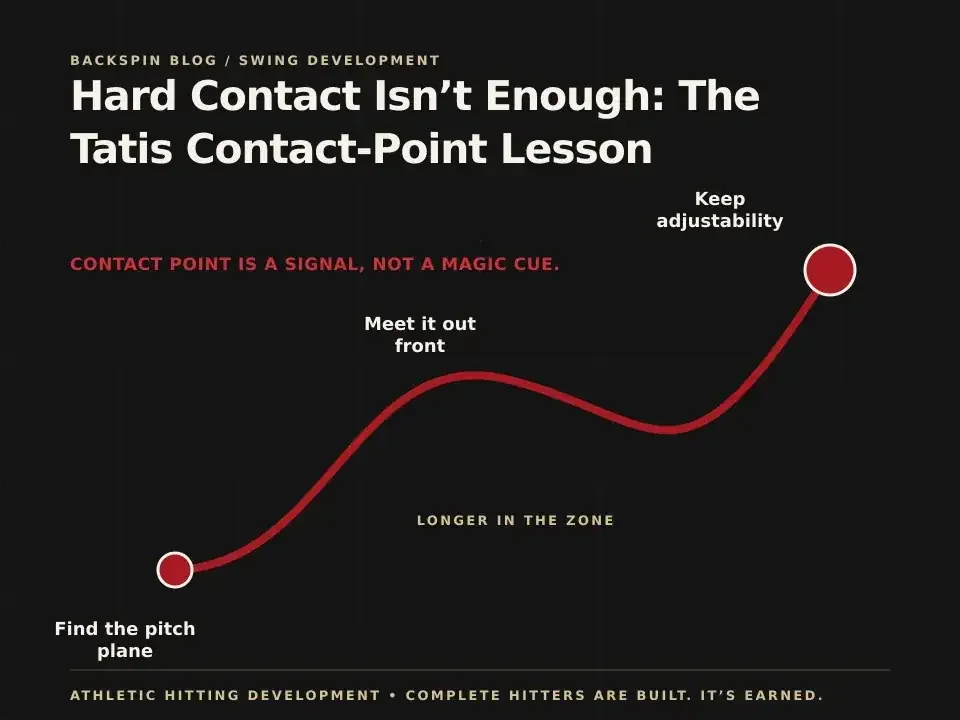
Fernando Tatis Jr.’s 2025 power drought shows that hard contact isn’t enough, and a deeper contact point is a lead to investigate, not a verdict. Contact point is the end of a chain, so diagnose what was seen, recognized, timed and decided before you yell “get it out front.”
Train it: Swing Structure & Mechanics Masterclass →He was making contact. He was getting on base. He was running, defending, and doing a lot of things that help a team win. But the power—the part of his game that can change a scoreboard with one swing—was missing for a long stretch. By August, he had gone 106 plate appearances without a home run, the longest homerless skid of his career.
The interesting part is not the drought. Every hitter will have one.
The interesting part is the question raised by the reporting: was the ball being met too deep?
The Athletic identified Tatis’s August 2025 intercept point at 27.6 inches, his lowest monthly mark since baseball began tracking the measurement. In plain language: the place where his barrel met the baseball had moved closer to his body than usual.
That is not a verdict. It is a lead.
And that distinction matters for every hitter, parent, and coach who sees a stat, a video clip, or a weakly hit ball and immediately starts shouting a fix.
Contact point is not a cue. It is a measurement.
It tells us what happened at the ball. It does not, by itself, tell us why it happened—or what one sentence every hitter should hear next.

FERNANDO TATIS JR., AUGUST 2025
NOT A VERDICT.A LEAD.
- 106 plate appearances, no HR.
- Intercept point: 27.6 inches.
- Lowest monthly mark tracked.
CONTACT POINT IS NOT A CUE.
Hard contact can still be the wrong kind of contact
Young hitters hear “hit the ball hard” so often that they start to treat it as the entire job.
Hard contact matters. Exit velocity matters. But damage is not just force.
Damage is force applied to the right pitch, on time, with a usable barrel, at a contact point that matches the hitter’s intent. A hitter can square a ball up well enough to create solid exit velocity and still keep it on the ground, send it the wrong way, or miss the best part of the barrel’s window.
That is why the Tatis conversation is useful.
If a hitter begins to make contact a little deeper than normal, the change can affect:
- Direction. A pitch that is met later can leak toward the opposite field instead of being driven in the pull-side air.
- Launch. The barrel may arrive with a different vertical direction, producing a lower line drive or ground ball rather than carry.
- Margin for error. The hitter may have less usable barrel through the contact window, especially against velocity.
- Decision quality. A late decision can turn a pitch to attack into a pitch the hitter merely survives.
None of that means every deep contact point is bad. An outside pitch should not be contacted at the same place as an inner-half fastball. A hitter driving the ball the other way is not automatically late. Pitch location, pitch shape, intent, and the individual hitter all matter.
But when a hitter’s usual contact location changes over time—and the damage changes with it—that is worth investigating.
The ball does not lie. Let it guide you. Just do not let it talk you into a lazy conclusion.
The trap: “Just get it out front”
This is where a lot of young hitters get hurt by well-meaning coaching.
Coach sees late contact. Coach says, “Get it out front.” Hitter starts throwing the barrel early. Now he rolls over the outside pitch, loses adjustability, pulls off the ball, and creates a brand-new problem.
That is not development. That is swapping one symptom for another.
There is no single perfect contact point painted in the air in front of every hitter. Good hitters meet different pitches in different places:
- A pitch inside may be contacted farther out front.
- A pitch away may be contacted deeper, with the barrel staying through it.
- A breaking ball may demand more patience and adjustment.
- A high fastball and a low sinker do not ask for the exact same barrel direction.
So the first AHD question is not, “How do we make every contact point farther out front?”
It is, “What pitch was it, what was the hitter trying to do, and what created the contact point we are seeing?”
That question keeps us honest.

WELL-MEANING COACHING THAT HURTS
JUST GET ITOUT FRONT?
- Barrel gets thrown early.
- Hitter rolls over.
- Adjustability is gone.
SWAPPING ONE SYMPTOM FOR ANOTHER.
Contact point is the end of a chain
The baseball does not arrive at contact in a vacuum. The contact point is the last visible link in a longer chain:
- See it. Did the hitter pick the ball up early enough?
- Recognize it. Did the hitter identify speed, spin, shape, and location?
- Time it. Did the hitter organize the move early enough for the pitch?
- Decide. Did the hitter commit to an attackable pitch, or get caught in between?
- Attack it. Did posture, sequence, and barrel direction give the hitter a usable bat path?
See It → Recognize It → Time It → Decide → Attack It.
That is the Hitting Processor. And it matters here because “late contact” can start long before the hands are late.
Maybe the hitter did not recognize the breaking ball soon enough. Maybe the forward move started late. Maybe the hitter drifted and lost the athletic position needed to turn the barrel. Maybe the hitter’s head moved, the eyes got unstable, and the pitch appeared to jump. Maybe the hitter was guessing, became indecisive, and tried to save the at-bat.
Then the video shows a deep contact point and everyone blames the hands.
The hands are often just where the problem finally showed up.
What to evaluate before changing the swing
If a hitter’s power disappears while contact remains decent, do not start by collecting drills. Diagnose.
1. Separate pitch location from timing
Chart the contact. Was the ball inside, middle, or away? Was it hard, soft, breaking, or running? What direction did it leave the bat?
An outside pitch driven hard the other way can be excellent contact. An inside fastball met too deep may be a different conversation. Context first.
2. Check the athletic position
Can the hitter hold posture, keep the head stable enough to see, and arrive in a position that still allows adjustment?
When a hitter is locked up, drifting, collapsing, or standing up through the move, the barrel often arrives late because the body arrived late.
The swing has checkpoints:
Athletic Setup → Gather/Load → Stride/Forward Move → Launch → Contact → Extension → Finish.
Do not skip to contact and pretend the earlier checkpoints do not exist.
3. Look for intent and barrel direction
Is the hitter trying to pull every pitch? Is he trying to stay inside everything? Is the barrel dumping early toward the ground? Is he cutting across the ball? Is he holding the athletic position long enough for the barrel to work?
The answer will not be the same for every hitter. The job is to find the movement that is stealing access to the ball.
4. Train the processor under a real decision
Front toss can show a hitter what a good swing feels like. It cannot replace seeing velocity, recognizing spin, timing a changing-speed pitch, and deciding whether the pitch is worth attacking.
If timing is the issue, train timing. If off-speed is the issue, train off-speed. If recognition is the issue, give the eyes and brain a real job to solve.
Good hitting is simple. It is not easy.
5. Use the ball flight as feedback—not as a personality test
A hitter who loses power does not need a pity party. He needs evidence.
What changed? Where did the ball get contacted? Which pitch types caused it? What does the video show before the barrel ever gets there? What can we test in practice and verify in competition?
That is how you use data without falling for a fad.
BEFORE YOU CHANGE THE SWING
DON'T GUESS.DIAGNOSE.
- Separate location from timing.
- Check the athletic position.
- Check intent and barrel path.
- Train the processor.
THE BALL DOES NOT LIE. LET IT GUIDE YOU.
The four AHD pillars at work
Tatis’s 2025 power question is not only a swing story. It is a complete-hitter story.
1. The Swing: movement, sequence, bat path, adjustability
Contact point is connected to the swing, but it is not solved by copying a swing on social media. The hitter needs an athletic position, organized sequence, a barrel that does not dump early, and enough adjustability to handle real locations.
2. Strength & Explosiveness: make power usable
Raw strength is not the same as usable force. A hitter has to control the body, maintain posture, transfer force from the ground, and still adjust when the pitch is not perfect.
The strongest hitter in the cage will not consistently do damage if the body is out of position when the pitch arrives.
3. The Hitting Processor: the pitch starts the swing
Power drops can begin with visual timing and decision-making. The hitter who sees it earlier and recognizes it better gives the body more time to organize. That is not “thinking too much.” That is what gives aggression a target.
4. Mental Training: respond, do not panic
Bad stretches invite desperate fixes. Hitters change stances every day, chase a viral drill, blame the bat, blame the umpire, or start believing the slump is who they are.
Stop.
Take the information. Test one priority. Compete again.
The elite swing has not been replaced by a trend. Human anatomy and the basic biomechanics of an efficient swing have not changed because a new clip got a million views. Good coaching still asks what the hitter needs, tests it, and keeps what consistently works.
What hitters can take to the field tomorrow
Do not try to manufacture a perfect contact point with a magic cue.
Instead:
- Film a few at-bats from the side and from behind. Match the swing to pitch location and ball flight.
- Mark your best contact. What did the body and barrel do on balls you drove—not just balls you pulled?
- Train one problem with a constraint. If timing is late, use more game-like velocity and a real timing window. If you are rolling over, use pitch locations that force the barrel to stay through the ball.
- Add off-speed and decisions. A good round is not ten identical strikes. Make the hitter recognize, time, and decide.
- Return to the field. The goal is not a pretty cage swing. The goal is a better at-bat.
Fernando Tatis Jr.’s numbers gave baseball a valuable reminder: power is not just how hard the hitter swings.
It is whether the hitter can meet the right pitch, in the right place, on time—with an athletic body and a barrel that is free to do damage.
That is why we do not guess from one number. We diagnose the whole hitter.
Complete Hitters Are Built… Not Given. Earned!
Find the first thing to build
Start with SwingChecker™ to identify the movement, athletic position, balance, timing, path, and process issue that deserves attention first.
Stop guessing. Build the complete hitter.
Reporting referenced
- Eno Sarris and Dennis Lin, The Athletic, “Fernando Tatis Jr.’s power is missing. His contact point may be to blame,” August 20, 2025.
- MLB Statcast’s batter-positioning and bat-tracking measurements.
This article uses public reporting as a development case study. A contact-point measurement can describe a pattern; it cannot prescribe an individual fix without pitch context, video, movement assessment, and a training plan.

THELESSON.
- Film from side and behind.
- Match swing to location.
- Mark your best contact.
- Train one problem.
- Add off-speed and decisions.
- Return to the field.
Complete Hitters Are Built…Earned.
Quick answers
What is contact point in hitting?
Contact point is where the barrel meets the baseball. It is a measurement, not a cue. It tells you what happened at the ball, but it does not tell you why it happened. You still have to figure out what created it before you change the swing.
Should hitters always try to hit the ball out front?
No. There is no single perfect contact point. An inside pitch may be met farther out front, and a pitch away may be met deeper. Telling a hitter to just get it out front can make him throw the barrel early, roll over and create a brand new problem.
Why would a hitter lose power but still make contact?
Hard contact is not enough. If the ball is met deeper than normal, it can change direction, launch and margin for error. That can start with late recognition, a late forward move or a lost athletic position. Chart the pitch, check the body, then train one problem.
Is it bad to tell a hitter to “get it out front”?
It can create a new problem. A hitter told to get it out front often throws the barrel early, rolls over the outside pitch, loses adjustability and pulls off the ball. Good hitters meet different pitches in different places, so find out what created the contact point first.
No subscription. No login. Keep learning, then take one priority into training.
This article is part of the AHD guide Baseball Swing Mechanics. Start there for the full picture and every related article.