By
Athletic Hitting Development
Complete Hitters Are Built… Not Given. Earned!
For a long time, Austin Hedges was the easiest kind of player for baseball to label.
Austin Hedges proves a label is not a diagnosis: after a decade as a career .186 hitter, he built a better system at 34. He cleaned up his setup, trained at game speed with uncertainty, flattened his path to stop creating easy fly balls and walked to the plate with one plan.
Train it: Complete Hitter Masterclass →Elite catcher. Tough as nails. Smart. Prepared. Great teammate. Valuable defender.
But as a hitter? The numbers were brutal. From his 2015 debut through 2025, Hedges carried a career .186 batting average, a 50 wRC+, and was near the very bottom of modern Major League Baseball among players with at least 2,500 plate appearances. He was not simply in a bad stretch. He had spent a decade being told, directly and indirectly, that offense was not going to be his part of the story.
Then, at age 34, something started to move.
In September 2025, he hit .267. In 2026 spring training, he hit .250. Early in the 2026 season, he opened at .350 and—more importantly—his underlying contact numbers changed in ways that are harder to dismiss as luck.
This is not a story about a hitter discovering a magic move. It is a story about a veteran finally building a better system: a cleaner starting position, more realistic practice, a simpler plan, and a new definition of success.
That is an Athletic Hitting Development story.
The label was real—but it was not permanent
Hedges did not survive in the Major Leagues because of his bat. He survived because he is one of the best defensive catchers in baseball and because pitchers trust him. Yet he never accepted that he was finished as a hitter.
That matters for young players and parents. A player can be called “weak,” “late,” “a singles hitter,” “a strikeout kid,” or even “not a hitter.” Sometimes those labels follow a player for years.
But a label is not a diagnosis.
Before you decide a hitter lacks talent, you have to ask better questions:
- Can he see the ball clearly and comfortably from his setup?
- Can she recognize the pitch early enough to make a good decision?
- Is the hitter in an athletic position long enough to adjust?
- Does the barrel work through the ball or dump underneath it too early?
- Does the player have a plan before the pitcher releases the ball?
- Is practice preparing the hitter for the speed, movement, and uncertainty of a real at-bat?
Those are trainable problems. Hedges’ work is proof.
A DECADE OF BEING LABELED
NOTFINISHED.
- Career .186 hitter.
- Never accepted he was done.
- Those are trainable problems.
A LABEL IS NOT A DIAGNOSIS.
What actually changed
1. His setup gave him a better chance to see and wait
Hedges made visible adjustments before the ball was ever thrown. He lowered his hands from roughly head height to shoulder height. He held the bat more parallel to the ground instead of pointing the barrel more upright. He also moved his front foot farther off the plate, creating a more open stance.
Statcast-based comparisons showed his stance angle widening from about 13 degrees in 2025 to roughly 26 degrees early in 2026, while he set up about an inch farther back in the box.
That does not mean every hitter should copy an open stance. It means a hitter’s setup has one job: put him in the best position to see, recognize, time, decide, and attack the baseball.
For Hedges, the new setup appears to have created a more comfortable visual window and allowed him to hold the decision longer. That is huge. The hitter who can see it a fraction longer does not have to panic, guess, or commit early.
In AHD language: athletic setup first; better information second; better swing decisions third.
2. His practice got harder—and more honest
This may be the biggest lesson in the whole story.
Hedges shifted time away from easy, predictable work. He cut out traditional flip drills and spent more time on Cleveland’s Trajekt machine, which pairs a pitcher video with a machine that reproduces velocity, movement, release, and random pitch combinations.
He was no longer practicing mostly in an environment where he knew what pitch was coming and could expect to barrel 10 out of 10 tosses. He was training at game speed, with uncertainty.
That sounds simple, but it changes everything. A young hitter can look great in a controlled drill and still be unprepared for a pitcher who throws hard, spins the ball, changes speeds, and competes.
Hedges learned to count a quality at-bat differently. If he had the right plan, made a good decision, and got his swing off—even if the result was not perfect—he considered it a win.
That is how hitters improve without becoming prisoners of every result.
3. He flattened the path enough to stop creating easy outs
Hedges’ attack angle—the vertical direction the sweet spot of the barrel is traveling at contact—dropped from about 13 degrees to 11 degrees. That is a small number on paper, but a meaningful change when it helps a hitter stop working so far under the baseball.
The early results lined up with it:
- Career exit velocity: 86.6 mph; since September 1, 2025: 88.5 mph
- Career line-drive rate: 18.8%; since September 1, 2025: 25.6%
- Career fly-ball rate: 44.4%; since September 1, 2025: 32.6%
- Career infield-fly rate: 15.8%; since September 1, 2025: 7.1%
- Squared-up swing rate: 22.4% for his career; 30.6% early in 2026
The point is not “never hit the ball in the air.” The point is that too much uphill or too much early barrel drop often creates weak, easy fly balls and pop-ups. A flatter, more direct move can give the hitter a larger margin for error—more line drives, fewer automatic outs, and a better chance to adjust.
At AHD, we want a path that produces solid contact while still creating force and an effective bat-to-ball angle. Direct does not mean downward. It means the barrel arrives on time, through the ball, and stays usable longer.
WHAT A FLATTER PATH DID
FEWERPOP-UPS.
- Line drives: 18.8% to 25.6%.
- Infield flies: 15.8% to 7.1%.
- Exit velo: 86.6 to 88.5 mph.
DIRECT DOES NOT MEAN DOWNWARD.
4. He stopped trying to solve the entire game in the box
Hedges is a catcher. He studies pitch shapes, patterns, scouting reports, sequencing, and game plans for a living. That intelligence helped make him a great defender—but in the batter’s box, it could create chaos.
His hitting coach, Grant Fink, helped him simplify: do the thinking before the at-bat. Enter the box with one plan. Then execute the plan instead of trying to out-think the pitcher and catcher on every pitch.
Hedges described it as turning his brain off enough to focus on what he could actually do to beat that pitcher.
That is a direct match for the AHD Hitting Processor:
See It → Recognize It → Time It → Decide → Attack It
The research, scouting, and approach happen before the game and between pitches. In the box, the hitter needs a clear job—not a hundred thoughts.
A great youth version is simple:
“I am looking heater in my zone. If it is there, I attack it. If it is not, I take it or adjust.”
That is the Heater/Hanger approach. Anticipate the heater you want to destroy. Stay athletic enough to recognize and adjust to the hanger. Do not go to the plate hoping a good thought appears.

DO THE THINKING BEFORE THE AT-BAT
ONEPLAN.
- Enter the box with one plan.
- Look heater in your zone.
- If it is there, attack it.
NOT A HUNDRED THOUGHTS. ONE CLEAR JOB.
5. His contact gains were more meaningful than an early batting average
Early batting average can lie. A few balls find grass, a few gloves miss, and suddenly a guy is hitting .350. But contact quality and strikeout rate can help tell us whether a real change may be underneath the surface.
Hedges’ strikeout rate early in 2026 was 18.5%, compared with a career 27% rate. His zone-contact rate rose to 94%, an elite mark he had never approached. He also cut out the automatic pop-up early in the season.
The sample was still small, and a smart coach never promises that a hot month means a player is permanently fixed. But the important point is this: the process indicators all moved in the same direction.
He was seeing better. He was swinging at a better time. He was making more contact in the zone. He was putting more balls on a line. He was turning fewer swings into easy pop-ups.
That is what progress looks like before the statistics fully catch up.
What young hitters should take from this
Austin Hedges was not a 12-year-old beginner. He was a 34-year-old Major League catcher with more than a decade of professional at-bats. If a player with that much history can still build a more functional hitting system, a young player is nowhere near finished being developed.
Here are five things every hitter can start doing now.
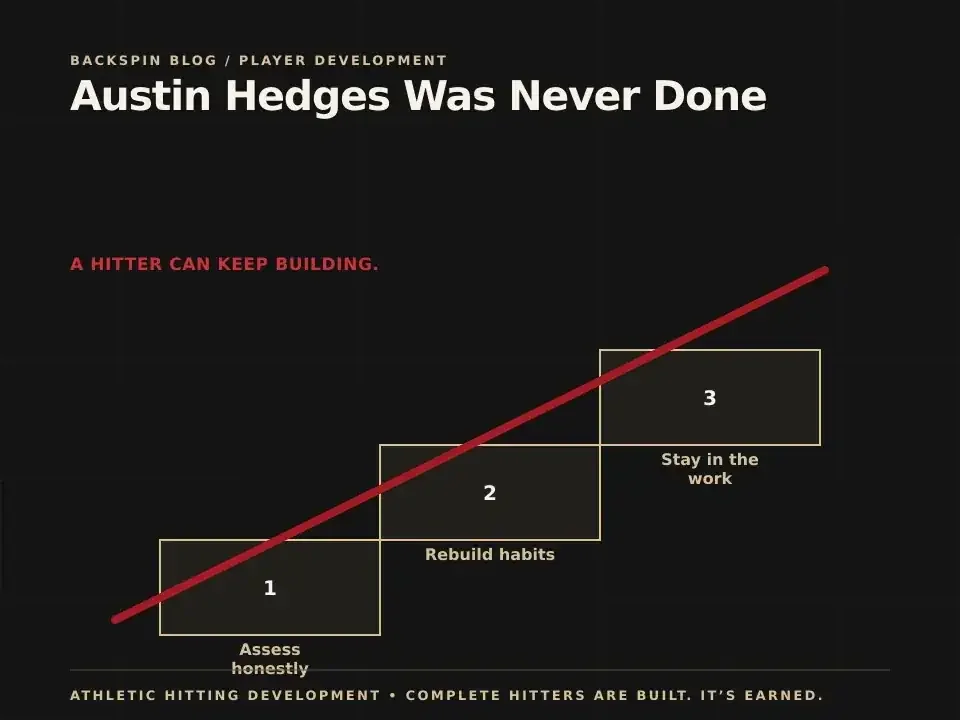
1. Get assessed before you overhaul
Do not copy a pro’s stance because it looks cool. Find your own first priority. It could be athletic position, timing, pitch recognition, balance, barrel direction, or approach. Fixing the right first problem is faster than chasing ten cues.
2. Train against uncertainty
Mix pitch types. Change speeds. Use machine work, live arm work, or competitive games where the hitter does not know what is coming. Make practice look and feel more like baseball.
3. Give every at-bat a plan
Know the pitcher, your best zone, and what you are ready to attack. A plan is not a guess. It is a prepared starting point that lets you react with confidence.
4. Measure the process, not just hits
Track quality decisions, on-time swings, hard line drives, two-strike competitiveness, and whether you stayed athletic through the swing. A clean process after an out can be a better sign than a lucky hit.
5. Do not confuse simple with easy
Hedges’ plan was simple, but he had to practice it repeatedly at game speed. Great hitters keep the thought simple because the game is hard—not because the work is easy.

THELESSON.
- Get assessed first.
- Train against uncertainty.
- Give every at-bat a plan.
- Measure the process.
- Simple is not easy.
Complete Hitters Are Built…Earned.
The real message: do not let the past write the next at-bat
Austin Hedges’ offensive career had enough bad evidence to convince almost anyone that he was what he was. He could have accepted the role, stopped searching, and called it realistic.
He did not.
He trained harder situations. He improved his visual setup. He cleaned up the direction of the barrel. He simplified the mental game. He learned to value a well-executed plan over an immediate result.
That is development.
The hitter you are today is not automatically the hitter you will be next season. But improvement is not made from hoping. It is made from an honest assessment, the right priorities, game-like training, and daily execution.
You are never just “a bad hitter.” You may be a hitter with a process that has not been fully built yet.
That can change.
Complete Hitters Are Built… Not Given. Earned!
Want to find your first priority?
Start with SwingChecker™. It helps identify the movement, setup, balance, path, timing, and process issues that may be getting in the way—then points you to what to work on first.
Stop guessing. Build the complete hitter.
Sources and notes
- MLB.com, Is MLB’s longest-running slump being snapped?,
April 19, 2026.
https://www.mlb.com/news/austin-hedges-improvement-as-hitter-in-2026 - Covering the Corner, Starting the Dialogue about Austin
Hedges, April 16, 2026.
https://www.coveringthecorner.com/cleveland-guardians-analysis/67328/starting-the-dialogue-about-austin-hedges - Baseball Savant defines attack angle as the vertical angle of the
bat’s sweet spot at impact.
https://baseballsavant.mlb.com/
The early-2026 performance figures discussed above were small-sample indicators, not a guarantee of a final-season outcome. The development lessons remain: improve the process, then let results follow.
Quick answers
What did Austin Hedges change in his swing?
He changed his setup first. He lowered his hands to about shoulder height, held the bat flatter and opened his stance. He also flattened his attack angle a little so he stopped working so far under the ball. The result was more line drives and fewer easy pop-ups.
Should my son copy Austin Hedges’ open stance?
No. Do not copy a pro’s stance because it looks cool. A setup has one job: put the hitter in the best position to see, recognize, time, decide and attack the baseball. Get assessed first and find your own first priority before you change anything.
How should young hitters practice to get game ready?
Train against uncertainty. Hedges cut out easy flip drills and practiced at game speed without knowing what pitch was coming. Mix pitch types, change speeds and use machine work, live arms or competitive games. Make practice look and feel like real baseball.
Can a hitter who has struggled for years still get better?
Yes. Problems like a poor setup, late recognition, a barrel that dumps under the ball or practice that doesn’t look like a real at-bat are trainable. Austin Hedges was labeled a non-hitter for a decade and still changed his contact numbers by fixing those things.
No subscription. No login. Keep learning, then take one priority into training.