By BK, Athletic Hitting Development
Complete Hitters Are Built… Not Given. Earned!
If you play this game long enough, it is going to hand you things you didn’t ask for and don’t deserve.
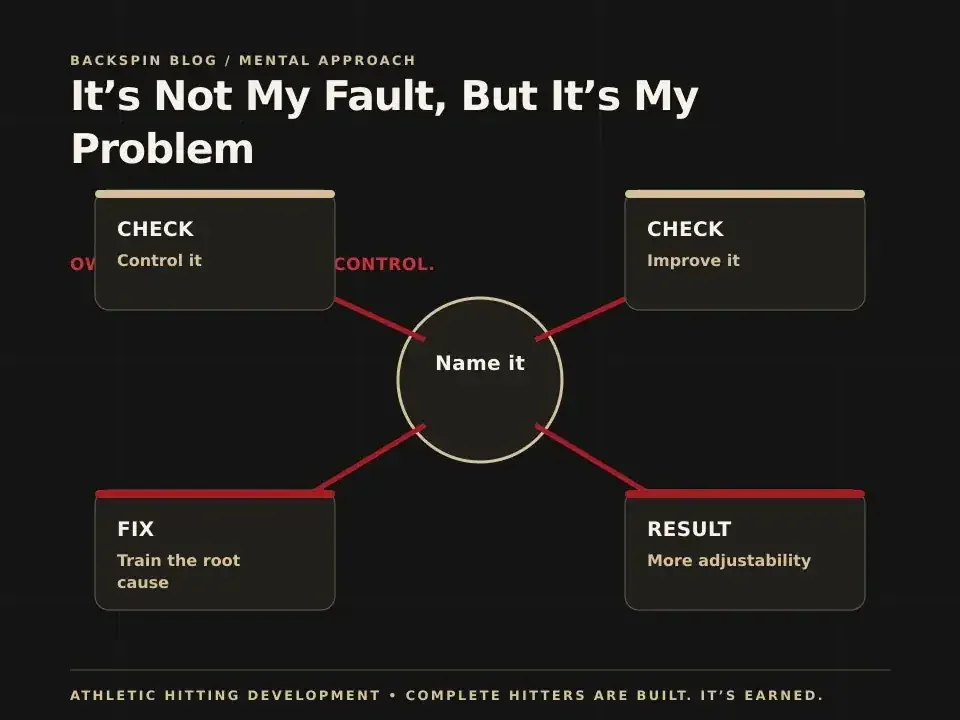
Plenty in this game isn’t fair or under your control, but it’s still yours to solve. Stop asking whose fault it is, ask what you can do about it, then feel it, name it, own it, plan one thing this week and prove it.
Train it: Mental Approach Masterclass →You’ll be the smallest kid on the field. You’ll hit a rocket right at the shortstop three times in one game. An umpire will ring you up on a pitch that was six inches off the plate. A coach will look right past you and play somebody you know you’re better than.
None of that is your fault.
All of it is your problem.
It’s not my fault, but it’s my problem. That one sentence is the difference between hitters who stay stuck and hitters who get better.
The list every hitter knows
Every player I’ve ever coached has had something on this list. Most have had a few of them at the same time.
- I’m not big enough.Not your fault. Still your problem.
- I’m not fast enough.Not your fault. Still your problem.
- My swing isn’t good enough yet.Not your fault. Still your problem.
- The umpire missed the call.Not your fault. Still your problem.
- Coach doesn’t see me the way I see myself.Not your fault. Still your problem.
- I hit it hard and it was caught. Again.Not your fault. Still your problem.
- I’m hitting 8th. Or I’m on the bench.Not your fault. Still your problem.
- I got cut. Or passed over. Or recruited late.Not your fault. Still your problem.
- I’m a late bloomer and everyone else grew first.Not your fault. Still your problem.
- I never had a real hitting coach until now.Not your fault. Still your problem.
Read that list again. Every single one of those can be 100% true. And not one of them gets better because you’re right about it.

IT'S NOT MY FAULT…
BUT IT'S MYPROBLEM.
- The umpire missed the call.
- I hit it hard. Caught again.
- I got cut. Or passed over.
NOT YOUR FAULT. STILL YOUR PROBLEM.
The trap: being right instead of getting better
Here’s where most hitters get stuck. They spend all their energy proving the problem isn’t their fault. They argue with the umpire in their head for three innings. They tell their parents the coach has favorites. They explain why the other kid gets more at-bats.
And they might be right. But being right doesn’t get you one more hit.
There are two questions you can ask when something goes wrong:
Question 1: “Whose fault is this?”
This question feels good for about five minutes. It protects your pride. It gives you someone to be mad at. Then it leaves you exactly where you started, with the same problem and less time to fix it.
Question 2: “What can I do about it?”
This question doesn’t care whose fault it is. It only cares about the next move. It’s harder to ask, because it puts the work back on you. It’s also the only question that ever changed anything for a hitter.
The hitters who make it aren’t the ones who had nothing go wrong. They’re the ones who stopped asking the first question.

TWO QUESTIONS
WHAT'S MYNEXT MOVE?
- Stop asking whose fault it is.
- Ask what you can do about it.
- It puts the work back on you.
BEING RIGHT DOESN'T GET YOU ONE MORE HIT.
The way out: turn every problem into a plan
You can’t control how tall you are, what the umpire calls, or who your coach writes in the lineup. You can control almost everything else. Here’s how each problem on that list turns into work.
“I’m not big enough.”
You can’t train your height. You can train your strength, your explosiveness and how efficiently your body moves. Small hitters who are strong, fast and on time hit the ball harder than big hitters who aren’t.
Your move: Train like an athlete, not just a hitter. That’s what athletic development is for.
“I’m not fast enough.”
Speed is a skill. Acceleration, first step, arm action and how you get out of the box can all be trained.
Your move: Practice speed on purpose, a few days a week, every week. Test it. Then test it again.
“My swing isn’t good enough.”
Then it isn’t done yet. A swing is built one piece at a time, and it starts with knowing which piece to fix first instead of trying ten drills at once.
Your move: Run SwingChecker™, find your #1 priority, and work on that one thing until it holds up in games.
“The umpire missed the call.”
He did. It’s over. The next pitch is coming either way, and it doesn’t care how mad you are.
Your move: Give yourself ten seconds. Step out, breathe, reset your plan, step back in. Your at-bat isn’t over until it’s over. At two strikes, the umpire’s zone is your zone.
“Coach doesn’t see me the way I see myself.”
This is the hardest one, because it feels personal. Here’s the truth: your coach can only see what you show him. How you see yourself isn’t evidence. What you do every day is.
Your move: Ask your coach one question: “What do I need to do to earn more at-bats?” Then go do exactly that, every day, where he can see it. Give him evidence he can’t ignore.
“I hit it hard and it was caught.”
That’s baseball and softball. Some days the scorebook lies. A hard-hit out is still a good at-bat.
Your move: Score yourself on the process, not the result. Did you see it early? Were you on time? Did you swing at your pitch? If the answer is yes, you won that at-bat.
“I’m on the bench, or I got cut.”
It stings. Let it sting for a night. Then use it. Some of the best hitters I’ve coached had their turning point right after somebody told them no.
Your move: Write down what you need to get better at. Build a plan with a start date. The next tryout, the next season, the next opportunity is coming. Be ready for it.
Five steps to owning your problem
When something unfair happens, run it through this:
- Feel it. You’re allowed to be frustrated. Give it a set amount of time, then let it go.
- Name it. What exactly is the problem? “I’m bad” isn’t a problem. “I chase breaking balls low and away” is.
- Own it. Say it out loud: “It’s not my fault, but it’s my problem.” Now it belongs to you, and so does the fix.
- Plan it. Pick the one thing you can work on this week. Not ten things. One.
- Prove it. Do the work, track it, and let your results do the talking.
FIVE STEPS TO OWNING IT
OWN THEPROBLEM.
- Feel it ↓ Name it ↓ Own it
- Plan it ↓ Prove it
PICK ONE THING THIS WEEK. NOT TEN.
A word for parents
When your son or daughter comes home upset about a coach, an umpire or a lineup, it’s natural to take their side. Sometimes they really were treated unfairly.
Listen first. Then help them get to the second question: “Okay. What can you do about it?” It’s one of the most valuable things you can teach a young athlete, and it will serve them long after they stop playing.

THELESSON.
- Feel it. Then let it go.
- Ask: what can I do?
- Train like an athlete.
- Fix one priority.
- Score the process.
- Earn more at-bats.
Complete Hitters Are Built…Earned.
You can’t control the problem. You can build the answer.
Being a hitter means failing more than you succeed and dealing with things that aren’t fair. That will never change. What can change is you: stronger, faster, a better swing, better decisions, and a mind that doesn’t fold when the game gets unfair.
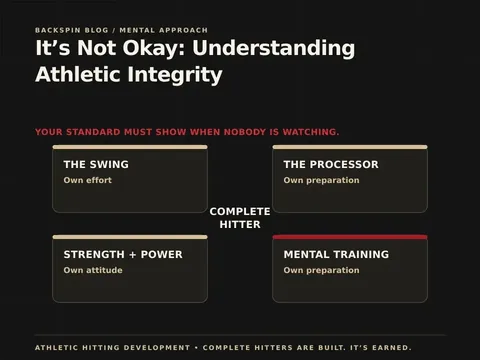
That’s why AHD trains all four pillars: the swing, athletic development, the hitting processor and the mental approach. Every problem on that list has an answer in one of them.
Don’t collect drills. Build a complete hitter.
Start with SwingChecker™ to find your first priority. Go deeper with the Mental Approach Masterclass or the Complete Hitter Masterclass. Or contact Coach about online remote baseball and softball training built around your hitter.
Quick answers
How do I help my child deal with an unfair coach?
Listen first. Sometimes they really were treated unfairly. Then help them get to the second question: "Okay. What can you do about it?" A good next move is asking the coach what they need to do to earn more at-bats, then doing exactly that every day where the coach can see it.
How should a hitter handle a bad umpire call?
He missed it. It is over. The next pitch is coming either way. Give yourself ten seconds. Step out, breathe, reset your plan and step back in. Your at-bat is not over until it is over, and at two strikes the umpire’s zone is your zone.
What should a player do after getting cut from a team?
Let it sting for a night. Then use it. Write down what you need to get better at and build a plan with a start date. The next tryout, the next season and the next opportunity are coming. Some of the best hitters I have coached turned the corner right after somebody told them no.
What should a hitter do after hitting the ball hard and getting out?
Score yourself on the process, not the result. Did you see it early? Were you on time? Did you swing at your pitch? If yes, you won that at-bat.
This article is part of the AHD guide The Mental Game of Hitting. Start there for the full picture and every related article.