By BK, Athletic Hitting Development
Complete Hitters Aren’t Born. They’re Built… and Earned.
Key takeaways
- Start with one question: what are we trying to learn from this clip?
- Only compare like with like: same angles, same distance, same pitch, same drill.
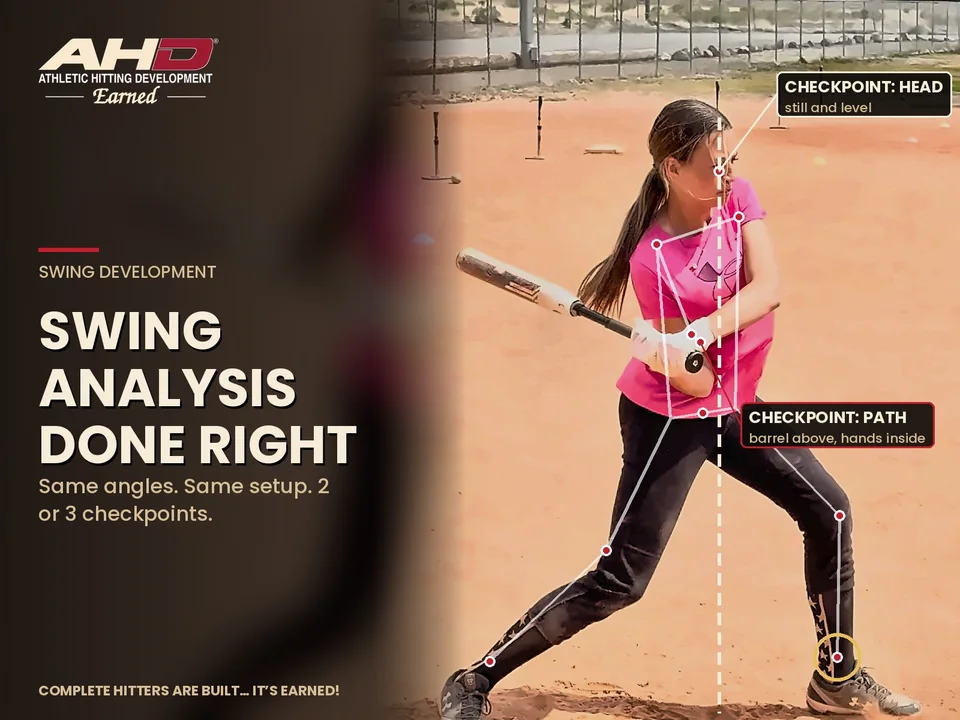
- Pick 2 or 3 checkpoints tied to the real problem, not all 10.
- Every adjustment is a test. Film again and see if it worked.
To analyze swing video, start with one question, compare clips filmed the same way every time, and look at only the two or three checkpoints tied to the hitter’s real problem. Phone video is evidence, not a lab report.
Start with one question, compare only clips filmed the same way (same angles, distance, pitch and drill), and look at the two or three checkpoints tied to the hitter’s real problem. Then test one adjustment and film again.
Train it: Swing Structure & Mechanics → Free tool: Online swing analysis + filming checklist →A slow-motion clip can show posture, direction, timing, how the barrel enters, where contact happens and how the hitter finishes. It turns a coaching conversation from emotional to exact.
What it can’t do is turn one clip shot from the bleachers into a biomechanics lab. That’s no reason to put the phone away. It’s a reason to use it like a coach.
1. What should I look for in my hitter’s swing video?
The worst first question is “What’s wrong with this swing?” The best one is “What are we trying to learn?”
- Is the hitter late against velocity?
- Does the barrel get to the zone above and inside, or does the hitter lose it during the move?
- Is contact moving because the pitch moved, or because the move changed?
- Does the better rep start with a better gather, better direction or a better decision?
One clear question turns video into a teaching tool. Ten random freeze frames turn it into a guessing contest.
“Ball — powdered.” That sound is the goal. Chase the swing that makes it, not the one that looks prettiest on a freeze frame.
FILM IT THE SAME
LIKEWITH LIKE.
- Same angles: side + behind
- Same height and distance
- Same pitch, same drill
- Same pause point
ONE QUESTION PER CLIP
2. How do you compare two swing videos?
A tee swing and a live at-bat are different tests. So are a side view and a rear view, or two clips shot from different distances against different pitches. Don’t claim more than your camera can prove.
Keep these the SAME every time you film:
- Camera angles, height and distance
- The hitter’s side and stance
- Pitch type, speed and location
- The goal of the drill
- The moment you pause to compare
“Two choices: A. Do everything in your control. B. Anything but A.” The filming setup is 100% in your control. Get it right and the video tells the truth.
That’s why AHD Swing Lab asks for two angles of the same swing, side and behind. The filming checklist covers phone settings and distance.
3. Which swing checkpoints matter most?
At AHD we read the swing in order: stance and ready position, the gather, a directionally sound load, launch position, the bump, letting go of the arrow, the barrel approach (above and inside), contact, extension and the finish.
Less is more. You don’t chase all of them on every clip. Pick the two or three tied to the hitter’s real problem:
- Late hitterLook at the gather, the launch and contact.
- Slicing under the ballLook at the barrel approach and contact.
- Spirals after a missLook at the routine between pitches before you touch mechanics.
Good hitters get into mechanically advantageous angles (MAA) at the right moments. Video is how you see whether your hitter gets there, one checkpoint at a time.
4. What should I ask my hitter after watching the video?
- What did you feel?Feel first, before the coach talks.
- What did you see?Let the hitter find it.
- What were you trying to do?Intent explains a lot of swings.
- What changed from your best rep?Compare to his own best, not to a big leaguer.
- What one adjustment do we test next?One thing. Then film it again.
Notice the word: test. We aren’t telling a kid he’s broken. We’re testing one idea, seeing if it helps and teaching the hitter to fix himself. Baseball or softball, same five questions.
Video is evidence, not magic.
5. Can a swing analysis app replace a hitting coach?
An app can draw lines and measure angles. A coach decides which checkpoint matters for this hitter, what caused it and what to test next. Used with one clear question and the same setup every time, video helps a hitter stop guessing and see the next step.
More on that tradeoff in Is Online Swing Analysis Worth It?
THELESSON.
- Ask one question
- Compare like with like
- 2 or 3 checkpoints
- Test one fix, film again
Complete Hitters Are Built…Earned.
Want to go deeper? Read How to Film Your Swing for Analysis (Angles, Settings, Checklist) and Is Online Swing Analysis Worth It? What Video Can See, and What It Can’t.
Quick answers
What is the best angle to film a baseball or softball swing?
Film from the side and from directly behind, chest high, at the same distance every time. Two angles of the same swing beat one angle.
Can a swing analysis app replace a hitting coach?
No. An app can measure and draw lines. A coach decides which checkpoint matters for this hitter and what to test next.
How do I compare my hitter’s swing videos?
Use the same angles, distance, pitch type and drill, and pause at the same checkpoint in both clips. Otherwise you’re comparing two different tests.
How many checkpoints should I look at in one video?
Two or three, tied to the hitter’s real problem. Looking at everything at once usually means fixing nothing.
Don’t collect drills. Build a complete hitter.
Complete Hitters Aren’t Born. They’re Built… and Earned.