
By BK, Athletic Hitting Development
Complete Hitters Aren’t Born. They’re Built… and Earned.
Key takeaways
- Online swing analysis is worth it when it leads to a plan and a retest. A one-off analysis with no follow-up rarely changes much.
- Video sees a lot. Sequence, posture, bat path, stride and contact point all show up on good slow-motion video.
- Video misses some things. Timing against real pitching, pitch decisions and what the hitter is thinking don’t show up on a tee swing.
- Start free, film it right, and pay for ongoing coaching when you need someone to own the plan with you.
Online swing analysis is worth it when it leads to a plan and a retest, not just a list of flaws. Good slow-motion video shows sequence, posture, bat path and contact point clearly, but a one-off review without follow-up rarely changes much, and no video of tee swings can see timing or decisions against live pitching.
Online swing analysis is worth it when it leads to a plan and a retest, not just a list of flaws. Good video shows sequence, posture, bat path and contact point, but it can’t see timing or decisions against live pitching, and a one-off review without follow-up rarely changes much.
Train it: 90-Day Private Hitter Development → Free tool: SwingChecker Precision (video-first) →Parents send me videos with the same question: “Is this worth paying for, or will an app tell me the same thing?” The honest answer is that it depends on what you do AFTER the analysis.
Here’s what video can and can’t see, how the different types of swing analysis compare and when each one is worth your money.
1. What can online swing analysis actually see?
More than most people think, IF the video is filmed right. From the side and from behind, chest high, landscape, slow motion (120 or 240 fps), whole body and bat through the finish, a trained eye can see:
- Sequence. Whether the hips, shoulders, hands and barrel move in the right order.
- Posture and balance. Lunging, collapsing, the head moving, how the front leg lands.
- Bat path. Casting, a long swing, bat drag and whether the barrel matches the plane of the pitch.
- Contact point. Where the ball is met compared to the front foot and the pitch location.
It also sees the positions that matter most. AHD hitters work from Mechanically Advantaged Angles (MAA), and those angles are easy to check on paused video. The full filming setup is in How to Film Your Swing for Analysis.
SWING ANALYSIS
WHAT VIDEOCAN SEE.
- Sequence and order
- Posture and balance
- Bat path and plane
- Contact point
NOT TIMING. NOT DECISIONS.
2. What can’t a swing analysis see?
Here’s where I’ll be blunt. A tee swing is not an at-bat.
- Timing against real pitching. A swing can look perfect on a tee and be late every time in a game.
- Pitch decisions. Video of 10 swings doesn’t show whether he chases the curveball in the dirt.
- The mental side. Fear, pressure and confidence don’t show up on a cage clip.
- Strength and explosiveness. Video shows the move, not whether the body is strong enough to do it faster.
That’s why one pillar is never the whole story. The Swing is one of the 4 Pillars of a Complete Hitter, next to Strength & Explosiveness, The Hitting Processor (see it, time it, decide, attack it, trained DAILY) and the Mental Approach. Game at-bat video fills in a lot of the gap. A tee clip alone can’t.
One more thing video can’t fix: bad video. A clip shot from the stands at an angle, in normal speed, with the bat cut off at the top of the frame, hides almost everything. Before you pay anyone, film it the right way first. Half the time, a parent who films it right can see the problem on their own.
3. Is a swing analysis app as accurate as a coach?
An app or checker is as good as the video and the answers you give it. It can catch clear, common problems. It can’t ask a follow-up question, watch game at-bats in context or change the plan when the first fix doesn’t work. Here’s how the types compare:
| Type | What you get | Worth it when |
|---|---|---|
| Free apps and checkers | A ranked priority or flagged positions | You want a starting point and to learn what to look for |
| One-off paid analysis | A coach’s eyes on one video, usually a written or video breakdown | You’ll act on it yourself and retest |
| Ongoing coaching | Evaluation, a plan, feedback on new video, adjustments | You want someone to own the process with you |
The free SwingChecker Precision is the video-first version of our checker. You pause on the frames it asks for, answer what you see, and it ranks the top priorities with a confidence score. No video? The guided SwingChecker takes about 3 minutes.
A diagnosis is not a cure.
4. Why doesn’t a one-time swing analysis change much?
Because the analysis is the easy part. The hard part is the next 6 to 8 weeks. In my experience, families get a list of five flaws, try to fix all five at once and give up when nothing feels different.
- Pick one priority.The one that’s causing the most problems, usually something early in the swing.
- Match one drill to it.Don’t collect drills. Build a complete hitter.
- Train it daily.10–20 minutes a day for two or three weeks.
- Retest on the same angles.Same camera spot, same drill, new video, and compare side by side.
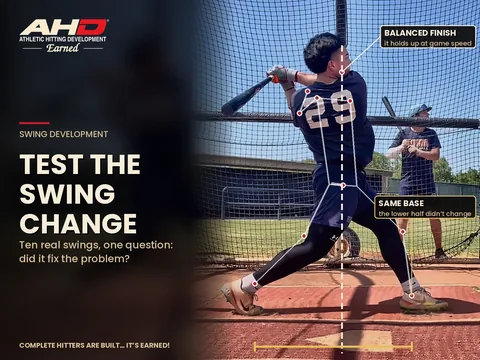
If you can run that loop on your own, a free tool or a one-off review can be plenty. If you can’t, or you’ve tried and it stalls, that’s what coaching is for. For more on testing a change, read How to Know If a Swing Change Is Working.
A one-off review also can’t tell you when to move on. Once the first priority is fixed, there’s always a next one, and the order matters. That’s the real value of a coach over a single report: someone who sees the new video, says “that’s fixed” and hands you the next step.
5. When is paying for swing analysis worth it?
It’s worth paying when the hitter is serious, you’ve already filmed it right and you want an expert to own the plan and the follow-up. It’s probably NOT worth paying yet if your hitter is very young, won’t film or hasn’t tried the free tools.
Start with the free tools and the filming checklist on our online swing analysis page. When you want my eyes on it for 90 days, 90-Day Private Hitter Development is $1,995: a starting evaluation across all 4 pillars, a personal 90-day plan, all 7 courses, ongoing swing and game at-bat video analysis, progress reviews and direct text access. Limited to 12 athletes. The goal is an aggressive and athletic hitter, built over time.
Not sure which fits? Text Coach at 480-881-5447. Or read Online vs In-Person Hitting Lessons to see which fits your hitter.
THELESSON.
- Film it right first
- Start with the free tools
- One priority, then retest
- Pay for a plan, not a list
Complete Hitters Are Built…Earned.
Want to go deeper? Read How to Film Your Swing for Analysis (Angles, Settings, Checklist) and How to Know If a Swing Change Is Working.
Quick answers
Are swing analysis apps accurate?
They can catch clear, common problems when the video is filmed well and the answers are honest. They can’t watch game at-bats in context, ask follow-up questions or adjust the plan the way a coach can.
How much does an online swing analysis cost?
It ranges from free checkers to paid one-off reviews to ongoing coaching. At AHD, SwingChecker and SwingChecker Precision are free, and 90-Day Private Hitter Development is $1,995 for 90 days.
What should I film for a swing analysis?
Film from the side and from behind, chest high, landscape, in slow motion if you can, with the whole body and bat in frame through the finish. Send 5 tee swings and 5 live or front toss swings, and game at-bats if you have them.
Is one swing analysis enough to fix a swing?
Rarely. One analysis tells you what to work on. The swing changes from training one priority daily for a few weeks and retesting on the same camera angles.
Don’t collect drills. Build a complete hitter.
Complete Hitters Aren’t Born. They’re Built… and Earned.