By BK, Athletic Hitting Development
Complete Hitters Are Built… Not Given. Earned!
It’s not okay to jog the last sprint because the coach turned around.
Athletic integrity is doing everything you’re supposed to do, to the best of your ability, every day, whether anyone is watching or not. It isn’t about talent; it’s about being honest with your own potential and being a strong link for your team.
Train it: Mental Approach Masterclass →It’s not okay to take a round of BP on autopilot, skip your arm care because nothing hurts yet, or take an at-bat off because the umpire missed a call.
It’s not okay to have more talent than effort.
Most players have never been told that. They’ve been told to have fun, to relax, to “just go play.” All true. But somewhere along the way, a lot of young hitters start believing that giving 80% is fine as long as nobody notices.
It isn’t. And it has a name.
What athletic integrity is
Athletic integrity is doing everything you are supposed to do, to the best of your ability, every day, whether anyone is watching or not.
It isn’t about talent. It isn’t about being the best player on the field. A backup with athletic integrity is worth more to a team than a star without it.
It’s about being honest with your own potential. You either did everything you could to reach it, or you didn’t. Nobody else really knows. You do.

WHAT ATHLETIC INTEGRITY IS
WHEN NO ONEWATCHES.
- Do what you're supposed to do.
- To the best of your ability.
- Every day.
IT'S NOT OKAY TO HAVE MORE TALENT THAN EFFORT.
You didn’t get here alone
Look at the uniform you put on. Now think about everything it took to get you into it.
Your parents drove you to every practice and sat through every doubleheader in the heat. Grandparents showed up with folding chairs. Brothers and sisters spent their Saturdays in the bleachers for your games. Coaches volunteered hours they’ll never get paid for. Trainers, teachers and instructors poured into you.
Nobody did any of that because they expected you to be perfect. They did it because they believed in you.
You don’t owe them a scholarship. You don’t owe them a batting title. You owe them your best effort. That’s the one thing completely in your control, and it’s the one thing they deserve.
When you cut a corner, you aren’t just cheating yourself. You’re spending their time, their money and their belief, and throwing some of it away.
The chain: your integrity isn’t just yours
A team is a chain. Every player is a link.
One link is all it takes.
Your teammates are counting on you in ways they’ll never say out loud. The pitcher is counting on you to have done your defensive work. The hitter behind you is counting on you to grind out a tough at-bat and get on. The whole dugout is counting on you to run out the ground ball, back up the throw and stay in the game when it gets ugly.
When one player’s athletic integrity starts to slip, the chain doesn’t bend. It breaks.
- One player skips conditioning, and the whole team gets tired in the seventh inning.
- One player jogs to first, and a dropped ball that should have been a hit becomes an out.
- One player takes an at-bat off, and a rally dies with runners on.
- One player sulks on the bench, and it spreads through the dugout.
You don’t get to decide whether the whole chain is strong. You only get to decide whether your link is.
A TEAM IS A CHAIN
ONELINK.
- One skips conditioning.
- One jogs to first.
- One takes an at-bat off.
- The chain breaks.
YOU ONLY DECIDE IF YOUR LINK IS STRONG.
Why a team with integrity is so tough to beat
Put nine, twelve or twenty players together who all do everything, every day, to reach their potential, and something happens.
They trust each other, because everyone has earned it. They don’t beat themselves with lazy mistakes. They stay composed when the game gets tight, because they know they’ve done the work. They don’t fold when they fall behind.
And when the season ends, win or lose, there are no regrets. Nobody is lying awake thinking about the sprints they jogged or the reps they skipped. They gave it everything. That’s a team nobody wants to play.
A team full of high-integrity players doesn’t always win. But it almost never loses to itself.
The choice: integrity or not
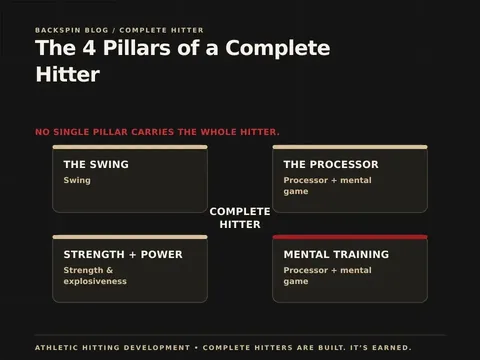
Every day, in every pillar, you choose. Here’s what that choice looks like for a hitter.
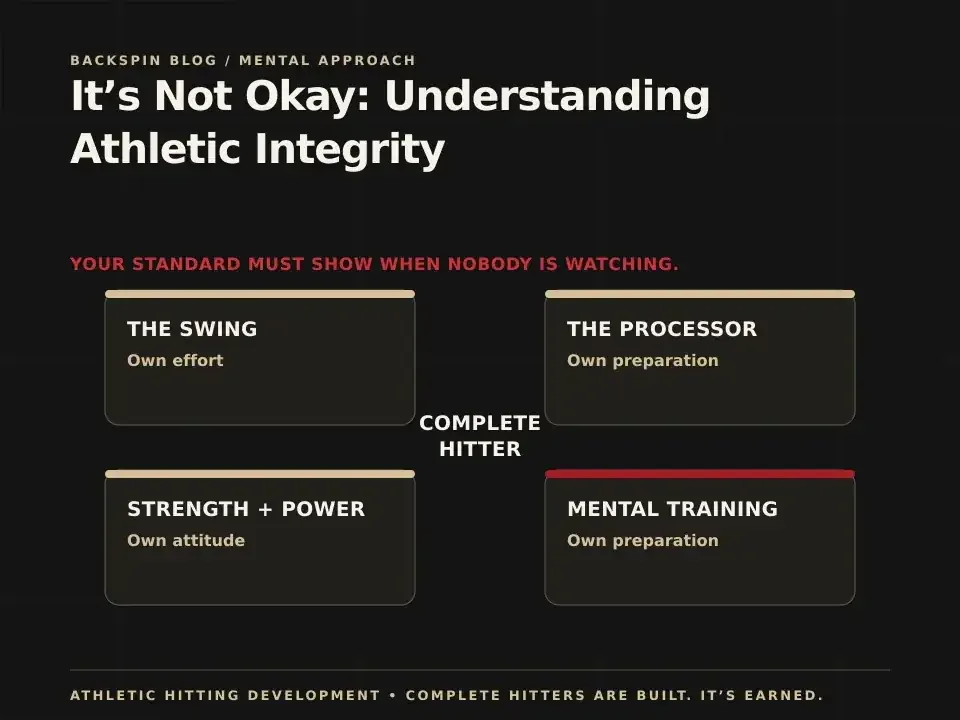
Pillar 1The Swing
- Takes every rep with a purpose and a target, even the 150th one.
- Works on the one thing Coach assigned until it holds up in games.
- Films the swing and actually watches it.
- Does the boring tee work when nobody is around.
- Takes 100 swings on autopilot and calls it practice.
- Jumps to a new drill every week because the last one got boring.
- Only swings hard in front of scouts, coaches or parents.
- Knows what the fix is but doesn’t do it.
Pillar 2Athletic Development
- Shows up for strength and speed work, not just BP.
- Does arm care every day, not just when something hurts.
- Sleeps, eats and hydrates like the season depends on it, because it does.
- Finishes every sprint through the line.
- Skips the lift because “I’m a hitter, not a weightlifter.”
- Starts arm care after the injury.
- Stays up until 2 a.m. and wonders why the bat feels slow.
- Jogs the last rep when the coach turns around.
Pillar 3The Hitting Processor
- Tracks every pitch from the dugout and the on-deck circle.
- Studies the pitcher’s release, sequence and out pitch before stepping in.
- Takes the ball that isn’t their pitch. Attacks the one that is.
- Charts at-bats to learn from them, not to make excuses.
- Watches the scoreboard, the crowd or their phone between at-bats.
- Walks up with no plan and swings at the first thing that looks close.
- Chases the same breaking ball three games in a row.
- Blames the umpire instead of studying the zone.
Pillar 4The Mental Approach
- Runs the same routine on the first pitch and the last one.
- Resets in ten seconds and goes after the next pitch.
- Competes the same way down ten runs or up ten runs.
- Owns mistakes out loud and fixes them.
- Takes the at-bat off after a bad call.
- Lets one strikeout become three.
- Plays hard only when the game is close or people are watching.
- Makes excuses, pouts, or blames teammates.
Beyond the pillars
Athletic integrity doesn’t stop at the four pillars. It shows up everywhere.
Beyond the pillarsPractice
- First one ready, last one to leave the field clean.
- Practices at game speed so games feel slower.
- Shows up late and leaves early.
- “Saves it for the game.”
Beyond the pillarsBeing a Teammate
- Runs out every ball. Picks up a teammate after a mistake.
- Is the same person in the dugout whether they’re 4-for-4 or 0-for-4.
- Sulks at the end of the bench.
- Cheers only when they’re playing well.
Beyond the pillarsOff the Field
- Handles the classroom, because eligibility is part of the job.
- Represents the uniform, the family name and the program everywhere.
- Loses a season to grades or a bad decision.
- Thinks what happens off the field doesn’t count.
Two kinds of pain
Every athlete eventually feels one of two kinds of pain: the pain of discipline, or the pain of regret.
The pain of discipline is the extra reps, the early workouts and the arm care you don’t feel like doing. It hurts a little, every day.
The pain of regret is looking back at the end of your career and knowing you could have done more. That one doesn’t go away.
Choose the first one.

EVERY ATHLETE FEELS ONE
DISCIPLINEOR REGRET?
- Discipline hurts a little.
- Every day.
- Regret doesn't go away.
CHOOSE THE FIRST ONE.
Your daily integrity check
Before you go to bed, ask yourself five questions:
- Did I do everything I was supposed to do today?
- Did I do it to the best of my ability, or just to get it done?
- Would I have trained differently if someone was watching?
- Was I a strong link for my teammates today?
- Did I honor the people who gave me this opportunity?
If the answer to any of them is no, it’s not okay. But it’s fixable, starting tomorrow.
A word for parents and coaches
Athletic integrity isn’t something you can yell into a player. It’s built by expecting it, modeling it and praising it when you see it. Catch them sprinting through the bag. Catch them doing arm care without being told. Talk about the effort more than the box score.
Players with athletic integrity become people with integrity. That lasts a lot longer than any season.

THELESSON.
- Did everything today.
- Did it at my best.
- Same work, watched or not.
- Was a strong link.
- Honored my people.
Complete Hitters Are Built…Earned.
Build it every day
Athletic integrity isn’t a speech. It’s a habit. At AHD, every lesson in every course trains all four pillars, because a complete hitter doesn’t get to pick which parts of the job to take seriously.
Don’t collect drills. Build a complete hitter.
Start with SwingChecker™ to find your first priority. Build the daily habits with the Complete Hitter Masterclass or the Mental Approach Masterclass. Or contact Coach about online remote baseball and softball training with real accountability built in.
So with everything you and your crew have gone through, and to your teammates and coaches…
it’s not okay to have anything but exceptional athletic integrity.
Quick answers
What is athletic integrity in sports?
Athletic integrity is doing everything you are supposed to do, to the best of your ability, every day, whether anyone is watching or not. It is not about talent. It is about being honest with your own potential. A backup with integrity is worth more than a star without it.
How does one player’s effort affect the whole team?
A team is a chain, and every player is a link. One player skips conditioning and the whole team gets tired late. One player jogs to first and a hit becomes an out. You do not control the whole chain. You control whether your link is strong.
How can parents and coaches build athletic integrity?
You cannot yell it into a player. Build it by expecting it, modeling it and praising it when you see it. Catch them sprinting through the bag or doing arm care without being told. Talk about effort more than the box score.
What does it mean to have more talent than effort?
It means a player is coasting on ability, giving 80% because nobody seems to notice. It’s not okay. A backup with athletic integrity is worth more to a team than a star without it.