It is simple. It is not easy.
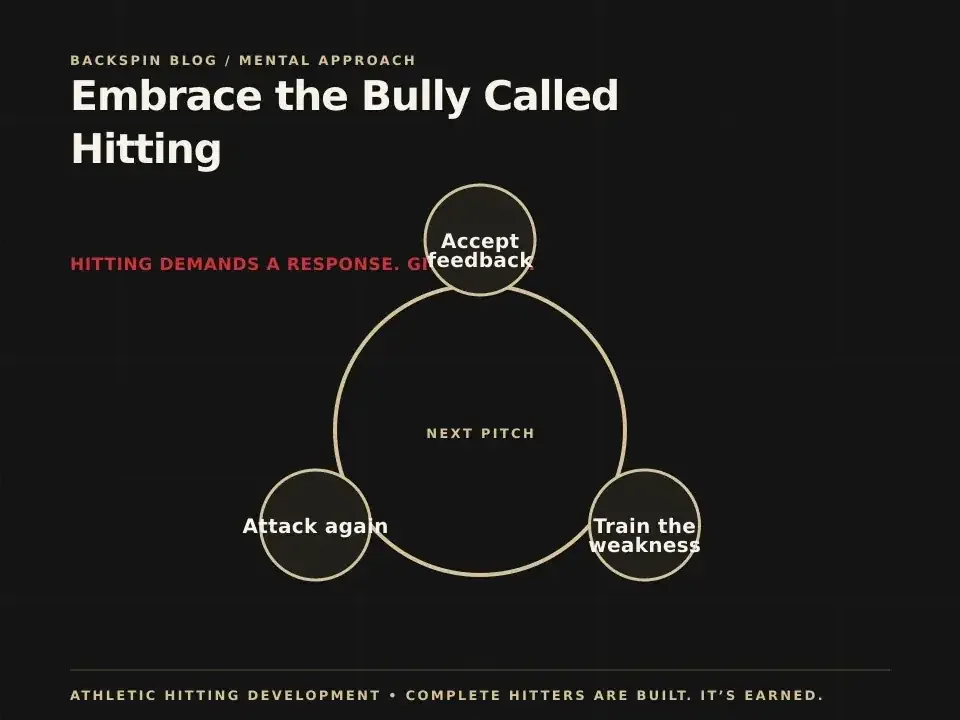
Embrace the bully called hitting: take the punch, learn what it exposed and go right back at it, with no excuses. Every ground ball, strikeout and line drive is feedback, not a verdict, so use the clue and train the one thing before the next game.
Train it: Mental Approach Masterclass →Hitting is going to punch you in the face sometimes.
It will do it after you worked all week. It will do it after a great batting-practice round. It will do it when you feel like you have finally figured everything out. A good pitcher, a tough count, a bad decision, a pitch you were not ready for, or a ball you just miss by an inch can make you feel like you are back at the beginning.
Good. That is the game talking to you.
Do not run from it. Do not give it the “poor me” speech. Do not spend your time complaining about the umpire, the weather, your coach, your lineup spot, the field, the mound, the machine, the bad hop, or the last at-bat.
Embrace the bully called hitting.
Take the punch. Look it in the face. Learn what it exposed. Then go right back at it.
That is what it takes to become your own version of the best hitter I can be. Not somebody else’s version. Not the guy on social media’s version. Yours.
The ball does not lie—let it guide you
The ball is honest.
It tells you when your timing is early. It tells you when you were late. It tells you when your barrel got underneath it, when you lost your balance, when you chased spin, or when you were so passive that a hittable pitch beat you to the plate.
It does not mean you are a bad hitter. It means there is information available.
The mistake is treating every result like a verdict on who you are. A ground ball, strikeout, pop-up, or line drive is feedback. It is a clue. The job is to be honest enough to use the clue.
Ask better questions after your at-bat:
- What pitch was I ready to hit?
- Did I see it and recognize it early enough?
- Was I on time—or did my body get started too early or too late?
- Did I stay athletic through the swing?
- Did my barrel work through the baseball or dump underneath it?
- What is the one thing I can train before the next game?
That is development. No drama. No excuses. Just information and work.

THE BALL DOES NOT LIE
IT'SFEEDBACK.
- Not a verdict.
- It's a clue.
- Be honest enough to use it.
NO DRAMA. NO EXCUSES. JUST WORK.
Hitting is simple. It is not easy.
People overcomplicate hitting because they are scared of how hard it is.
The job is simple: see the baseball, recognize what it is, get your body on time, make a good decision, and attack a pitch you can handle with a direct, powerful, adjustable swing.
At AHD, we call that the Hitting Processor:
See It → Recognize It → Time It → Decide → Attack It
Simple does not mean automatic.
You have to do it against velocity. You have to do it against spin. You have to do it when you are tired, when you are nervous, when the count is 0–2, and when the pitcher is trying to get you out. That is why a hitter needs more than a pretty swing in a cage.
Hitting has to be trained in the real world.
The template is right in front of you: build all four pillars
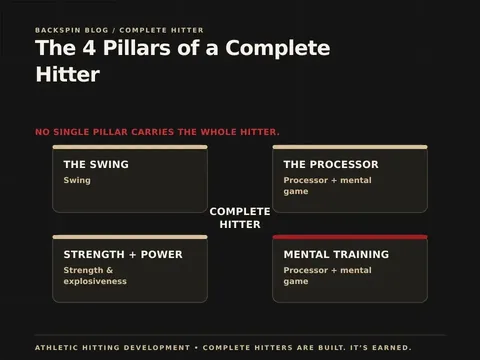
There is no mystery system hidden somewhere on the internet. The complete hitter is built through four connected systems.
1. The Swing
Build a swing that gives you a large margin for error for solid contact while producing force and an effective bat-to-ball angle.
That means an athletic setup, a usable gather and forward move, a clean launch, a barrel that works through the baseball, and enough body control to adjust. You do not need to chase a new cue every Tuesday. You need to own the basics long enough for them to hold up under pressure.
2. Strength & Explosiveness
The swing is not just hands and a bat. It is force, speed, posture, balance, coordination, and the ability to keep an athletic position while moving fast.
Get stronger. Get more explosive. Learn how to control your body. A stronger, more athletic hitter has more options—and more ways to stay in an at-bat when the pitch is not perfect.
3. The Hitting Processor
If you cannot see it, recognize it, time it, decide, and attack it, none of the swing talk matters enough.
Train your eyes. Train release-point awareness. Train pitch shape. Train your timing. Train your strike zone. Train the ability to sit on a heater and adjust to a hanger. The game is too fast to merely hope your reaction saves you.
4. Mental Training
This is where you decide who you are when hitting gets hard.
Confidence is not pretending you will never fail. Confidence is knowing that a bad at-bat does not get to take your plan away. It is competing after the strikeout. It is stepping in after the jam shot. It is trusting your work when the game gets loud.
The best hitters do not need everything to feel perfect. They keep going.
THE TEMPLATE IS RIGHT THERE
BUILD ALLFOUR.
- The swing.
- Strength & explosiveness.
- The Hitting Processor.
- Mental training.
DON'T COLLECT DRILLS. BUILD A COMPLETE HITTER.
Never seen a good young passive hitter
Let’s be clear: controlled does not mean passive.
I have never seen a young hitter become dangerous by standing in the box hoping to walk, hoping the pitcher misses, or hoping somebody tells them exactly what to do after every pitch.
Great young hitters are ready to do damage. They have a plan. They are looking for a pitch and a location they can attack. They are not swinging at everything—but when the pitcher gives them a mistake, they do not apologize for hitting it hard.
That is the Heater/Hanger mentality:
Be ready to destroy the heater in your zone. Stay athletic enough to recognize and adjust to the hanger.
Go to the plate with intent. Be aggressive with discipline. Make the pitcher feel you.
Timing: work on it
Timing is not a talent that some kids are born with and others never find. Timing is a skill.
Work on it.
Practice different speeds. Practice rhythm. Watch the pitcher. Find the release window. Get your body started early enough that you can make the decision later. Learn the difference between being on time for the fastball and being committed too soon for the off-speed pitch.
If you are late, do not just say, “I’m late.” Find out why. Were you not ready? Did your move start too late? Did you lose posture? Did you not pick up the ball early? Did you get surprised by velocity?
Then build the answer into practice.
Off-speed: work on it
Off-speed pitching is not unfair. It is part of the test.
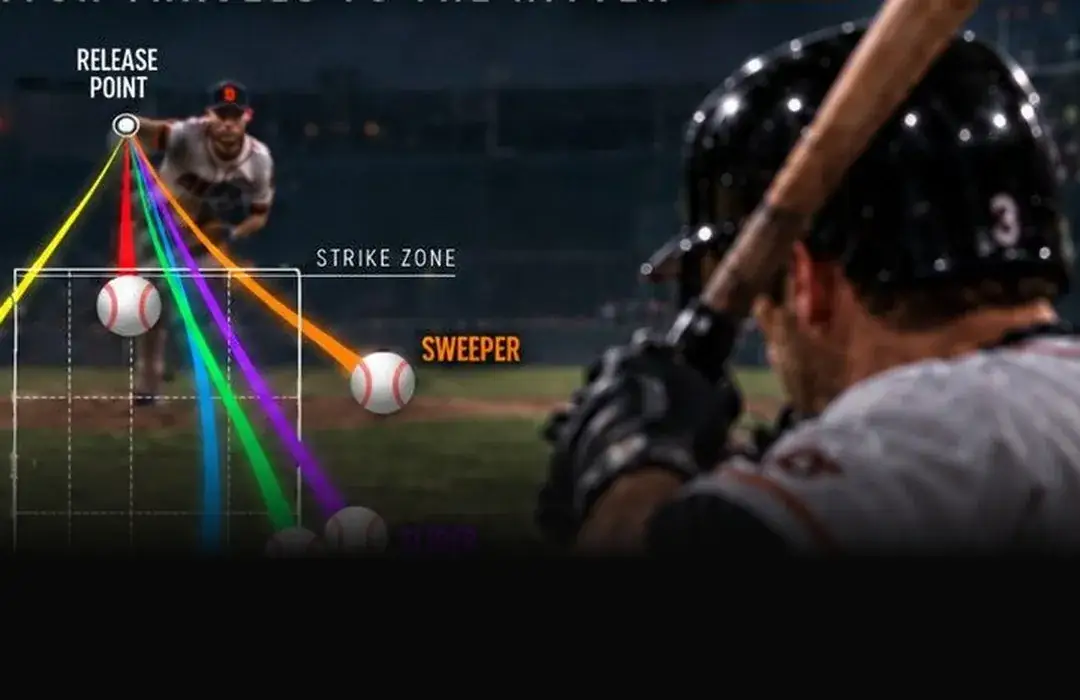
The hitter who refuses to train spin, shape, speed change, and adjustment will keep getting the same lesson in games. A slider, curveball, changeup, drop ball, rise ball, or anything that makes the hitter panic is not a reason to complain. It is a category of work.
See more of it. Name it. Track it. Train your eyes to recognize the release and early flight. Put yourself in competitive situations where you do not know what is coming.
The goal is not to hit every off-speed pitch for a home run. The goal is to recognize it early enough to take the bad one, spoil the tough one, and crush the mistake.
OFF-SPEED IS PART OF THE TEST
WORKON IT.
- See more of it.
- Name it. Track it.
- Take the bad one.
- Crush the mistake.
TIMING IS A SKILL. WORK ON IT.
Try things—but do not get stuck being insane
There is a difference between experimenting and spinning your wheels.
Try things. Test a better setup. Test a better rhythm. Test a drill that attacks your actual first priority. Test it with honest feedback from video, ball flight, and game-like reps.
But do not get trapped doing the same thing over and over while expecting a different result. That is not toughness. That is just being stuck.
Make a meaningful change. Give it enough reps to learn it. Measure whether it helps. Keep it, adjust it, or throw it away. Then move forward.
Do not fall for fads
Every few months, somebody announces that they have found the one magical swing thought, the one device, the one drill, or the one style that will make every hitter great.
Be careful.
Players are different. Bodies are different. Strength levels, movement patterns, vision, timing, and goals are different. There is no one-size-fits-all swing.
But the body has not suddenly changed. The anatomy and biomechanics that allow a hitter to create force, control the barrel, see the ball, and adjust under pressure are still the anatomy and biomechanics of a human being.
That means the principles do not disappear just because a fad gets a million views:
- Athletic position matters.
- Balance and body control matter.
- Sequence matters.
- A direct, adjustable barrel matters.
- Timing matters.
- Vision and pitch recognition matter.
- Strength and explosiveness matter.
- A real competitive plan matters.
The elite swing is not a costume. It is a functional solution to a fast, difficult problem.
The daily standard
You are going to get beat sometimes. Every hitter does.
When it happens, do not hide from the work. Do not become passive. Do not worship a fad. Do not let one rough day turn into a story about why you cannot do this.
Go back to the template. Build the swing. Build the athlete. Build the processor. Build the competitor.
And every once in a while, drink some hose water. Stuff is magic.
Then head out to the field.
Take the punch.
And go right back at it.
COMPLETE HITTERS ARE BUILT… NOT GIVEN. EARNED!
Find the first thing to build
Start with SwingChecker™ to identify the movement, athletic position, balance, path, timing, and process issue that deserves your attention first.
Stop guessing. Build the complete hitter.

THELESSON.
- Take the punch.
- Let the ball guide you.
- Build all four pillars.
- Be aggressive with discipline.
- Don't fall for fads.
- Go right back at it.
Complete Hitters Are Built…Earned.
Quick answers
How do you deal with failure in hitting?
Embrace it. Hitting is going to punch you in the face sometimes. Do not complain about the umpire, the weather or the last at-bat. Take the punch, learn what it exposed and go right back at it. A bad at-bat does not get to take your plan away.
Can timing in hitting be learned?
Yes. Timing is a skill, not a talent some kids are born with. Practice different speeds and rhythms. Watch the pitcher and find the release window. Get your body started early enough to decide later. If you are late, find out why, then build the answer into practice.
How do you get better at hitting off-speed pitches?
Off-speed is not unfair. It is part of the test. See more of it, name it, track it and train your eyes on the release and early flight. Compete in reps where you do not know what is coming. The goal is to take the bad one, spoil the tough one and crush the mistake.
What should a hitter ask himself after a bad at-bat?
What pitch was I ready to hit? Did I see it and recognize it early enough? Was I on time? Did I stay athletic? Did the barrel work through the ball? Then pick the one thing to train before the next game. No drama, just information and work.
From the 2015 archive: Staying Connected: The Back Elbow Slot at Contact.
No subscription. No login. Keep learning, then take one priority into training.
This article is part of the AHD guide The Mental Game of Hitting. Start there for the full picture and every related article.