
By BK, Athletic Hitting Development
Complete Hitters Aren’t Born. They’re Built… and Earned.
Key takeaways
- In my experience, more than half of all balls in play come off a pitch the hitter had to adjust to, not his perfect pitch.
- The movement solution is how a hitter changes his move mid-swing to still get the barrel to the ball.
- It is not a reaction-time gift. It’s a blend of mechanics, perception, motor coordination, timing and experience.
- It can be trained on purpose: a swing that can adjust, eyes that read early, and practice that makes the hitter solve problems.
More than half of all balls in play come off a pitch the hitter had to adjust to. That adjustment is the movement solution, and it’s a skill you build, not a gift you’re born with.
The movement solution is a hitter’s ability to change his swing mid-move to handle a pitch he didn’t expect, which in BK’s experience covers more than half of all balls in play. It blends mechanics, perception, coordination, timing and experience, and it can be trained.
Train it: Complete Hitter Masterclass →In 52 years of playing, coaching and scouting, here’s what I’ve seen over and over: hitters rarely get the exact pitch they were sitting on, in the exact spot, at the exact speed. They get something close. A little in. A little soft. A little down. The hitters who win are the ones who can still find the barrel.
That’s the movement solution. And most hitters leave it to chance.
1. What is the movement solution in hitting?
Every swing starts as a plan. The hitter loads for a pitch he expects. Then the ball shows him something different, and the body has to change the plan while the swing is already moving.
The movement solution is that change. A hitter sits heater, gets a changeup, and holds his launch a beat longer. He looks away, gets in, and turns the barrel inside the ball. He reads a high pitch and matches its plane. Same hitter, same intent, a different move to solve a different problem.
Hitters don’t get the pitch they want. They get the pitch they have to solve.
That’s why the best hitters never look exactly the same twice. It’s also why one “perfect” swing, repeated a thousand times off a tee, is not the whole job.
2. Why does it matter for more than half of all balls in play?
Pitchers are paid to keep hitters off their A-swing. They change speeds, move the ball in and out, and change eye levels. So the pitch a hitter actually puts in play is very often not the one he was hunting.
From what I’ve seen in cages, dugouts and scouting seats, more than half of all balls in play come off a pitch where the hitter had to adjust something: his timing, his barrel path, his posture or his finish. The true no-doubter, the A-swing on the exact pitch he was hunting, is the small slice that’s left. That’s my experience, not a published stat. But ask any coach who has watched thousands of at-bats, and I think you’ll hear the same thing.
THE ADJUSTMENT
MORE THANHALF.
- Late on the heater
- Out front on the change
- Jammed inside
- Reaching away
- Under the high pitch
SOLVE IT OR MISS IT
If more than half of your balls in play depend on adjusting, then adjusting is not a bonus skill. It’s THE skill.
3. Isn’t that just fast reaction time?
No. And this is where a lot of training goes wrong.
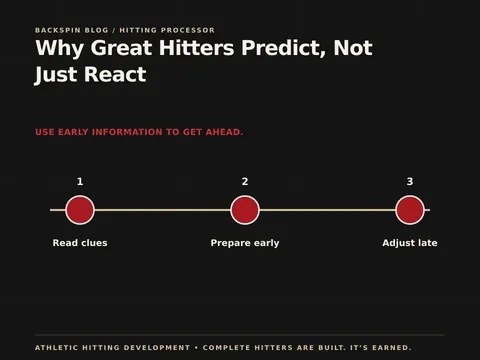
Pure reaction time is too slow to hit a good fastball. The ball gets there before a hitter can see it, decide and start over. Great hitters don’t win by reacting faster. They win because they read the pitch earlier, start with a move that can still change, and have solved that problem so many times their body already knows the answer. I go deeper on that in Why Great Hitters Predict, Not Just React.
The movement solution is a blend of five things:
- Mechanics. A swing built to adjust: balance, an athletic front leg, a barrel that stays behind the hands longer, and Mechanically Advantaged Angles (MAA) that give the hitter room to change.
- Perception. The eyes pick up speed, spin and location early, so the body gets the information in time to use it.
- Motor coordination. The body can actually change the move: hold, shorten, lengthen or redirect without falling apart.
- Timing. A load and launch that arrive on time and can still wait. Early enough to attack, calm enough to adjust.
- Experience. Thousands of solved problems. The brain stores what worked and calls on it faster next time.
Take away any one of those and the adjustment breaks. A hitter can have great eyes and a stiff swing. Or a beautiful swing that commits too early. Neither one solves the pitch.
4. What does a good movement solution look like?
You see it in the hitters who look fooled and still drive the ball. The barrel stays on plane while the body changes underneath it. They’re aggressive and athletic, controlled violence, but never locked into one answer.
- Gets to launch on timeThe hitter is loaded and ready before he knows exactly what’s coming.
- Lets the arrow go lateHe fires only when the eyes say yes, which buys time to read the pitch.
- Keeps the barrel behind the handsThat keeps options open for in, away, hard or soft.
- Adjusts with the body, not just the handsPosture, front side and finish change together, so contact stays strong.
- Finishes balancedIf he can hold his finish, the adjustment was under control.
For a great look at this in the big leagues, see Late Barrel Adjustability: Chase DeLauter’s Swing.
5. How do hitters train the movement solution?
You don’t leave it to chance. You build every piece on purpose, then make practice ask the hitter to solve problems.
- Build an adjustable swing first. Work the sequence in order: stance, gather, load, launch, the bump, letting the arrow go, barrel approach, contact, extension, finish.
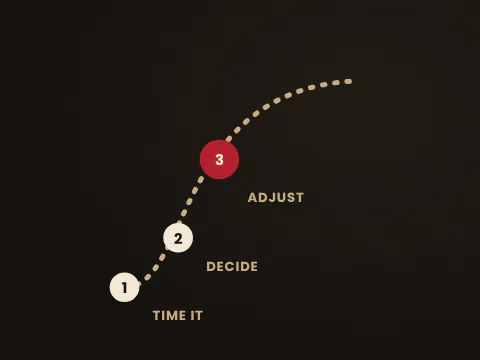
- Train the eyes daily. Short, focused pitch-reading reps make the read earlier. That’s the Hitting Processor: see it, time it, decide, attack it.
- Mix the pitches. Random speeds and locations in BP, not 20 straight middle-middle. Heater or hanger: the hitter has to sort it out.
- Use constraints. Change the tee height, the distance, the ball, the target. Make the body find a new answer.
- Build the body. Strength and explosiveness give a hitter room to adjust and still hit it hard.
- Film and check. Look for the barrel staying on plane and a balanced finish on pitches he wasn’t sitting on.
Not sure which piece is holding your hitter back? Run SwingChecker™ free. It ranks the top priority across all 4 pillars and points you to the right lessons.

THELESSON.
- Mechanics
- Perception
- Motor coordination
- Timing
- Experience
Complete Hitters Are Built…Earned.
6. The bottom line for hitters, parents and coaches
Hitting is simple. It’s just not easy. The ball never gives you the same problem twice, so the hitter who can only do one thing will only hit one pitch.
Build the swing. Train the eyes. Build the body. Then make practice look like the game. That’s how the movement solution stops being luck and starts being a skill. Every one of those pieces is in the Complete Hitter Masterclass.
Don’t collect drills. Build a complete hitter.
Want to go deeper? Read Why Great Hitters Predict, Not Just React and Late Barrel Adjustability: Chase DeLauter’s Swing.
Quick answers
What is a movement solution in hitting?
It’s how a hitter changes his swing while it’s already moving to still get the barrel to the pitch, like holding his launch on a changeup or turning the barrel inside an inside pitch.
Can you train a hitter to adjust mid-swing?
Yes. Build a swing that can adjust, train the eyes to read pitches earlier, and use practice with mixed speeds and locations so the hitter has to solve real problems.
Is adjusting to off-speed just quick reaction time?
No. Reaction time alone is too slow. Good hitters read the pitch earlier and start with a move that can still change, so they have time to adjust.
Why do hitters look fooled and still hit the ball hard?
They keep the barrel on plane and their body under control while the move changes. Balance and a barrel that stays behind the hands give them room to adjust.
How many balls in play come off a pitch the hitter had to adjust to?
In BK's experience, more than half. The true no-doubter swing on the exact pitch a hitter was hunting is the small slice that's left.
Don’t collect drills. Build a complete hitter.
Complete Hitters Aren’t Born. They’re Built… and Earned.