By BK, Athletic Hitting Development
Complete Hitters Are Built… It’s Earned!
Key takeaways
- A 2026 study of 95 college hitters found no single stride pattern that separated the better swings from the rest.
- Stride width had only a weak link to bat speed. Stride direction and leg-lift height had none.
- Different hitters reached high bat speed with different stride strategies.
- Don’t ask “Does it look like mine?” Ask “Does it organize the hitter?”
There is no universal “right” stride. There are organized hitters and disorganized hitters. The difference matters.
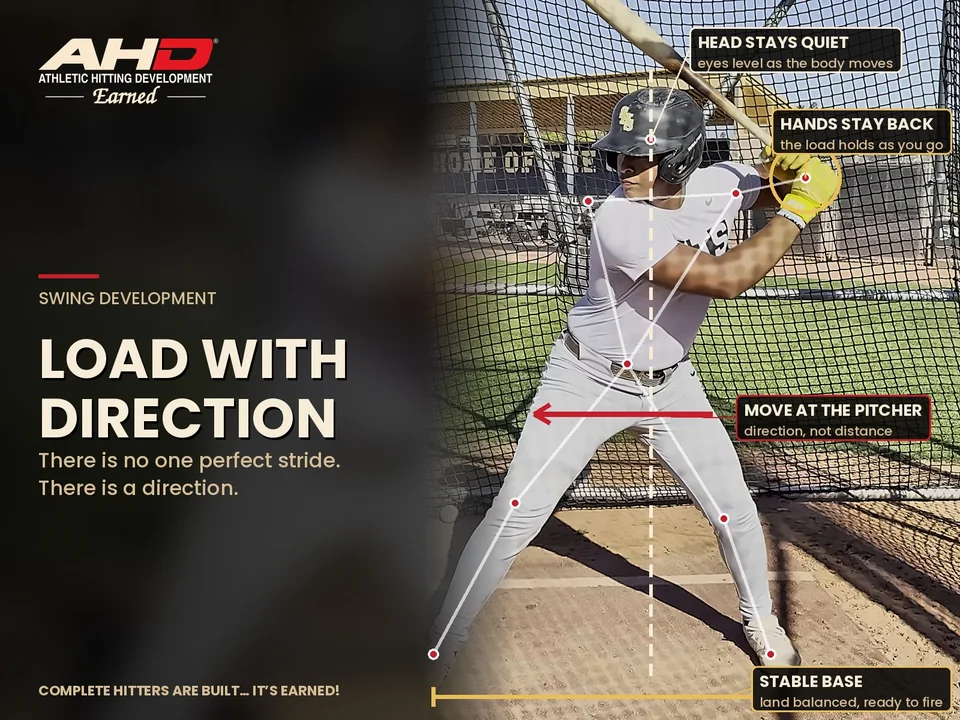
There is no single perfect stride. A 2026 study of 95 college hitters found high bat speed came from many different stride widths, directions and leg-lift heights, so judge a stride by whether it organizes the hitter, not whether it looks like someone else’s.
Train it: Swing Structure & Mechanics Masterclass →Coaches have been arguing over stride length, height and direction forever. Short stride. Big leg kick. No stride. Toe tap. Land here. Do not land there. Some of those conversations are useful. Too often, though, the hitter is being made to copy a picture instead of solve a hitting problem.
A new baseball biomechanics study gives us a clean reminder: the look of the stride is not the whole story.
1. What the study found
Kuwabara, Ohyama, Fujii and Maeda studied 95 collegiate baseball hitters using 3D motion capture and force plates during maximum-effort tee swings. They examined three parts of the stride: width, direction and peak foot height.
No single stride pattern separated the better swings from the rest.
Stride width had a statistically significant but weak relationship with bat-head speed (r = .328). That means it explained only a small piece of the difference in bat speed. Stride direction and foot height were not significantly related to bat-head speed at all.
The three stride pieces were also independent of one another. A hitter could use a bigger lift without a particular direction. He could move wider without having the same foot height. Different athletes reached high swing speed through different stride strategies.
95 COLLEGE HITTERS · 3D MOTION CAPTURE
NO PERFECTSTRIDE.
- Stride width: weak link to bat speed
- Stride direction: no link
- Leg-lift height: no link
- Many strides. Same speed.
A STRIDE ORGANIZES THE HITTER. IT’S NOT A SPEED BUTTON.
That is the teaching point: a stride is a way to organize the hitter. It is not a magic swing-speed button.
2. What it does not say
This is not permission for “anything goes.” The study was observational, used male college hitters and tee swings, and did not measure live-pitch decisions, contact quality or long-term improvement. It cannot tell us which stride will help a specific hitter hit better in games.
It does tell us not to force every hitter into the same visual model just because it looks good in a still frame.
A bad stride can still create a bad swing. If a hitter leaks, spins open, loses posture, lands too early, lands too late or cannot arrive in a usable launch position, that needs attention. But the correction should solve that hitter’s issue, not make him imitate someone else’s footwork.
3. The AHD standard: assess the whole move
AHD does not coach a “one right way” swing. We coach a hitter toward the largest margin for solid contact while producing maximum force and an effective bat-to-ball angle. AHD hitters build Mechanically Advantaged Angles (MAA), and a good stride is one that lets those angles show up on time.
For the forward move, ask:
- Does the hitter stay athletic and balanced long enough?
- Does the move help the hitter get to a usable launch position?
- Can the hitter time a fastball and still adjust to off-speed?
- Does the barrel get on plane with enough time and space?
- Can the hitter repeat it when the pitch and the game speed up?
If the answer is yes, the hitter does not need a cosmetic rebuild because his stride is not someone else’s favorite version. If the answer is no, we use the stride as one piece of the diagnosis, not the automatic answer.

ORGANIZEDHITTER?
- Balance through contact
- Timing to be on time
- Launch position that works
- Adjustable barrel path
- Repeatable under pressure
Complete Hitters Are Built…Earned.
4. Use video better: compare function, not just form
This is exactly why SwingChecker™ should be used as an assessment tool, not as a contest to see whose stride looks most “textbook.”
Film two swings from the same angle. Compare the hitter’s balance, timing, launch position, contact, extension and finish. Then connect what you see to the ball flight and the hitter’s misses.
Look for the one change that helps the whole sequence work better.
Good coaching is not about having the loudest rule. It is about seeing the hitter in front of you, understanding what the move is doing, and teaching the change that actually helps.
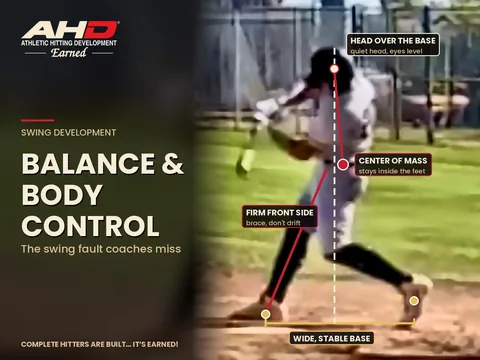
Want to go deeper? Read Balance & Body Control, or start the free Lesson 2: Stance, Ready Position and the Gather.
Quick answers
Is there one correct stride in hitting?
No. A 2026 study of 95 college hitters found no single stride pattern that separated faster swings from the rest. Hitters reached high bat speed with different stride widths, directions and leg-lift heights.
Does a wider stride increase bat speed?
Stride width had a weak positive link to bat-head speed (r = .328) in the study. It explained only a small part of the difference, so widening a stride is not a reliable bat-speed fix by itself.
Should I change my hitter's stride?
Only if it is causing a real problem: leaking, spinning open, losing posture, landing early or late, or not reaching a usable launch position. Fix that hitter's issue instead of copying someone else's footwork.
How do I evaluate a hitter's stride?
Ask whether the move keeps the hitter balanced, gets them to a usable launch position, lets them time fastballs and adjust to off-speed, gets the barrel on plane and repeats when the game speeds up.
Is a leg kick or a toe tap better for hitting?
Neither is automatically better. In the 2026 study of 95 college hitters, leg-lift height had no link to bat speed. Pick the move that keeps the hitter balanced, gets him to a usable launch position on time and still lets him adjust to off-speed.
5. Read the research
Kuwabara, J., Ohyama, K., Fujii, M., & Maeda, A. (2026). Diversity and independence of stride strategies in collegiate baseball batters: A descriptive study. Scientific Journal of Sport and Performance, 5(4), 658–671. Published August 22, 2026.
Don’t collect drills. Build a complete hitter.
Complete Hitters Are Built… It’s Earned!
From the 2015 archive: The Timing Stride: When Should the Front Foot Land?.
This article is part of the AHD guide Baseball Swing Mechanics. Start there for the full picture and every related article.