By BK, Athletic Hitting Development
Complete Hitters Aren’t Born. They’re Built… and Earned.
Key takeaways
- Watching a pitch and preparing to hit a pitch are different jobs, for the body and, a small 2026 study suggests, for the eyes too.
- Every recognition rep should ask for a decision: call it, take it or swing it.
- Use the 4-step progression, call it, plan it, move on it, compete on it, and score decisions separately from contact.
- A good take is an aggressive decision, and sometimes a “swing problem” is really a seeing-and-deciding problem.
Watching pitches is not the same skill as hitting them. Pitch recognition gets better when every rep asks the hitter to DECIDE something, call it, take it or swing it, instead of just tracking the ball.
Watching pitches is not the same as training to hit them. Make every recognition rep ask for a decision, call it, take it or swing it, and score those decisions separately from contact for 10–15 minutes a day.
Train it: Hitting Processor → Free tool: Pitch Recognition Trainer →“See the ball” is good advice. It’s also incomplete.
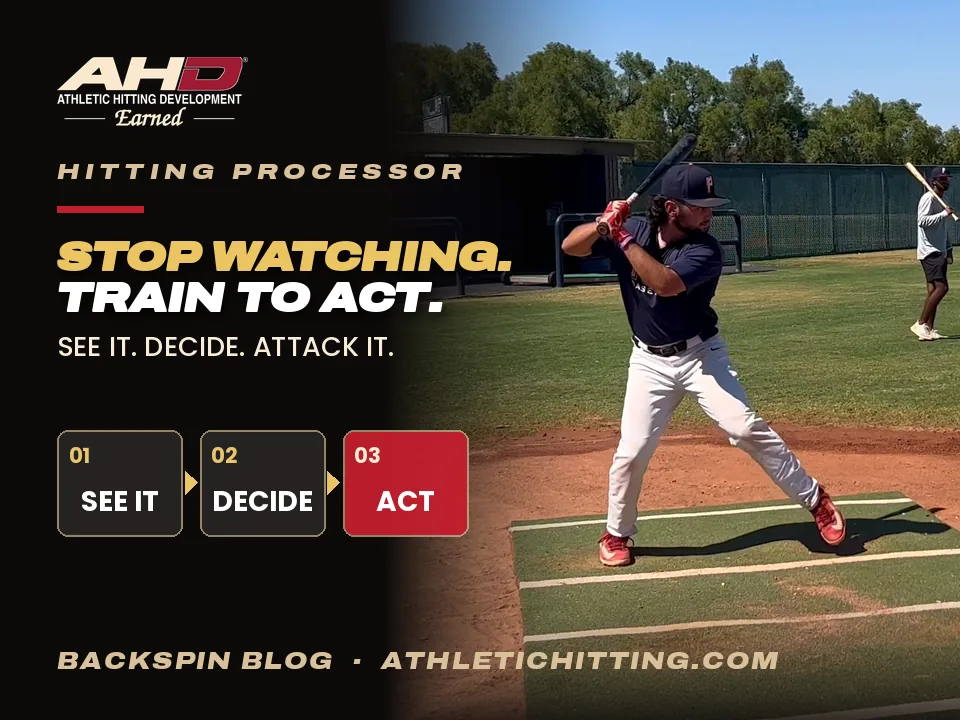
In a game a hitter doesn’t just watch a pitch. He has to recognize it, match it to his plan, decide whether to swing, and get his body moving fast enough to hit it. That whole chain is the Hitting Processor: see it, time it, decide, attack it. At AHD we train it DAILY.
1. Is watching a pitch the same as getting ready to hit it?
No. And a small 2026 study from Ohio State’s College of Optometry lines up with that. Researchers put eye trackers on baseball and softball players (15 in one experiment, 10 in a second, most with high school or college experience) while a pitching machine threw tennis balls at them.
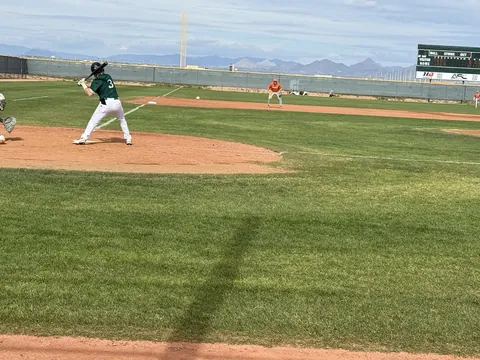
In one task the players took a partial swing at the ball. In the other they only judged how high it passed, with a net stopping it. Quick gaze shifts showed up on 53% of pitches in the watch-and-judge task and on about 40% in the swing task.
Other parts of their gaze looked the same in both tasks, and the authors say plainly that a partial swing at tennis balls isn’t a real game. So I won’t oversell it. But it fits what I’ve seen for decades: the eyes do their job differently when the body has a job to do.
Watching a pitch and preparing to hit it are not the same job.
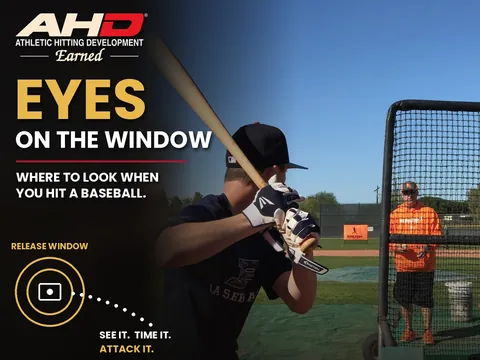
Where the eyes should be before the pitch is its own topic. I covered it in what you should look at when hitting.
2. Why do pitch recognition drills need a decision?
Many vision drills are better than nothing. But if the hitter never has to commit to a take, a swing, a location call or a movement, the drill turns into a disconnected eye exercise.
The processor gets better when the hitter has a reason to see the pitch. Give him a question to answer on every pitch, and make a wrong answer cost something, even if it’s just a point on the board.
HITTING PROCESSOR
SEE IT.THEN ACT ON IT.
- See it
- Time it
- Decide
- Attack it
EVERY REP ASKS FOR A DECISION
3. How do you train pitch recognition with decisions?
Here’s the progression I use. A parent or coach can run it with a bucket, an L-screen and front toss or a machine:
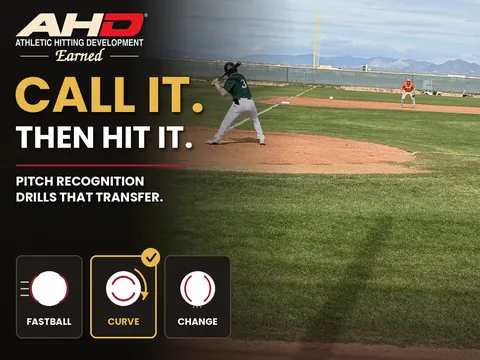
- Call itNo swing yet. He calls fastball or off-speed, or in, middle, away, out loud before the ball reaches the plate. Two rounds of 10.
- Plan itGive one location the green light, say middle-in, and require a take everywhere else. He still gathers and loads on every pitch.
- Move on itNow he swings at green-light pitches with full intent and takes the rest. The take should look like a swing right up until it isn’t.
- Compete on itScore decisions separately from contact: one point for a correct swing or take, one for a hard-hit ball. Two rounds of 10.
Run it three or four days a week for 10–15 minutes. Mix speeds and locations at random so he can’t guess the pattern. When he gets 8 of 10 decisions right, shrink the green-light zone or add off-speed.
On days you can’t get to a cage, the free Pitch Recognition Trainer gives quick “call it” reps from the hitter’s view. That’s step one, not the whole thing. For more drills built this way, see 7 pitch recognition drills that transfer.
4. Is taking a pitch part of hitting?
Absolutely. Young hitters often believe discipline means being passive. It doesn’t. A good take is an aggressive decision to wait for a better pitch.
I tell hitters, “Swing at a bad pitch? No biggie. Take a good pitch to hit? Not happening.” Be aggressive on the pitches you can drive, and save the take for the ones you can’t.
And when it is your pitch: “Pitcher gets one, hitter gets one, umpire gets one… two of those aren’t in your favor. Roll the pole!!” If it’s in your zone, swing it, and don’t hand the decision to the umpire.
If a player can’t take a ball just off the plate in practice, he’ll have a hard time doing it with runners on. The fix isn’t a lecture. It’s reps where the correct take is visible, valued and scored. More on that in a better approach is not passive.
5. What should you ask after a bad swing?
When you watch a clip, phone video from the cage or a game at-bat, don’t only ask, “What did your hands do?” Ask:
- What pitch did you think it was?
- Where did you first see it?
- Was it in your attack zone?
- Did your body have time to follow your decision?
Sometimes the swing problem is really a seeing-and-deciding problem. A hitter who decides late lunges, rolls over or chops at it, and it looks mechanical. That changes the whole training plan.
Not sure which one you’re dealing with? The free SwingChecker™ ranks your hitter’s top priorities across all 4 Pillars in about three minutes, with cues, drills and matching free lessons. If you want a coach to watch the actual video, AHD Swing Lab is a $79 coach-reviewed video analysis (opening Nov. 15).
6. How much pitch recognition training does a hitter need?
A little, every day. The Hitting Processor is one of the 4 Pillars of a Complete Hitter, right next to The Swing, Strength & Explosiveness and the Mental Approach. It’s also the one most hitters never train on purpose.
Ten focused minutes of decision reps beats an hour of watching. Track his correct-decision percentage for a few weeks and compare him to himself, not to a teammate.
Don’t train watching. Train recognizing and acting.
THELESSON.
- Every rep needs a decision
- A good take is aggressive
- Score decisions, not just contact
- Ask what he saw, not just his hands
Complete Hitters Are Built…Earned.
Our Hitting Processor course is 16 lessons built on exactly this idea, most of them 10–20 minutes. Lesson 1, Test Day: Your Decision Baseline, is free. It’s a great day to hit!!
Want to go deeper? Read Pitch Recognition Drills: 7 Drills That Actually Show Up in Games and Swing Decisions Are a Skill.
Quick answers
Do pitch recognition drills actually work?
They help most when they’re tied to a decision and a movement, like calling the pitch, taking or swinging, instead of watching alone. Score decisions separately from contact so you can see real progress.
How can my hitter train pitch recognition at home?
Use short daily reps: call pitch type or location on front toss, use a free screen-based game for quick calls, and add swing-or-take rules when you can get to a cage.
Why does my son take good pitches and swing at bad ones?
Usually he’s deciding late or without a plan. Give him one green-light zone, score correct takes and swings, and train it a few minutes every day.
How long does it take to improve pitch recognition?
It varies by hitter. Track the percentage of correct decisions over a few weeks and compare him to himself; steady improvement is the goal.
Don’t collect drills. Build a complete hitter.
Complete Hitters Aren’t Born. They’re Built… and Earned.