By BK, Athletic Hitting Development
Complete Hitters Aren’t Born. They’re Built… and Earned.
Key takeaways
- Switch hitting is a tool, not a trophy. A dangerous hitter from one side beats two unfinished swings.
- At 10–12, keep it playful. At 13–14, the second side has to handle moving pitches. At 15+, it’s an opportunity-cost decision.
- Use BK’s four-question test: primary swing, second swing, time, and the hitter’s own motivation.
- A second swing never replaces the 4 Pillars. It has to fit inside them.
Switch hitting makes sense in high school only when the second side holds up against real pitching and doesn’t starve the main swing. A dangerous hitter from one side beats two unfinished swings, every time.
Keep switch hitting into high school only when the second side holds up against real pitching, the main swing keeps improving, and the hitter wants the extra work. At 10–12 it’s an experiment; by 15 it’s an investment you judge by results.
Train it: Complete Hitter Masterclass → Free tool: SwingChecker™ →A 12U player can experiment with switch hitting. A 13–15-year-old heading toward bigger fields and better arms has to decide whether that experiment is actually making him a better hitter.
This is the transition point parents miss. On a 46/60 field, a kid can get away with late decisions and unfinished movement. As the distance grows and breaking balls get real, two swings demand a lot more than a cool batting-practice video. I’m all for athletic development. I also hate wasting a hitter’s most important reps.
1. Why switch hitting is worth considering
- A better look at the ball. Hitting opposite the pitcher’s throwing arm can give a cleaner look at release and movement. That matters more as breaking balls get better. But a better angle doesn’t rescue a hitter who is late or can’t control the barrel.
- Athletic coordination both ways. Gathering, loading, launching and rotating in mirrored directions is a real coordination challenge. Even a player who never switch hits in games can benefit from exploring it.
- Lineup flexibility. A competent switch hitter has options when the pitching changes. Standing in the other box isn’t a weapon. Controlling the zone and squaring the ball is.
THE AHD VERDICT
A TOOL,NOT A TROPHY.
- Better look at the ball
- Coordination both ways
- Lineup flexibility
- Only if it’s competitive
ONE GREAT SWING BEATS TWO OKAY ONES
2. What does a second swing really cost?
Every AHD swing is built in the same order: stance and ready position, the gather, a directionally sound load, launch position, the bump, letting go of the arrow, the barrel approach, contact, extension and the finish. Owning that from one side is already a serious project. A second side doubles the deliberate practice it takes.
Timing is the bigger cost. A tee shows movement and barrel organization. It can’t prove a hitter is ready to see it, time it, decide and attack it from both sides. That’s the Hitting Processor, and it only develops against live, changing pitches.
If he looks athletic from both sides in front toss but freezes at game speed, the second side is still a practice skill, not a game tool.
Then there’s confidence. Some hitters love the challenge. Others dread being pulled away from the side where they compete. The player has to own the project. A parent’s dream of having a switch hitter isn’t enough.
3. How does the decision change from 12U to high school?
| Age | What to do | The question |
|---|---|---|
| 10–12 | Keep it playful: Wiffle ball, tee swings, easy toss from the new side. | Is it fun, and is the main swing still improving? |
| 13–14 | Film both sides. Check balance, launch position, barrel route, contact and timing against moving pitches. | Can the new side handle speed and location? |
| 15+ | Treat it as an opportunity-cost decision. | Would the same hours build more in the main swing, strength, pitch recognition or approach? |
You’re not looking for two identical swings. You’re looking for two competitive swings. AHD hitters build Mechanically Advantaged Angles (MAA) from whichever side they hit, and that’s what to compare on video: angles that let the barrel get on plane and stay there, not a mirror image.
If the goal is to be an excellent hitter, don’t spend the whole offseason becoming an average switch hitter.
4. BK’s four-question switch-hitting test
- Primary swingIs it balanced, repeatable and producing solid contact against real pitching?
- Second swingDoes it do more than look good on a tee? Can it adjust to speed and location?
- TimeCan he build the second side without starving the first side or the rest of the 4 Pillars?
- MotivationDoes the hitter, not the parent, genuinely want to do the extra work?
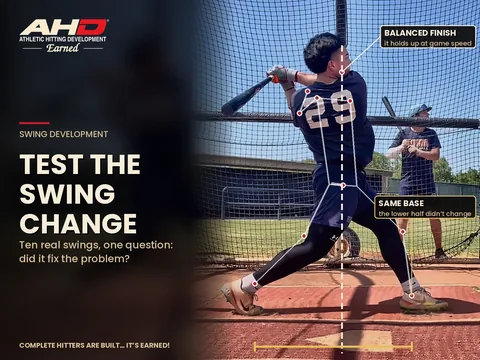
If any answer is no, keep it a low-pressure experiment. If all four look good, give it a defined trial with video checkpoints and a contact-quality number you track every week. Here’s how to test a swing change so you know it’s working instead of guessing.
THELESSON.
- Primary swing solid?
- Second swing live-ready?
- Time without starving side one?
- Does HE want it?
Complete Hitters Are Built…Earned.
5. Does switch hitting fit the complete hitter?
AHD builds four connected pillars: the Swing, Strength & Explosiveness, the Hitting Processor and the Mental Approach. Switch hitting isn’t a substitute for any of them. It’s a technical choice that has to fit the larger athlete.
On the other hand, if an athletic, confident hitter is making competitive contact from both sides and loves the work, there’s no reason to shut down a good thing just because two swings are harder than one. Stay aggressive and athletic from both boxes, and let performance decide.
Softball note: in fastpitch, the version of this question is usually slapping from the left side versus hitting away. Same rule: the second skill has to beat good pitching, not just look good. See Slap or Hit Away?
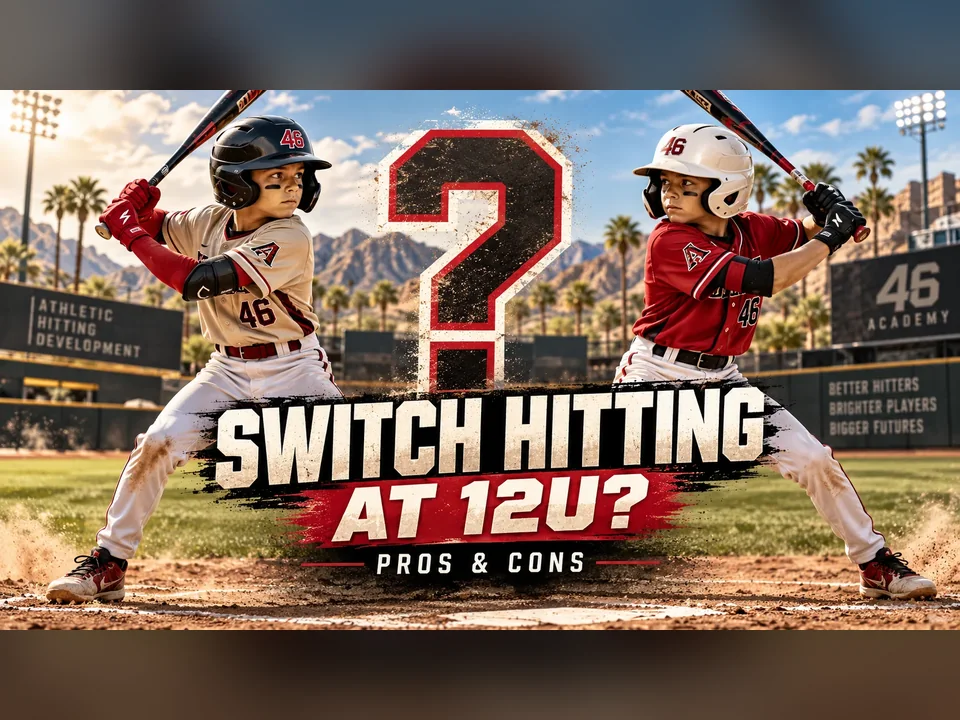
Parents of 7–12 year olds: our 46/60 Academy has the parent-first version, Switch Hitting at 12U: Pros, Cons & a 30-Day Trial. And if you’re still deciding whether to start at all, read Switch Hitting: Should Your Kid Learn It?
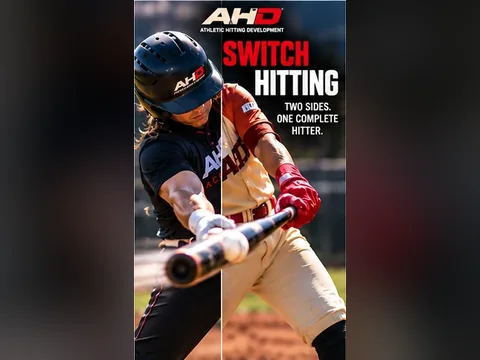
Want to go deeper? Read Switch Hitting: Two Sides, One Complete Hitter and How to Know If a Swing Change Is Working.
Quick answers
What age should a kid stop switch hitting?
There’s no set age. By 13–14 the second side should handle moving pitches and varied locations; by 15 and up, keep it only if it creates a real game advantage without slowing the main swing.
Does a switch hitter have to use both sides in games?
No. Training from two sides and using two sides against competitive pitching are separate decisions. Many hitters practice the second side long before it earns game at-bats.
Does switch hitting help with high school or college recruiting?
Not by itself. Coaches evaluate real hitting ability, and a weak second swing doesn’t add value. A strong hitter from one side is worth more than an average switch hitter.
How do you know if switch hitting is working?
Film both sides, vary the pitches, and track hard-contact rate over several weeks. If both sides and the hitter’s confidence keep improving, keep going; if the main swing slips, scale the second side back.
Don’t collect drills. Build a complete hitter.
Complete Hitters Aren’t Born. They’re Built… and Earned.