By BK, Athletic Hitting Development
Complete Hitters Are Built… It’s Earned!
Key takeaways
- Should your daughter slap or hit away? Slapping fits when she has real speed, will commit to daily left-side reps and wants to do it.
- Slapping is not a fix for a struggling swing. It adds a second skill to learn instead of fixing the first.
- Many slappers are natural right-handers who learned from the left side; that takes months of daily reps.
- Best path for most: keep building the full swing and add the slap as a weapon, not a replacement.
Should your daughter slap or hit away? If she has real speed, will commit to daily left-side reps and already has a solid swing, slapping can be a weapon. If she’s slapping to escape a swing that isn’t working, keep building the swing.
Your daughter should slap if she has real speed, is willing to train left-side footwork daily and wants to do it. If she’s slapping only to escape a swing that isn’t working, keep building the full swing and add the slap later as a weapon.
Train it: Complete Hitter Masterclass →I coached high school and college softball in Arizona and Texas for 30 years. I’ve seen slapping turn a fast kid into a lineup problem for the other team. I’ve also seen kids moved to the left side because a coach didn’t know what else to do with their swing.
This guide is about the decision, not the footwork. For how slapping actually works, read Softball Slapping Basics first.
1. Should my daughter slap or hit away? Slap hitting vs swinging away
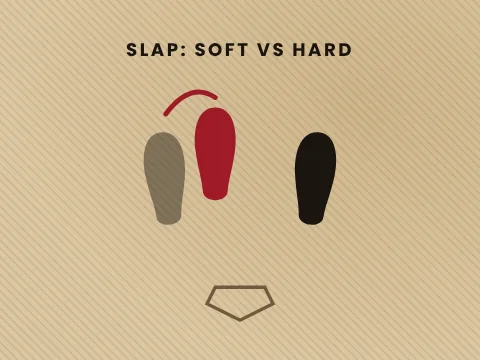
Swinging away is the full swing: load, stride, rotate and drive the ball. Slapping is a left-side approach where she moves toward the pitcher and puts the ball in play on the run, using speed to beat the throw. The slapping basics post covers the bunt, soft slap and hard slap.
| Factor | Slapping | Hitting away |
|---|---|---|
| Speed | Has to be real; the run is the weapon | Helps, but not required |
| Side of the plate | Left-handed box | Her natural side (or both) |
| Main skill | Footwork, bat control, reading the defense | Swing, timing, pitch recognition, power |
| Practice load | Daily footwork plus contact reps | Daily swing and timing reps |
| How defenses adjust | Corners crash; she needs the hard slap or a swing | Pitchers work her zone and pitch sequence |
| Biggest risk | Slapping to hide a weak swing | Ignoring speed she could use |
The two aren’t enemies. The best slappers I coached could also swing away from the left side when the corners crept in. That’s the goal if she slaps: options, not a single trick.
2. Is she fast enough to be a slapper, and does it matter if she’s right-handed?
Speed is the first filter. Slapping works because the defense has to hurry. Without real speed, a soft slap is just a ground ball to short.
I won’t give you a magic stopwatch number. Instead, time her home to first from the left side a few times and compare her with the rest of her team and the teams she plays. If she’s clearly one of the fastest on the field, slapping is worth a look. If she’s average, it’s probably not her best path.
Handedness matters less than parents think. Many slappers are natural right-handers who learned to hit from the left side. But learning a new side takes months of daily reps, and for a while she’ll feel worse than she does from her natural side. Kids who can already swing a bit from the left have a head start. Natural lefties who are fast are the easiest call: same side, just a new tool.
Speed earns the look. Commitment earns the spot.
3. What age should a softball player decide to slap?
There’s no set age, but I don’t like locking a young kid into slapping. At 10U and 12U the job is to build a real swing, learn the zone and get her athletic. Plenty of kids who are fast at 10 aren’t the fastest at 15, and some slow kids grow into power.
Commitment is the bigger question at any age. Slapping has to be trained daily, just like a full swing. If she’ll do 15–20 minutes of footwork and contact work most days, it can work. If she’ll only slap during games, it won’t.
- She wants to. A slapper who doesn’t want to slap won’t practice it.
- She can already put the barrel on the ball. Bat control carries over to the slap.
- She has a plan for her full swing too. One side or both, the swing keeps getting trained.
If you’re not sure where her swing stands, the basics in How to Hit a Softball and Softball Batting Stance are a good check first.
4. What does her team need, and what do college coaches look for?
Team needs matter, but they change every season. A coach may want a slapper at the top of this year’s lineup. That’s fine if it fits her. It’s not a good reason to give up a swing she’s worked years to build.
If her coach asks her to slap, have a calm conversation. Ask what the coach sees, how long the trial will be and whether she’ll still get swing reps in practice. Most coaches respect a family that asks good questions. What you want to avoid is a quiet switch that nobody revisits for two years.
On college: from my years coaching and scouting, coaches recruit hitters who can do damage, and that includes fast slappers who can bunt, soft slap, hard slap and swing away. A one-tool slapper who can only bunt and soft slap is easier to defend, and coaches see that. A short, strong swing with real speed is what gets noticed. More in What College Coaches Look For in a Hitter.
Every complete hitter I’ve coached, slapper or not, built the same foundation: the swing, strength and speed, the hitting processor and the mental approach. AHD hitters build Mechanically Advantaged Angles (MAA), and those angles help whether she’s driving the ball or slapping it through the left side.
SLAP OR SWING?
SPEED EARNSTHE LOOK.
- Real speed, not average
- Months of left-side reps
- She wants to do it
- Swing training continues
A WEAPON, NOT A HIDING PLACE
5. How can she try slapping without losing her swing?
Treat it as a trial, not a conversion. Give it a season of real reps with a clear check-in at the end. A trial with an end date takes the pressure off her and off you.
- Keep the full swing on the schedule.Every practice day still includes swing work; slapping is added, not swapped in.
- Learn the footwork with no bat.Daily box-line reps from the slapping basics post until the crossover lands inside the box every time.
- Add the bunt and soft slap first.Control before power; the hard slap comes once she’s on time with the barrel. See How to Bunt in Softball.
- Film it and compare.Film both the slap and the swing from the side and behind each month so you can see if either is slipping.
- Decide together after a set period.After 8–12 weeks, look at how she feels, how she’s practicing and what game at-bats show, then choose a path.
Before you start, run the free SwingChecker to see her top priority across the 4 pillars. If her swing needs work first, that’s your answer for now. For softball-specific coaching, see our Online Softball Hitting Lessons, and to build every pillar in order, the Complete Hitter Masterclass. If she ends up slapping, small-ball skills like the two-strike approach become even more important.
THELESSON.
- Don’t slap to hide a swing
- Don’t lock in at 10U
- Try it for a season
- Bunt, slap AND swing
Complete Hitters Are Built…Earned.
Want to go deeper? Read Softball Slapping Basics: How to Slap (Soft Slap vs Hard Slap) and What College Coaches Look For in a Hitter.
Quick answers
Can a right-handed softball player become a slapper?
Yes. Many slappers are natural right-handers who learned to hit from the left-handed box. Expect months of daily reps before it feels natural.
Do college softball coaches recruit slappers?
In my experience, yes, when the slapper has real speed and several tools: bunt, soft slap, hard slap and a swing. A one-tool slapper is easier to defend and less attractive.
Is it too late to start slapping in high school?
Not necessarily. A fast, committed high school player can learn it, but switching sides takes daily work and she should keep training her full swing while she learns.
Will slapping ruin my daughter’s swing?
Not if her full swing stays on the practice schedule. Problems start when slapping replaces swing work entirely or is used to hide a swing that isn’t working.
Sources: USA Softball: 2026 Rule Differences (USA Softball, NCAA, NFHS)
Don’t collect drills. Build a complete hitter.
Complete Hitters Are Built… It’s Earned!
This article is part of the AHD guide Fastpitch Softball Hitting. Start there for the full picture and every related article.