By BK, Athletic Hitting Development
Complete Hitters Aren’t Born. They’re Built… and Earned.
Key takeaways
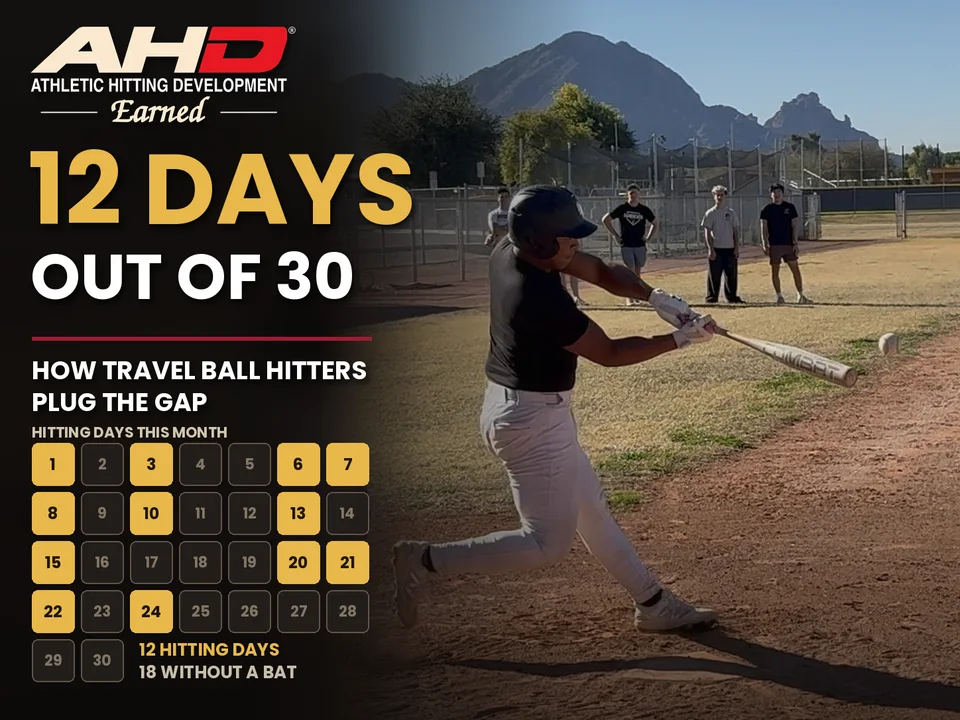
- A club schedule of a couple practices a week and a tournament every other weekend gives a hitter about 12 hitting days out of 30, and that’s if he hits at every one.
- Hitting in season is an EVERY DAY thing. Big leaguers don’t go 18 days a month without a bat in their hands.
- Even those 12 days aren’t all development. Games and team practice are mostly competing and waiting, not building.
- In 2026, quality remote training with a proven system is the most practical way to fill the other 18 days.
If your hitter plays club or travel ball, he’s probably hitting about 12 days out of every 30, and that’s only if he swings at every practice and every game. Hitting in season is an EVERY DAY thing, and quality remote training with a proven system is how you plug the other 18.
A club schedule of a couple practices a week and a tournament every other weekend gives a hitter about 12 hitting days out of 30. Quality remote training with a proven system fills the other 18 with short, purposeful daily work.
Train it: Complete Hitter Masterclass → Free tool: SwingChecker™ →I’ve been doing this a long time, and here’s what I see in 2026. The way youth athletics and travel baseball are set up, the schedule and real life leave hitters with too few swings. Not because anybody is lazy. Because the calendar won’t allow it.
That’s exactly why remote online training is so effective right now, if the coach is of quality. That “if” matters, and I’ll get to it.
1. Count the days: how often does a travel ball hitter actually hit?
Take a typical club team in season. You get a couple of practices a week and a tournament every other weekend or so. Now count the days a bat is in your hitter’s hands.
| What’s on the calendar | Hitting days in a month |
|---|---|
| A couple of team practices a week | About 8 |
| A tournament every other weekend | About 4 |
| Total, if he hits at every one | About 12 out of 30 |
| Days with no hitting at all | About 18 |
That’s hitting about 12 days out of 30.
And that’s the best case. Miss a practice for school, a rainout, a family weekend, and the number drops fast.
2. Would a big leaguer be at his best not hitting 18 days a month?
Ask yourself this one honestly. Think a major league hitter could be his best not hitting 18 out of 30 days?
Not a chance. Big leaguers take swings almost every single day of their season, in the cage, on the field and in games. They know timing, feel and confidence leak away fast when you stop.
Hitting in season is an EVERY DAY thing.
If it’s an every-day thing for the best hitters on the planet, it’s an every-day thing for a 14-year-old trying to make his high school team. The 18 empty days are where hitters quietly slide backward, and then everybody wonders why the swing looks different at the next tournament.
3. And what development are you actually getting in those 12 days?
Here’s the part nobody talks about. Even those 12 days aren’t all development. Games are for competing. You get a handful of at-bats, and nobody is building a swing in the middle of a tournament.
Team practice is usually built for the whole roster, not your hitter. A lot of standing in line, a round or two in the cage, and on to defense. That’s not anybody’s fault. It’s just what a team practice is.
THE CLUB CALENDAR
12 DAYSOUT OF 30.
- A couple practices a week
- A tourney every other weekend
- 18 days with no hitting
- Hitting is an EVERY DAY thing
QUALITY REMOTE TRAINING PLUGS THE GAP
So the honest picture is this: a few real development swings a month, scattered across a schedule that keeps your hitter busy but doesn’t necessarily make him better. Busy and better are not the same thing.
4. Why remote online hitting training works in 2026 (if the coach is quality)
A quality remote coach with a good, proven system can plug that gap. Your hitter doesn’t need to drive across town on a Tuesday. He needs a plan he can do on the 18 days the team isn’t hitting, and a coach who sees the video and adjusts the plan.
Quality is the whole deal. Here’s what I mean by it:
- A proven system, not a pile of drills. Don’t collect drills. Build a complete hitter.
- A plan built for your hitter. His top priorities, in order, not the same routine everybody gets.
- Real video review. Side and behind, the same angles every time, so progress is visible.
- All 4 pillars. The swing, strength and explosiveness, the Hitting Processor and the mental approach, trained together.
- A way to measure. Retest, compare, adjust. If nothing is measured, nothing is managed.
That’s how AHD hitters build Mechanically Advantaged Angles (MAA) and the aggressive and athletic swing we want, a little every day, instead of hoping a weekend tournament fixes it.
5. How to fill the 18-day gap
- Find the top priorityRun the free SwingChecker™ so you know the one or two things that matter most right now.
- Train it daily10–20 minutes on non-team days: a lesson, purposeful tee or front-toss work, and Hitting Processor reps.
- See it every dayRecognition and timing get trained DAILY, not just on game day. A few minutes is enough.
- Film itSame angles every time, so you and your coach can see what’s changing.
- Retest and adjustEvery 10 lessons, check the priorities again and move to the next one.
Do the math the other way now. If your hitter adds 15 focused minutes on most of those 18 off days, he’s hitting nearly every day of the month, and every one of those days has a purpose.
THELESSON.
- Count the hitting days
- Train the 18 off days
- Quality coach, proven system
- Measure, retest, adjust
Complete Hitters Are Built…Earned.
6. Is remote training right for your hitter?
Honest answer: it depends on the coach and the system. Remote training with a coach who has no plan is just more swings. Remote training with a quality coach and a proven system is the most practical way I know to fill the gap that the club schedule leaves.
If you want BK’s eyes on your hitter personally, that’s 90-Day Private Hitter Development: a starting evaluation across all 4 pillars, a personal 90-day plan and ongoing video review. If you want the system to run yourself, start with the Complete Hitter Masterclass. Not sure? Contact Coach, and I’ll point you the right way.
Either way, start today. It’s a great day to hit!!
Want to go deeper? Read Are Online Hitting Lessons Worth It? An Honest Answer and Baseball Hitting Drills at Home: A 15-Minute Daily Plan.
Quick answers
How often should a travel baseball player hit?
In season, a little every day. Team practices and games usually cover about 12 days a month, so add short, focused sessions of 10 to 20 minutes on the off days.
Is online hitting training effective for travel ball players?
Yes, if the coach is quality and uses a proven system with a plan built for your hitter, real video review and a way to measure progress. Without that, it is just more swings.
Isn't team practice and games enough hitting?
Rarely. Games are for competing and team practice is built for the whole roster, so your hitter gets few true development swings even on the days he does hit.
What should my hitter do on days without practice?
Work on his top one or two priorities for 10 to 20 minutes, train pitch recognition and timing, and film the same angles regularly so progress can be checked.
Don’t collect drills. Build a complete hitter.
Complete Hitters Aren’t Born. They’re Built… and Earned.